CM Fadnavis Meets 7-Year-Old Abacus Record Holder Pranika Patil
Synopsis
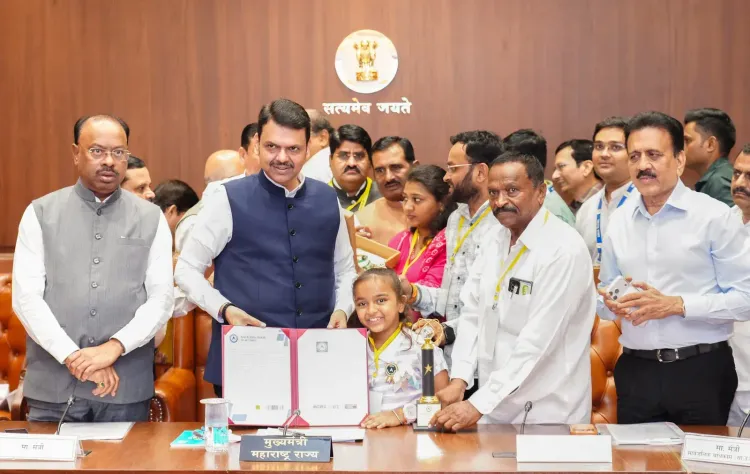
Seven-year-old Pranika Prafull Patil of Nandurbar, who solved 120 abacus problems in 3 minutes 39 seconds to earn entries in the India Book of Records and National Book of Records, met Chief Minister Devendra Fadnavis at Vidhan Bhavan in Mumbai on 10 July 2026, receiving his congratulations and best wishes.
Key Takeaways
Pranika Prafull Patil , aged 7 , solved 120 abacus problems in 3 minutes 39 seconds , setting a record recognised by the India Book of Records and the National Book of Records .
She met Chief Minister Devendra Fadnavis at Vidhan Bhavan, Mumbai on 10 July 2026 .
Pranika hails from Nandurbar , a tribal-majority district in northern Maharashtra.
CM Fadnavis offered her heartfelt congratulations and wished her well for future endeavours.
The felicitation follows Maharashtra's established practice of officially recognising child record-holders to promote skill-based education.
The Chief Minister's Office of Maharashtra announced on Friday, 10 July 2026 that Pranika Prafull Patil, a 7-year-old girl from Nandurbar, met Chief Minister Devendra Fadnavis at Vidhan Bhavan, Mumbai, after setting a record by solving 120 abacus problems in 3 minutes and 39 seconds.
Context
Pranika's feat earned her recognition from both the India Book of Records and the National Book of Records, two national-level bodies that certify exceptional individual performances, including mental-arithmetic achievements. The CMO's post noted that CM Fadnavis offered her his manaḥpūrvak abhinandan (heartfelt congratulations) and wished her well for the road ahead.
The meeting took place at Vidhan Bhavan, Maharashtra's legislature complex in Mumbai, where the Chief Minister periodically hosts young achievers for official recognition. Pranika's home district, Nandurbar, is a tribal-majority district in northern Maharashtra that has occasionally produced child record-holders in academic disciplines.
Policy Backdrop
Maharashtra administrations have maintained a consistent practice of inviting child record-holders for official felicitation, a tradition aimed at spotlighting skill-based education and encouraging foundational numeracy from an early age. The abacus — a centuries-old counting tool — has seen renewed institutional interest across Indian states as a method for building rapid mental-calculation ability in primary-school children.
Nandurbar's tribal and semi-rural character makes Pranika's achievement particularly notable in the context of the state's broader push to identify and nurture talent from non-metro districts, where access to specialised coaching is limited compared to urban centres.
Stakeholders and Impact
The immediate beneficiaries of such high-profile recognition are rural students and their families, for whom a Chief Minister's audience provides both validation and visibility. For the wider community of abacus learners across Maharashtra, Pranika's record and the official attention it has drawn could encourage greater enrolment in mental-math programmes.
Educators and abacus training institutes in the state are likely to cite the recognition as evidence of the discipline's merit, potentially strengthening the case for its inclusion in school curricula. Nandurbar district officials may also leverage the moment to highlight local talent in state-level education forums.
What's Next
The broader policy question is whether Maharashtra will formalise abacus or mental-math modules within its primary school curriculum revisions, or launch district-level talent searches modelled on Pranika's example. The state has periodically explored foundational numeracy initiatives, and high-visibility cases like this one have historically preceded policy announcements on skill identification.
For Pranika Prafull Patil, the meeting with CM Fadnavis marks a significant moment of state-level recognition that could open doors to further competitions, scholarships, or mentorship programmes aimed at child prodigies from Maharashtra's rural districts.
Point of View
A potential push for abacus or mental-math modules in the primary curriculum. The dual certification from national record bodies lends the achievement institutional credibility, making it harder for policymakers to treat it as a one-off photo opportunity. Whether this translates into structured talent-search programmes for rural districts will be the real measure of the state's commitment to foundational numeracy.
NationPress
8 Oct 2026
Frequently Asked Questions
Who is Pranika Prafull Patil?
Pranika Prafull Patil is a 7-year-old girl from Nandurbar district in Maharashtra who set a record by solving 120 abacus problems in 3 minutes and 39 seconds, earning recognition from the India Book of Records and the National Book of Records.
What record did Pranika Patil set in abacus?
Pranika solved 120 abacus problems in just 3 minutes and 39 seconds, a feat that was certified by both the India Book of Records and the National Book of Records.
Why did Pranika Patil meet CM Devendra Fadnavis?
Chief Minister Devendra Fadnavis invited Pranika to Vidhan Bhavan in Mumbai to felicitate her for her record-breaking abacus performance and to offer his personal congratulations and best wishes.
Where is Nandurbar district in Maharashtra?
Nandurbar is a tribal-majority district located in northern Maharashtra, known for its Adivasi population and occasionally for producing young academic achievers.
What is the India Book of Records?
The India Book of Records is a national-level body that certifies exceptional individual performances across various fields, including mental arithmetic and academic feats.