CM Fadnavis pays tribute to RashtraSant Tukdoji Maharaj on Punyatithi
Synopsis
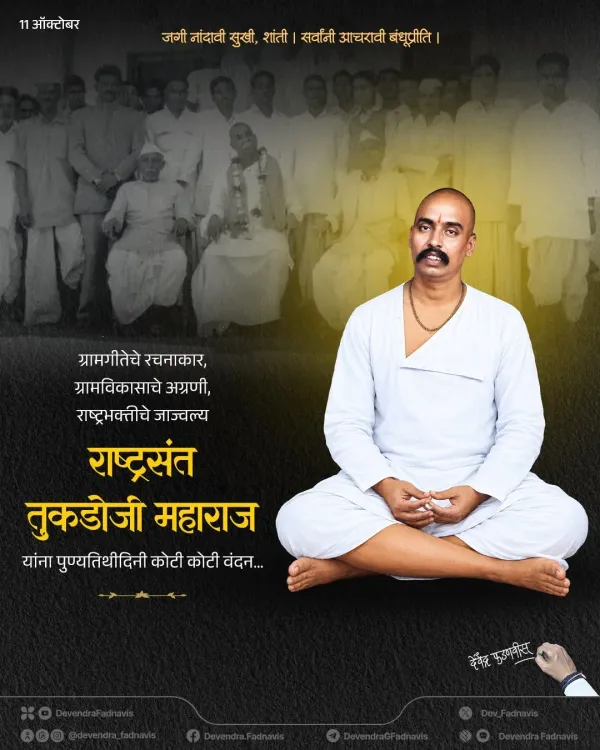
Maharashtra CM Devendra Fadnavis marked the Punyatithi of RashtraSant Tukdoji Maharaj on October 11, 2026, honouring the Gram Geeta composer as a beacon of social harmony, rural development, and national devotion through his timeless Bhajans.
Key Takeaways
CM Devendra Fadnavis paid tribute to RashtraSant Tukdoji Maharaj on his Punyatithi on October 11, 2026 .
Tukdoji Maharaj is the composer of the Gram Geeta , a seminal work blending spirituality with a vision for village self-reliance.
Fadnavis quoted the saint's verse calling for universal peace and brotherhood: 'जगी नांदावी सुखी, शांती । सर्वांनी आचरावी बंधूप्रीति ।' The saint earned the title RashtraSant for fusing personal devotion with public conscience and grassroots social reform.
Fadnavis described him as the 'pioneer of village development' and a 'blazing flame of patriotism,' underscoring his enduring relevance to Maharashtra's rural ethos.
On the death anniversary of one of Maharashtra's most venerated saint-reformers, Maharashtra Chief Minister Devendra Fadnavis offered his homage to RashtraSant Tukdoji Maharaj on Sunday, October 11, 2026, remembering him as a tireless voice for social harmony and rural awakening whose words still echo across the state.
Fadnavis quoted the saint's own verse — 'जगी नांदावी सुखी, शांती । सर्वांनी आचरावी बंधूप्रीति ।' ('May the world live in happiness and peace; may all practise the love of brotherhood') — to anchor his tribute, letting Tukdoji Maharaj's philosophy speak for itself on a day Maharashtra pauses to remember him.
The saint who sang a village into a nation
Tukdoji Maharaj is celebrated across Maharashtra as the composer of the Gram Geeta, a landmark devotional-literary work that wove together spiritual wisdom and a practical vision for village self-reliance. His Bhajans — sung in the language of ordinary people — carried messages of caste equality, communal harmony, and grassroots development at a time when such ideas needed a poet's courage to travel. He earned the title RashtraSant ('Saint of the Nation') for the way he fused personal devotion with public conscience.
Gram Geeta's enduring call for rural development
The Gram Geeta remains a touchstone in Maharashtra's cultural and political memory. Its vision — that genuine national progress must begin in the village — resonates in contemporary debates around rural infrastructure, self-governance, and community welfare. Fadnavis, describing the saint as 'ग्रामविकासाचे अग्रणी, राष्ट्रभक्तीचे जाज्वल्य' ('the pioneer of village development, the blazing flame of patriotism'), drew a direct line between Tukdoji Maharaj's philosophy and the ongoing work of building Maharashtra from its roots upward.
The Chief Minister's tribute, offered with the phrase 'कोटी कोटी वंदन' ('a hundred-million salutations'), reflects the deep reverence the saint commands not just among the devout, but across Maharashtra's political spectrum — a rare kind of moral authority that outlasts any single era.
As long as a child in a Vidarbha village sings a Bhajan that asks for brotherhood before it asks for anything else, RashtraSant Tukdoji Maharaj's work is not finished.
Point of View
Reflecting how saint-reformers occupy a space above partisan politics in the state's public life. For CM Fadnavis, invoking Tukdoji Maharaj's Gram Geeta philosophy also aligns with the BJP-led government's stated emphasis on village-level development and rural self-sufficiency. The tribute signals that Maharashtra's political leadership continues to draw legitimacy from the state's rich tradition of saint-poets — a tradition that functions as both moral compass and cultural common ground. How governments translate that philosophical inheritance into measurable rural outcomes remains the sharper question.
NationPress
11 Oct 2026
Frequently Asked Questions
Who was RashtraSant Tukdoji Maharaj?
RashtraSant Tukdoji Maharaj was a revered Maharashtra saint and social reformer known for composing the Gram Geeta and spreading messages of social harmony, caste equality, and rural development through his Bhajans.
What is the Gram Geeta?
The Gram Geeta is a landmark devotional-literary work composed by Tukdoji Maharaj that blends spiritual wisdom with a practical vision for village self-reliance and rural upliftment in India.
When is Tukdoji Maharaj's Punyatithi observed?
Tukdoji Maharaj's Punyatithi (death anniversary) is observed annually; in 2026, CM Devendra Fadnavis paid tribute on October 11.
Why is Tukdoji Maharaj called RashtraSant?
He earned the title RashtraSant, meaning 'Saint of the Nation,' for combining deep personal devotion with active public conscience, advocating for social equality and national unity across Maharashtra and beyond.
What did CM Fadnavis say about Tukdoji Maharaj?
CM Devendra Fadnavis described Tukdoji Maharaj as the pioneer of village development and a blazing flame of patriotism, quoting his verse on universal peace and brotherhood and offering 'a hundred-million salutations' on his Punyatithi.