CM Fadnavis sets 400 GCC, ₹50,000 cr target for Maharashtra
Synopsis
At the GCCPros Leadership Summit in Pune, CM Devendra Fadnavis announced Maharashtra's target of 400 Global Capability Centers, 4 lakh high-skill jobs, and ₹50,000 crore in investment, backed by a six-city decentralisation blueprint and a single-point government facilitation mechanism.
Key Takeaways
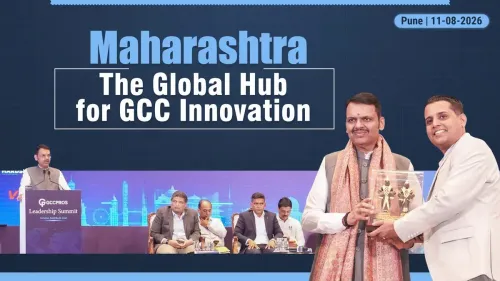
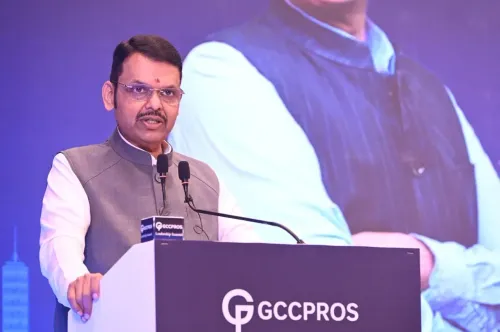
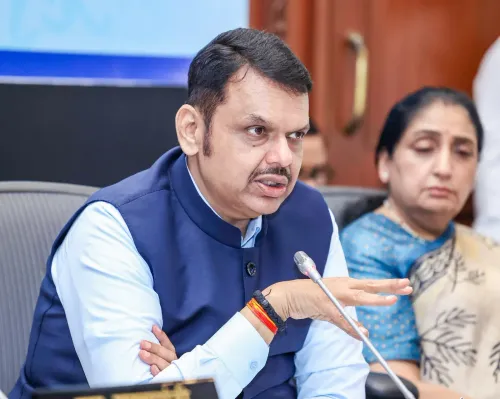
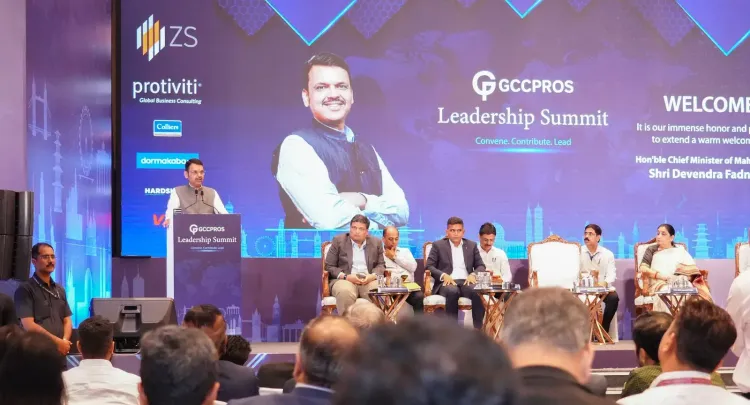
CM Devendra Fadnavis addressed the GCCPros Leadership Summit in Pune on 11 August 2026 , outlining Maharashtra's GCC ambitions.
The state has set targets of 400 new GCCs , 4 lakh high-skill jobs , and ₹50,000 crore in investment .
A six-city model assigns distinct GCC specialisations to Mumbai, Pune, Navi Mumbai, Nagpur, Nashik, and Chhatrapati Sambhajinagar .
Maharashtra will establish a single-point government contact and system for GCC setup, scaling, and problem resolution.
GCCs are positioned as central to Maharashtra's goal of becoming a $1 trillion economy , bringing knowledge, R&D, and high-value employment.
Fadnavis called for a government-industry-academia compact to build future-ready talent in AI, semiconductors, cybersecurity, and biotech.
Four hundred Global Capability Centers. Four lakh high-skill jobs. Fifty thousand crore rupees in investment. Chief Minister Devendra Fadnavis arrived at the GCCPros Leadership Summit in Pune on 11 August 2026 with numbers that reframe Maharashtra's ambition in the global knowledge economy — and a blunt message: subsidies alone will not win this race.
From back-office to boardroom: how GCCs are changing
Fadnavis opened by tracing the arc of India's GCC story. These centres began as cost-arbitrage plays — skilled labour, lower overheads, English fluency. That era, he argued, is closing fast. '2030 मधील जागतिक क्षमता केंद्रे केवळ कार्यालयीन सहाय्यक कामकाजापुरती मर्यादित राहणार नाहीत' ('By 2030, Global Capability Centers will no longer be confined to back-office support work'), he told delegates. The next generation, he said, will drive engineering, artificial intelligence, product development, cybersecurity, financial services, data analytics, and research and development — and will make consequential decisions for global businesses from Indian soil.
That shift is already visible in Maharashtra's own numbers. The Chief Minister cited Pune as having emerged as India's second-largest GCC office market in 2025, with demand for GCC office space more than doubling year-on-year. He expressed confidence that Pune will lead the country in the GCC segment by end-2026. (NationPress notes these specific market rankings and projections are drawn from the Chief Minister's address and have not been independently verified.)
A six-city blueprint — not just Mumbai and Pune
The most architecturally ambitious part of Fadnavis's pitch was a deliberate push to decentralise GCC growth across Maharashtra's urban network. He mapped out distinct roles for six cities: Mumbai as the hub for global finance and institutional functions; Pune for engineering and product development; Navi Mumbai for global business and technology; Nagpur for specialised technology and shared services; Nashik for engineering and industrial capability; and Chhatrapati Sambhajinagar for advanced manufacturing and the automotive sector.
The logic is competitive: rather than asking a multinational to bet on one city, Maharashtra is offering a portfolio of talent pools and industrial clusters — each city's GCC specialisation aligned to its existing economic DNA. Mumbai's deep financial ecosystem, Pune's engineering and automotive base, and Nagpur's emerging tech corridor together, Fadnavis argued, create a more resilient and scalable GCC destination than any single-city rival can offer.
Beyond incentives: the ecosystem and governance promise
Fadnavis was emphatic that fiscal sweeteners — wage subsidies, capex support, interest subvention, R&D grants, additional FSI, and preferential land access — are instruments, not the strategy. 'The real objective is capability creation,' he said. A durable ecosystem, he insisted, rests on talent pipelines, infrastructure, ease of doing business, quality of life, research institutions, universities, connectivity, and — critically — trust between government and industry.
On governance, he announced that Maharashtra will create a single-point GCC facilitation mechanism: one designated government contact and one system responsible for setting up a centre, scaling it, and resolving problems as they arise. Industries, he said, should not wait weeks or months for routine approvals. 'Ease of doing business means improving the experience an industry has when it walks into a government office — and the government is committed to improving that experience.'
AI, semiconductors, and the ₹1-trillion economy link
Fadnavis connected the GCC push directly to Maharashtra's stated goal of becoming a $1 trillion economy. GCCs, he argued, do not merely bring capital — they bring knowledge, global best practices, R&D capability, leadership, and high-value employment. They plug Maharashtra's talent directly into global supply chains and concentrate global decision-making on Indian soil.
He flagged Maharashtra's existing industrial strengths in semiconductors, fintech, cybersecurity, advanced engineering, pharmaceutical R&D, electric vehicles, and industrial technology as the foundation on which the next generation of GCCs should be built. He also referenced a memorandum of understanding signed at Davos this year for establishing an AI-focused centre in BKC, Mumbai — aimed at applied AI research and innovation. (This MoU is cited from the Chief Minister's address; independent verification is pending.)
On skills, Fadnavis issued a direct challenge to industry: stop telling universities what was needed five years ago, and start telling them what will be needed in the next five. AI engineers, data scientists, cybersecurity specialists, semiconductor engineers, quantitative finance professionals, and biotech experts — these are the profiles Maharashtra must produce at scale, he said, through a three-way compact between government, industry, and academia.
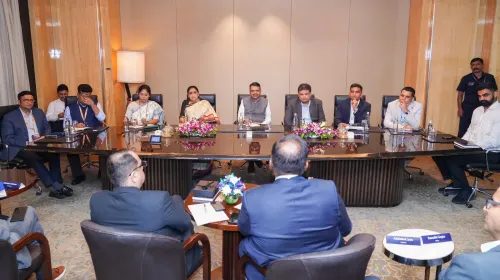
Deputy Chief Minister Sunetra Ajit Pawar, GCCPros CEO Shammi Prabhakar Singh, and GCCPros co-founder Nilesh Deshmukh were among the dignitaries present at the summit.
Maharashtra has the ecosystem, the cities, and now a stated policy architecture. Whether the single-window promise and the university-industry compact translate from summit stage to factory floor will determine whether the 400-GCC target becomes a milestone or a headline.
Point of View
Multi-city industrial policy — a playbook that mirrors what Karnataka did with its IT corridor in the 1990s but with a deliberate effort to avoid Bengaluru's single-city concentration problem. The ₹50,000 crore target and the six-city specialisation map signal that the state views GCCs not merely as employment generators but as anchors for a knowledge-economy transition tied to the $1 trillion GDP goal. The governance reform — a single-point facilitation mechanism — is the most operationally testable commitment: if it works, it becomes a differentiator; if it stalls in bureaucratic inertia, the fiscal incentives alone will not close the gap with competing states. The summit's real audience is not the delegates in the room but the global HR and real-estate heads at multinationals currently deciding their next GCC location.
NationPress
12 Aug 2026
Frequently Asked Questions
What is Maharashtra's GCC target announced by CM Fadnavis?
CM Devendra Fadnavis announced targets of 400 new Global Capability Centers , 4 lakh high-skill jobs , and ₹50,000 crore in investment for Maharashtra, outlined at the GCCPros Leadership Summit in Pune on 11 August 2026.
Which cities in Maharashtra are being developed as GCC hubs?
Fadnavis outlined a six-city model: Mumbai for finance, Pune for engineering and product development, Navi Mumbai for global business and technology, Nagpur for specialised tech and shared services, Nashik for engineering and industry, and Chhatrapati Sambhajinagar for advanced manufacturing and automotive.
What incentives does Maharashtra offer to attract GCCs?
Maharashtra's GCC policy includes wage subsidies, capital expenditure support, interest subvention, R&D grants, additional FSI, preferential land access, and 24x7 operational support . Fadnavis stressed, however, that the real goal is ecosystem building — talent, infrastructure, ease of doing business, and government-industry trust — not subsidies alone.
What is the GCCPros Leadership Summit?
GCCPros is an industry body focused on Global Capability Centers. The GCCPros Leadership Summit held in Pune on 11 August 2026 brought together industry leaders, government officials, and GCC ecosystem stakeholders to discuss Maharashtra's positioning as a preferred GCC destination.
How are GCCs connected to Maharashtra's $1 trillion economy goal?
Fadnavis stated that GCCs are central to Maharashtra's ambition of becoming a $1 trillion economy because they bring not just capital but knowledge, global best practices, R&D capability, leadership pipelines, and high-value employment — directly connecting Maharashtra's talent to global decision-making networks.