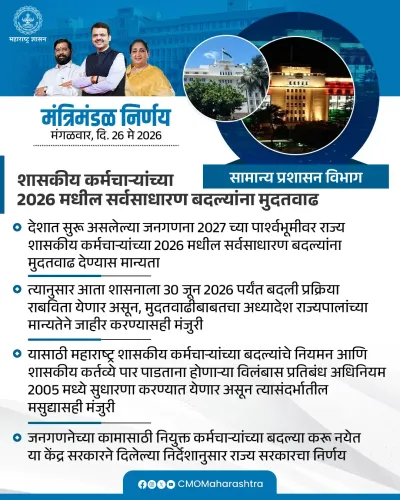
CM Fadnavis Tables Transfer Regulation Ordinance 2026
Synopsis
Maharashtra CM Devendra Fadnavis tabled the Government Servants Regulation of Transfer and Prevention of Delay in Discharge of Official Duties Ordinance, 2026, in the Vidhan Sabha on 22 June during the Monsoon Session, updating the state's 2005 transfer regulation law.
Key Takeaways
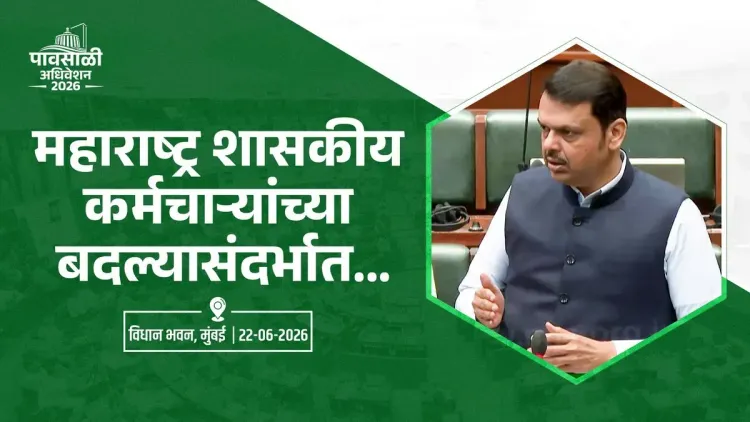
CM Devendra Fadnavis tabled the Maharashtra Government Servants Regulation of Transfer and Prevention of Delay in Discharge of Official Duties Ordinance, 2026 on 22 June 2026 .
The ordinance was placed before the Maharashtra Legislative Assembly (Vidhan Sabha) during the Monsoon Session 2026 in Mumbai .
It seeks to update the foundational Maharashtra Government Servants Regulation of Transfers and Prevention of Delay in Discharge of Official Duties Act, 2005 .
The legislation aims to regulate transfers of state government employees and enforce timely discharge of official duties.
Specific clauses and amendments will be subject to legislative debate before the ordinance can be enacted.
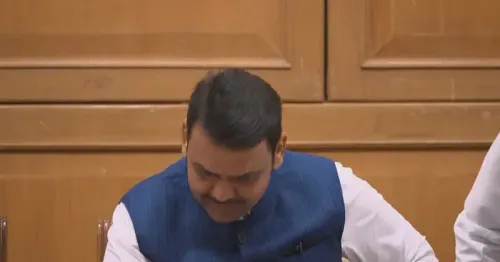
Maharashtra Chief Minister Devendra Fadnavis on Monday, 22 June 2026, tabled the Maharashtra Government Servants Regulation of Transfer and Prevention of Delay in Discharge of Official Duties Ordinance, 2026, before the Maharashtra Legislative Assembly in Mumbai during the ongoing Monsoon Session 2026. The move signals the state government's intent to update the regulatory framework governing transfers and timely disposal of official duties for state employees.
Context
Fadnavis announced the tabling in a bilingual post, stating in Marathi: 'महाराष्ट्र शासकीय कर्मचाऱ्यांच्या बदल्यांचे विनियमन आणि शासकीय कर्तव्ये पार पाडताना होणाऱ्या विलंबास प्रतिबंध सुधारणा अध्यादेश 2026 सभागृहाच्या पटलावर सादर' ['The Maharashtra Government Servants Regulation of Transfer and Prevention of Delay in Discharge of Official Duties Amendment Ordinance 2026 tabled before the house']. The ordinance was placed on the floor of the Vidhan Sabha, Mumbai, on 22 June 2026.
The 2026 ordinance builds on existing state law. The original Maharashtra Government Servants Regulation of Transfers and Prevention of Delay in Discharge of Official Duties Act, 2005, was enacted to curb the practice of frequent, politically motivated transfers and to establish timelines for the disposal of files across government departments.
Policy Backdrop
Transfer regulation has been a persistent governance challenge across Indian states. The 2005 Act was Maharashtra's legislative response to demands from civil society and administrative reformers who argued that arbitrary transfers disrupted institutional continuity and created opportunities for corruption. Successive Maharashtra governments have periodically revisited service rules to strike a balance between administrative stability and departmental flexibility.
Maharashtra is not alone in this effort. Multiple Indian states have enacted similar transfer-regulation statutes over the past two decades, reflecting a broader national consensus that limiting political interference in postings improves the quality and speed of public service delivery. The introduction of an ordinance — rather than a standalone bill — suggests the government considers the matter time-sensitive within the current session's legislative calendar.
Stakeholders and Impact
The ordinance directly concerns Maharashtra's state government employees and the administrative departments that manage their postings. If enacted, updated transfer rules could affect the tenure security of officers across the state's vast bureaucracy, which spans departments from revenue and public works to health and education.
Civil servants' associations have historically welcomed legislative guardrails on transfers, arguing they reduce uncertainty and allow officials to complete long-term projects. At the same time, departments have sought flexibility to redeploy staff in response to emergencies and shifting administrative priorities. How the 2026 ordinance reconciles these competing interests will become clearer as its specific clauses are debated in the house.
What's Next
The ordinance will now be subject to debate and scrutiny during the Monsoon Session 2026. Legislators from both the treasury and opposition benches are expected to examine its provisions, and the government will need to secure passage before the session concludes. Rules framed under the ordinance — specifying transfer cycles, posting durations, and timelines for file disposal — will determine its practical impact on Maharashtra's administrative machinery.
If passed, the legislation could set a renewed benchmark for transfer governance in one of India's largest and most economically significant states, with implications for how other state governments approach similar reforms.
Point of View
Who is in his third term as Chief Minister, updating the 2005 framework is consistent with a broader pattern of using legislative action to signal administrative seriousness. The real test will be in the implementation rules and whether the ordinance includes enforceable penalties for violations.
NationPress
22 Jun 2026
Frequently Asked Questions
What is the Maharashtra Government Servants Transfer Regulation Ordinance 2026?
It is an ordinance tabled by CM Devendra Fadnavis in the Maharashtra Vidhan Sabha on 22 June 2026, aimed at regulating the transfers of state government employees and preventing delays in the discharge of official duties, updating the earlier 2005 Act.
Why did Maharashtra introduce a new transfer ordinance in 2026?
The 2026 ordinance appears to update and strengthen the existing 2005 law governing state employee transfers and file-disposal timelines. Successive Maharashtra governments have periodically revised these rules to address administrative challenges and limit arbitrary postings.
What was the Maharashtra Government Servants Transfer Act 2005?
The 2005 Act was Maharashtra's original legislation to curb frequent, politically driven transfers of state employees and to set timelines for the disposal of official files, aiming to bring stability and accountability to the state bureaucracy.
Who does the Maharashtra transfer ordinance 2026 affect?
The ordinance directly affects Maharashtra state government employees across all administrative departments, as well as the departments responsible for managing postings and ensuring timely delivery of government services.
What happens next after the ordinance was tabled in the Vidhan Sabha?
The ordinance will be debated by legislators during the Monsoon Session 2026. It must be passed by the house before becoming law, after which the government will frame implementation rules specifying transfer cycles and file-disposal timelines.