CM Rekha Gupta echoes Modi's push to make animal husbandry a rural income engine
Synopsis
Delhi CM Rekha Gupta quoted PM Modi on 30 October 2026, framing healthy livestock, higher milk output, and cow-dung utilisation as pillars of rural income growth — directly linking the message to the PM-KISAN farmer-support scheme.
Key Takeaways
Delhi CM Rekha Gupta shared a quote from PM Narendra Modi on 30 October 2026 calling animal husbandry a tool for farmer income and village prosperity.
The post was tagged with #PMKisanSammanNidhi , linking livestock welfare to the flagship ₹6,000-per-year direct-transfer scheme launched in February 2019 .
PM Modi's vision as quoted covers three pillars: healthy animals, increased milk production, and full utilisation of cow dung.
Central policy frames milk sales and bio-gas from cow dung as independent revenue streams for small dairy producers and rural households.
BJP state leaders regularly amplify central agricultural messaging, signalling policy continuity between state governments and the Union government.
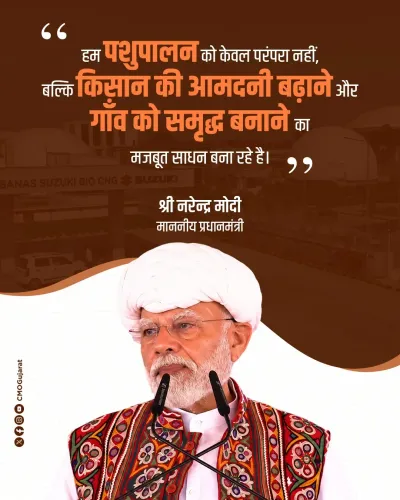
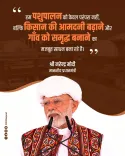
Healthy animals, more milk, and zero-waste cow dung — Delhi Chief Minister Rekha Gupta on Friday, 30 October 2026, shared a sharp three-point vision for India's livestock sector, quoting Prime Minister Narendra Modi to underline that animal husbandry is no longer just a tradition — it is a deliberate economic strategy for rural India.
The quote shared by CM Gupta, originally from PM Modi, lays out the goal plainly: 'पशु स्वस्थ हों, दूध उत्पादन बढ़े और गोबर का भी पूरा उपयोग हो' — 'animals must be healthy, milk production must rise, and cow dung must be fully utilised.' The post was tagged with #PMKisanSammanNidhi, explicitly linking livestock welfare to the flagship farmer-income programme.
PM-KISAN's livestock link: income beyond the crop
The Pradhan Mantri Kisan Samman Nidhi (PM-KISAN) scheme, launched in February 2019, delivers ₹6,000 per year in direct benefit transfers to landholding farmer families. By tagging this post to the scheme, CM Gupta signals the BJP's intent to frame animal husbandry as a natural income complement — a second revenue stream that works alongside the cash-transfer floor PM-KISAN provides.
Central policy has for several years tried to shift how rural India thinks about its cattle. Milk production, bio-gas from cow dung, and organic fertiliser sales are each positioned as revenue lines in their own right — not by-products of farming, but the main event for millions of small dairy producers.
Village prosperity as the end goal, not just farm output
The framing in the quoted words is deliberate: the target is not merely the individual farmer's income ('किसान की आमदनी') but the enrichment of the entire village ('गांव को समृद्ध बनाने'). That distinction matters. It positions livestock development as community-level infrastructure — something a budget line or a subsidy alone cannot capture.
State leaders across the BJP have increasingly amplified central agricultural messaging, and CM Gupta's post fits that pattern — signalling policy continuity between New Delhi as a national capital and the Union government's rural-welfare priorities.
If India's villages are to grow richer on four legs as well as two crops, the question that follows is concrete: how much of the next state budget goes to veterinary care, cold-chain dairy infrastructure, and bio-gas plants? That number will tell us whether this vision is a headline or a plan.
Point of View
The party ties its cash-transfer flagship to a broader 'whole village' prosperity argument, which is harder to reduce to a single budget line. The emphasis on cow-dung utilisation also quietly signals alignment with the government's bio-economy push without naming it directly. The real test of this vision will be whether state budget allocations for veterinary services, dairy cold-chains, and bio-gas infrastructure actually follow the rhetoric.
NationPress
30 Oct 2026
Frequently Asked Questions
What did Delhi CM Rekha Gupta say about animal husbandry?
CM Rekha Gupta quoted PM Modi on 30 October 2026, stating that the goal is healthy animals, higher milk production, and full utilisation of cow dung — framing animal husbandry as a means to increase farmer income and enrich villages, not merely a tradition.
What is the PM-KISAN scheme and why was it mentioned?
The Pradhan Mantri Kisan Samman Nidhi (PM-KISAN) scheme, launched in February 2019, provides ₹6,000 per year in direct benefit transfers to landholding farmer families. CM Gupta tagged the post with #PMKisanSammanNidhi to link livestock welfare policies with this broader farmer-income support programme.
How does the BJP connect animal husbandry with rural income?
BJP's policy framing positions milk production and cow-dung-derived bio-gas or fertiliser as independent revenue streams for rural households, complementing crop income and direct benefit transfers under schemes like PM-KISAN.
What role does cow dung play in India's rural income policy?
Government policy encourages farmers to convert cow dung into bio-gas for energy and organic fertiliser for sale or farm use, turning what was previously waste into an additional income source and supporting sustainable agricultural practices.
Why do BJP state leaders share PM Modi's agricultural quotes?
State BJP leaders regularly amplify central government agricultural messaging to signal policy continuity, reinforce the party's rural-welfare narrative across India, and connect local governance priorities with national schemes.