CM Himanta: 70 Lakh Assam Families Got Free Rice in July
Synopsis
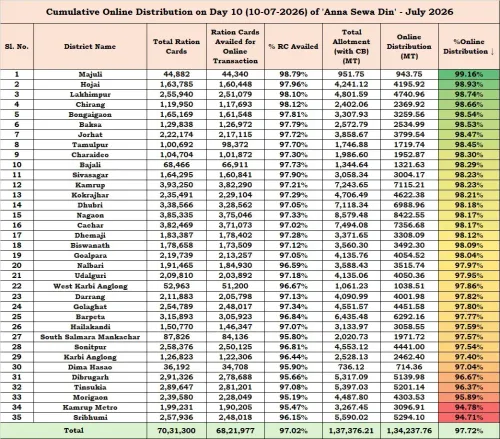
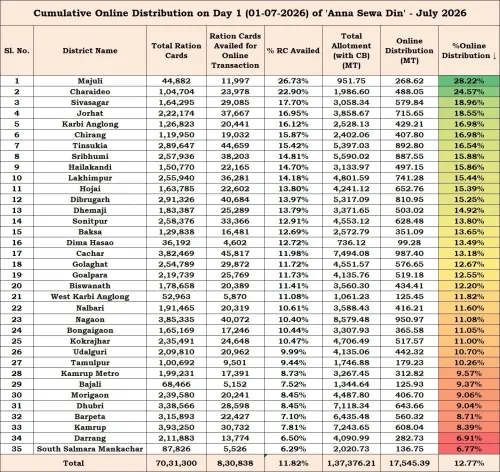
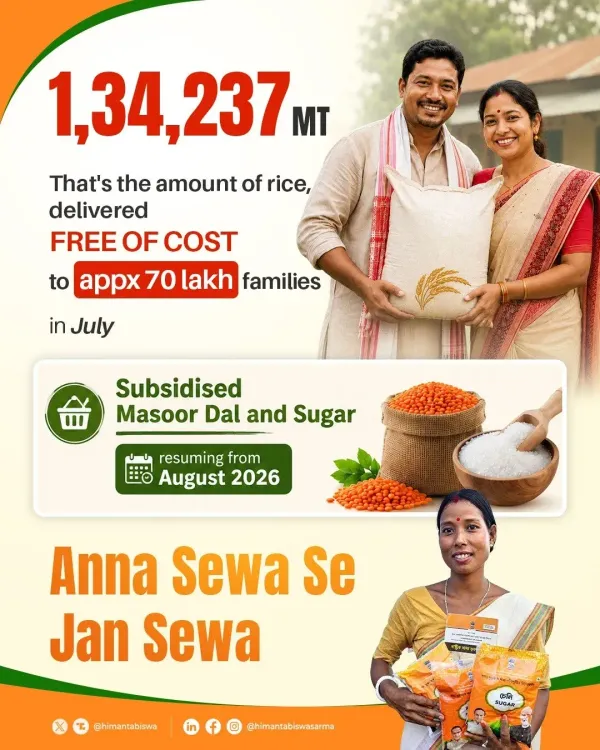
Assam Chief Minister Himanta Biswa Sarma announced on 11 July 2026 that nearly 70 lakh families received free rice this July, with 1.34 lakh MT distributed statewide. Subsidised masoor dal and sugar are set to return from August, expanding the state's food security basket under the slogan Anna Sewa Se Jan Sewa.
Key Takeaways
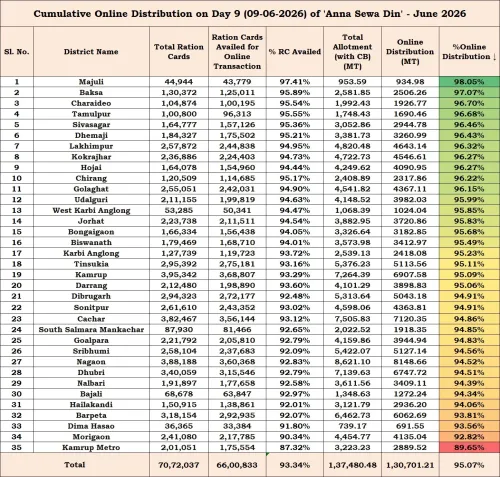
Nearly 70 lakh families in Assam received free rice during July 2026 .
The state distributed a total of 1.34 lakh metric tonnes of free rice for the month.
Subsidised masoor dal and sugar will return to PDS beneficiaries from August 2026 .
CM Himanta Biswa Sarma credited the initiative to the vision of Prime Minister Narendra Modi .
The distribution is framed under the slogan Anna Sewa Se Jan Sewa — service through food as service to the people.
The move aligns with the National Food Security Act and central food welfare schemes implemented at the state level.
Assam Chief Minister Himanta Biswa Sarma announced on Saturday, 11 July 2026 that nearly 70 lakh families across Assam received free rice during the month of July, with the state having distributed 1.34 lakh metric tonnes of free rice in total. The Chief Minister also confirmed that subsidised masoor dal and sugar will return to beneficiaries from August 2026.
Context
Posting on X, CM Sarma wrote: 'Nearly 70 lakh families have received free rice this July. Anna Sewa Se Jan Sewa is our commitment to every household. Inspired by the vision of Adarniya Narendra Modi Ji, Assam has provided 1.34 lakh MT of free rice, with subsidised masoor dal and sugar returning from August.' The phrase Anna Sewa Se Jan Sewa — roughly, 'service through food is service to the people' — frames the distribution as a broader welfare philosophy rather than a standalone relief measure.
The announcement covers the state's public distribution operations for July 2026 and signals an expansion of the subsidy basket starting next month. The return of subsidised pulses and sugar alongside free rice marks a notable step-up in the state's food security commitments under the current BJP-led government.
Policy Backdrop
The distribution aligns with the architecture of the National Food Security Act (NFSA), 2013, which mandates subsidised foodgrains to up to 75 per cent of rural and 50 per cent of urban households across India. The Pradhan Mantri Garib Kalyan Anna Yojana (PMGKAY), launched in March 2020 during the COVID-19 pandemic, expanded this framework by layering additional free grain entitlements on top of existing NFSA quotas and has since been extended in successive phases.
Assam, a northeastern state under BJP governance since 2016, has consistently aligned its state-level public distribution system with central food security schemes. CM Sarma explicitly attributed the initiative to the 'vision' of Prime Minister Narendra Modi, reinforcing the political and programmatic continuity between New Delhi and Dispur on welfare delivery.
Stakeholders and Impact
The primary beneficiaries are low-income families enrolled under the state's public distribution system — a segment that depends heavily on government-supplied foodgrains to manage household food budgets. With nearly 70 lakh families covered in a single month, the scale of the July operation underscores the reach of Assam's PDS network.
The phased return of subsidised masoor dal and sugar from August broadens the nutritional basket available to beneficiaries beyond staple rice. Pulses are a critical source of protein for lower-income households, making their return to the subsidised basket particularly significant for food security outcomes in the state.
As convenor of the North-East Democratic Alliance (NEDA), CM Sarma plays a coordinating role across BJP-aligned northeastern governments. Assam's welfare model, when publicly highlighted, can set a reference point for similar implementation efforts in neighbouring NEDA states.
What's Next
The immediate policy watch is the operationalisation of subsidised masoor dal and sugar distribution from August 2026 — the logistics, pricing, and beneficiary eligibility criteria for these commodities will determine the on-ground impact of the expanded basket. Any related announcements in the Assam state budget or the state legislative assembly could provide further detail on the fiscal outlay and duration of these measures.
Broader attention will also focus on whether the state maintains or scales the free rice component beyond July, and how the subsidy rollout is received by beneficiaries ahead of the next electoral cycle in the region.
Point of View
Possibly in response to household-level food cost pressures. For a government that has consistently positioned the northeast as a model of BJP governance, high-visibility food security numbers serve a dual purpose: they reinforce the NEDA bloc's credibility and pre-empt opposition narratives on inflation and welfare. The scale — 70 lakh families in a single month — also reflects the administrative depth of Assam's PDS network, which will now face a logistical test with the added commodities from August.
NationPress
12 Jul 2026
Frequently Asked Questions
How many families received free rice in Assam in July 2026?
According to CM Himanta Biswa Sarma, nearly 70 lakh families in Assam received free rice in July 2026.
How much free rice did Assam distribute in July 2026?
Assam distributed 1.34 lakh metric tonnes of free rice in July 2026 under its public distribution operations.
What is Anna Sewa Se Jan Sewa?
'Anna Sewa Se Jan Sewa' is the welfare slogan used by the Assam government meaning 'service through food is service to the people,' framing its free rice and subsidy programme as a broader public commitment.
Will Assam provide subsidised dal and sugar to beneficiaries?
Yes. CM Sarma confirmed that subsidised masoor dal and sugar will return to PDS beneficiaries in Assam from August 2026.
Is Assam's free rice scheme linked to a central government programme?
Assam's distribution aligns with the National Food Security Act and the Pradhan Mantri Garib Kalyan Anna Yojana, central schemes that provide free or subsidised foodgrains to eligible low-income households.