CM Himanta: Assam child marriage chargesheet rate hits 98.8%

Synopsis
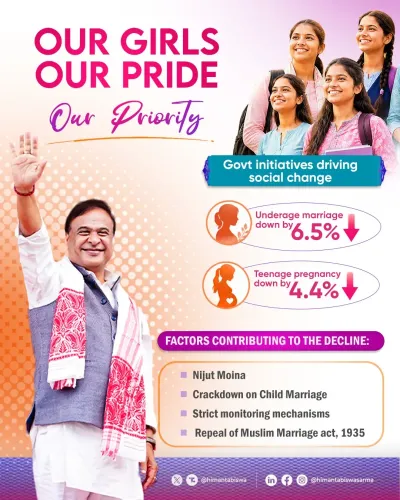
Assam Chief Minister Himanta Biswa Sarma revealed on October 7, 2026, that the state's child marriage chargesheet rate has reached 98.8%, marking a major milestone in Assam's sustained legal crackdown on the practice since 2023.
Key Takeaways
Assam's child marriage chargesheet rate now stands at 98.8% , meaning nearly every registered case has been formally charged before a court.
CM Himanta Biswa Sarma announced the figure on October 7, 2026 , framing it as proof of sustained prosecutorial follow-through.
Assam launched a landmark mass-arrest campaign against child marriage in early 2023 , running into thousands of cases across districts.
Sarma signalled the campaign is expanding 'beyond the altar' — hinting at social and preventive interventions alongside legal prosecution.
A near-99% chargesheet rate in a major state sets a data benchmark that could influence child-protection enforcement policy across India.
The true measure of success will ultimately be conviction rates and whether adolescent girls remain in school in Assam's most vulnerable districts.
A single statistic — 98.8% — is Assam's answer to a crime that has stolen childhoods for generations. Assam Chief Minister Himanta Biswa Sarma announced on Wednesday, October 7, 2026, that the state's crackdown on child marriage has driven its chargesheet rate to near-total accountability, declaring the fight is now moving 'beyond the altar.'
What a 98.8% chargesheet rate actually means
A chargesheet rate measures the proportion of registered cases in which police successfully file a formal charge document before a court — the critical legal step that transforms an arrest into a prosecution. At 98.8%, Assam's law-enforcement machinery is converting virtually every child marriage case it registers into a live court battle. That figure signals not just arrests, but sustained institutional follow-through: evidence gathered, witnesses recorded, and files submitted to judges.
The Chief Minister framed the milestone in sharp moral terms: 'Adolescence is meant to be lived, not rushed into marriage.' The phrase is deliberate — it shifts the lens from a legal violation to a stolen phase of life, underscoring why the government treats this as a human-rights emergency rather than a routine law-and-order file.
Assam's sustained campaign against child marriage
Assam launched a high-visibility crackdown on child marriage in early 2023, with mass arrests that ran into the thousands across districts in a matter of weeks. The campaign was polarising at the time — critics flagged concerns about procedural fairness and the welfare of families caught in a poverty-driven practice, while the state government held firm that legal deterrence was non-negotiable. The near-perfect chargesheet rate announced now suggests the prosecutorial infrastructure built during that period has matured and held.
Sarma's phrase 'taking the fight beyond the altar' points to the next frontier: prosecution alone does not keep a teenage girl in school or give a family the economic safety net that often makes early marriage feel like the only option. The signal is that enforcement will be paired with deeper social intervention — though the specific programmes were not detailed in Wednesday's post.
Why this number matters beyond Assam
India remains home to one of the largest populations of child brides in the world, and state-level execution has always been the weak link in national child-protection law. A chargesheet rate approaching 99% in a large, diverse north-eastern state sets a data benchmark that other state governments — and the Union government — will find difficult to ignore. If Assam's model holds under judicial scrutiny, it becomes a replicable template.
The next test is conviction rates and, beyond courtrooms, whether adolescent girls in Assam's most vulnerable districts are actually staying in school longer. Numbers in a chargesheet are a beginning. A childhood fully lived is the finish line.
Point of View
The figure serves a dual purpose: it validates the 2023 crackdown that drew fierce criticism for its scale and speed, and it repositions Assam as a governance model for the BJP's social reform agenda in the north-east. The phrase 'beyond the altar' is the more consequential signal — it acknowledges that deterrence without economic alternatives has limits, and suggests the next phase must address the poverty and patriarchal structures that make child marriage feel rational to many families. Whether that second phase materialises in policy or remains rhetorical will define the campaign's lasting legacy.
NationPress
8 Oct 2026
Frequently Asked Questions
What is Assam's child marriage chargesheet rate in 2026?
Assam's child marriage chargesheet rate stands at 98.8% as of October 2026, according to Chief Minister Himanta Biswa Sarma. This means that in nearly all registered child marriage cases, police have successfully filed a formal chargesheet before a court.
When did Assam start its child marriage crackdown?
Assam launched a large-scale child marriage crackdown in early 2023 , conducting mass arrests across multiple districts in a short period. The campaign was one of the most aggressive state-level enforcement drives against child marriage in India.
What does a chargesheet rate mean in the context of criminal cases?
A chargesheet rate refers to the percentage of registered criminal cases in which police file a formal charge document — called a chargesheet — before a court within the stipulated time. A high rate like 98.8% indicates strong prosecutorial follow-through and evidence gathering.
What did CM Himanta Biswa Sarma say about child marriage in Assam?
CM Sarma stated: 'Adolescence is meant to be lived, not rushed into marriage,' and announced that Assam is 'taking the fight beyond the altar' — signalling that the government intends to move beyond legal prosecution toward broader social intervention against child marriage.
Is child marriage still a major problem in India?
Yes. India continues to have a significant child marriage challenge, with state-level enforcement historically being the weak link in implementing national child-protection legislation. High-performing states like Assam, with a 98.8% chargesheet rate, are increasingly cited as potential models for other states.