CM Himanta: Assam education drives reach 36 lakh students

Synopsis
Assam Chief Minister Himanta Biswa Sarma on 1 July 2026 announced that the state's education initiatives are reaching over 36 lakh students, reducing financial burdens on families. The post, addressed to Education Minister Ranoj Pegu, highlights the government's sustained push on school-level welfare since 2021.
Key Takeaways
Assam CM Himanta Biswa Sarma stated that state education programmes are benefiting over 36 lakh students as of 1 July 2026 .
The initiatives aim to ease the financial burden on families and help every child fulfil their educational aspirations.
The post was addressed to Education Minister Ranoj Pegu , reflecting coordination between the Chief Minister's office and the education department.
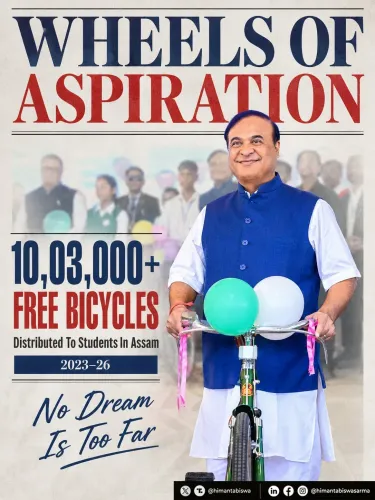
Since 2021 , Assam has expanded free textbooks, uniforms, and bicycles for school students under state welfare schemes.
State programmes complement central schemes such as Samagra Shiksha and align with the National Education Policy 2020 .
Future education allocations in the Assam state budget will be a key indicator of the government's next steps.
Assam Chief Minister Himanta Biswa Sarma on Wednesday, 1 July 2026, highlighted the cumulative reach of the state government's education initiatives, stating that programmes aimed at easing the financial burden on families are now benefiting over 36 lakh students across Assam. The post, addressed to Education Minister Ranoj Pegu, underscored the government's focus on making schooling accessible and affordable for every child in the state.
Context
In his post, CM Sarma wrote: 'Our numerous initiatives are making an impact on over 36 lakh students of Assam. All our efforts are easing the burden on families so that every child can fulfil their dreams.' The message, tagged to Ranoj Pegu, signals a coordinated communication between the Chief Minister's office and the state education department on the progress of welfare schemes.
The statement comes as the Assam government continues to position education as a cornerstone of its governance agenda since CM Sarma took office in May 2021. The reference to 'numerous initiatives' encompasses a range of entitlements the state has rolled out for school-going children over the past several years.
Policy Backdrop
Since 2021, the Assam government has expanded the distribution of free textbooks, uniforms, and bicycles to school students — measures designed to reduce out-of-pocket expenditure for families, particularly in rural and semi-urban areas. These state-level subsidies complement central schemes such as Samagra Shiksha, which provides funding for school infrastructure and learning outcomes across India.
The state has also aligned its curriculum and institutional frameworks with the National Education Policy 2020, undertaking infrastructure upgrades and pedagogical revisions in government schools. Together, these efforts represent a multi-layered approach to improving both access and quality in Assam's public education system.
Across the Northeast, state governments have increasingly treated school-level entitlements as a human-capital investment, and Assam's scale — reaching over 36 lakh beneficiaries — reflects one of the more expansive such programmes in the region.
Stakeholders and Impact
The primary beneficiaries are the 36 lakh-plus students enrolled in government and government-aided schools across Assam, along with their families who stand to see reduced household spending on education-related costs. For lower-income households, free uniforms, textbooks, and transport support can meaningfully lower the effective cost of keeping children in school.
Education Minister Ranoj Pegu has been the administrative face of these programmes, overseeing both school and higher education delivery in the state. The Chief Minister's public acknowledgement of Pegu's role signals institutional alignment at the top of the state government on education priorities.
Civil society groups and parent communities in Assam have broadly welcomed measures that reduce dropout risk, especially for girls and students from economically weaker sections, though independent assessments of on-ground implementation continue to be watched closely.
What's Next
Attention will now turn to the forthcoming Assam state budget, where education allocations will indicate whether the government plans to deepen existing schemes or introduce new ones. Any fresh guidelines from the Assam education department on scheme eligibility, coverage, or funding could expand the beneficiary base beyond the current 36 lakh mark.
With state assembly dynamics and the broader Northeast political landscape in view, the Sarma government's continued emphasis on visible welfare delivery in education is likely to remain a central plank of its public messaging in the months ahead.
Point of View
Projecting a unified delivery front ahead of what could be a politically sensitive budget cycle. The '36 lakh students' figure anchors an otherwise broad welfare narrative in a concrete scale of impact, a communications strategy the BJP-led Assam government has refined since 2021. This fits a wider Northeast pattern where ruling parties are increasingly using school entitlements — visible, household-level benefits — as both a governance record and an electoral asset. The forward-looking implication is clear: education spending in Assam is unlikely to plateau, and the next budget will be a litmus test of whether ambition matches allocation.
NationPress
1 Jul 2026
Frequently Asked Questions
What education initiatives has the Assam government launched for students?
The Assam government has rolled out free textbooks, uniforms, and bicycles for school students, and has aligned its curriculum with the National Education Policy 2020, with these combined efforts now reaching over 36 lakh students.
Who is Ranoj Pegu and what is his role in Assam education?
Ranoj Pegu is the Education Minister of Assam, responsible for overseeing state school and higher education programmes, and was directly acknowledged by CM Himanta Biswa Sarma in the 1 July 2026 post.
How many students benefit from Assam government education schemes?
According to CM Himanta Biswa Sarma's post on 1 July 2026, over 36 lakh students in Assam are benefiting from the state government's various education initiatives.
What is Samagra Shiksha and how does it relate to Assam's education programmes?
Samagra Shiksha is a central government scheme that funds school infrastructure and learning outcomes across India; Assam's state-level subsidies on textbooks, uniforms, and bicycles complement this central framework.
What should we watch for next in Assam's education policy?
The upcoming Assam state budget will be the key indicator, with education allocations and any new scheme guidelines from the state education department set to reveal the government's next moves.