CM Himanta Backs School Entrepreneurship to Build Assam's Startup Base

Synopsis
Assam Chief Minister Himanta Biswa Sarma spotlighted student Krishnajyoti's mushroom cultivation venture, born from a school training programme, as proof that embedding entrepreneurship in early education can build a stronger startup ecosystem across the state.
Key Takeaways
CM Himanta Biswa Sarma shared the story of student Krishnajyoti , who took up mushroom cultivation after a school-based enterprise training programme.
The post explicitly links early school-level training to the long-term goal of strengthening Assam's startup ecosystem .
Assam's Skill Development Mission , established in 2017 , provides the policy backbone for vocational and entrepreneurship training in the state.
Mushroom cultivation is positioned as a low-capital, accessible agri-enterprise entry point for rural school students.
The initiative is part of a broader northeastern India pattern of combining education reform with youth self-employment under NEDA -aligned governments.
Potential next steps include scaling enterprise modules to more schools and new budget allocations for agri-enterprise training.
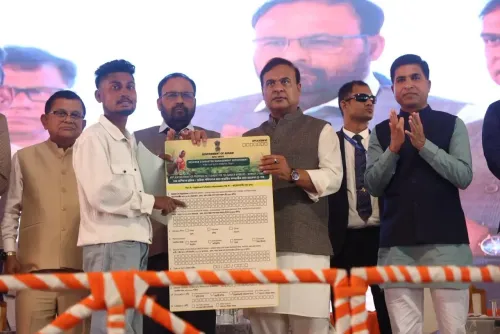
Assam Chief Minister Himanta Biswa Sarma on Friday, 3 July 2026, highlighted the story of a student named Krishnajyoti who took up mushroom cultivation after a school-based training programme, using the example to articulate his government's vision of embedding entrepreneurship into early education and strengthening the state's startup ecosystem.
Context
In his post, CM Sarma wrote: 'We want our future generation to be ready to embrace the power of entrepreneurship. A training programme in his school encouraged Krishnajyoti to take up mushroom cultivation and he hasn't looked back since then.' He added that such an 'initial head start will help children navigate enterprises from an early age and eventually strengthen Assam's start up ecosystem.'
The post, accompanied by a video, frames Krishnajyoti's journey as a model outcome of integrating practical enterprise training into school curricula — with mushroom cultivation serving as an accessible, low-capital entry point into agri-enterprise for rural youth.
Policy Backdrop
Assam established the Assam Skill Development Mission in 2017 to provide vocational and entrepreneurship training to youth across the state. The current administration under CM Sarma, in office since May 2021, has sought to deepen that framework by pushing enterprise modules into school-level education rather than limiting them to post-secondary programmes.
Mushroom cultivation fits neatly within this strategy: it requires minimal land, has a short production cycle, and connects to existing agricultural value chains in northeastern India. By introducing such activities at the school level, the state aims to reduce the gap between formal education and self-employment readiness among rural youth.
Stakeholders and Impact
The primary beneficiaries of this approach are school students and rural youth in Assam, particularly those in districts where formal employment opportunities are limited. Early exposure to enterprise training is intended to reduce dependence on government jobs and channel young people toward self-sustaining livelihoods.
For the broader startup ecosystem, a pipeline of entrepreneurially oriented young people — even at a micro-enterprise level — creates the cultural and practical groundwork that larger startup support programmes can build upon. Assam's approach mirrors a wider pattern across North East India, where NEDA-aligned state governments have combined education reform with economic self-reliance initiatives.
What's Next
The immediate question is whether Assam will scale similar entrepreneurship modules to additional schools across the state and whether the upcoming state budget will earmark fresh allocations for agri-enterprise training at the school level. CM Sarma's public spotlight on Krishnajyoti's story suggests the government is building a narrative case ahead of potential policy announcements.
If the model proves replicable, it could position Assam as a reference point for other northeastern states looking to address youth unemployment through education-linked enterprise pipelines — a development that would carry political as well as economic significance for the NEDA bloc.
Point of View
The BJP-led government in Assam is building public legitimacy for deeper education-enterprise integration ahead of what could be budget-cycle announcements. The move also reinforces NEDA's broader messaging that northeastern states are capable of homegrown economic innovation. Watched across the region, this framing could pressure peer state governments to demonstrate similar grassroots entrepreneurship outcomes.
NationPress
3 Jul 2026
Frequently Asked Questions
What did Assam CM Himanta Biswa Sarma say about school entrepreneurship?
CM Sarma stated that a school training programme encouraged a student named Krishnajyoti to take up mushroom cultivation, and he used this example to argue that early enterprise training will help children navigate businesses from a young age and strengthen Assam's startup ecosystem.
Who is Krishnajyoti in CM Sarma's post?
Krishnajyoti is a student from Assam whose school-based training programme inspired him to start mushroom cultivation, cited by CM Sarma as a model of school-level entrepreneurship success.
What is the Assam Skill Development Mission?
The Assam Skill Development Mission was established in 2017 to provide vocational and entrepreneurship training to youth in the state, forming the policy foundation for programmes that now extend into school curricula.
How does mushroom cultivation fit into Assam's startup plans?
Mushroom cultivation is a low-capital, short-cycle agri-enterprise that connects to existing agricultural value chains in northeastern India, making it an accessible starting point for rural school students entering self-employment.
Will Assam expand school entrepreneurship programmes to more schools?
No official announcement has been made yet, but CM Sarma's public focus on this model suggests the government may scale similar enterprise modules to additional schools and could include fresh budget allocations for agri-enterprise training.