CM Himanta Backs EU Blue Valley Cluster for Assam Growth
Synopsis
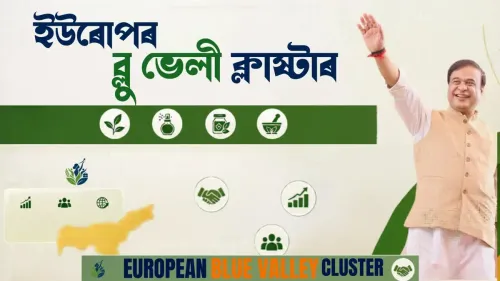
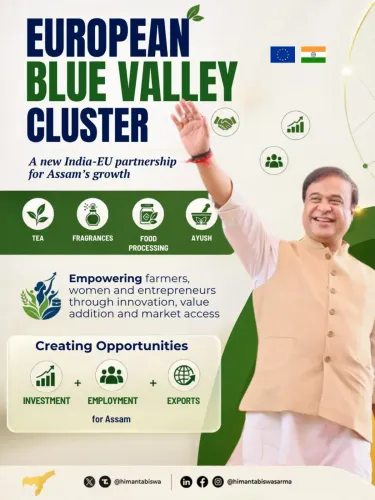
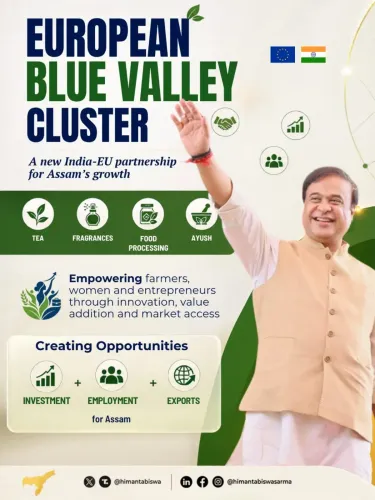
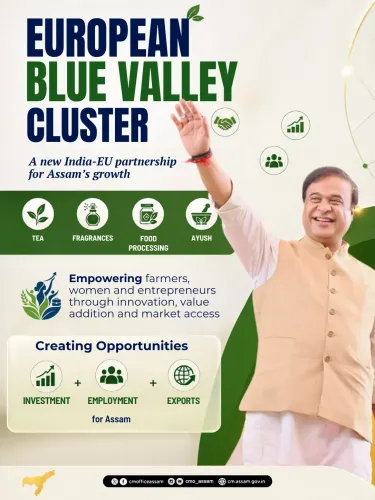
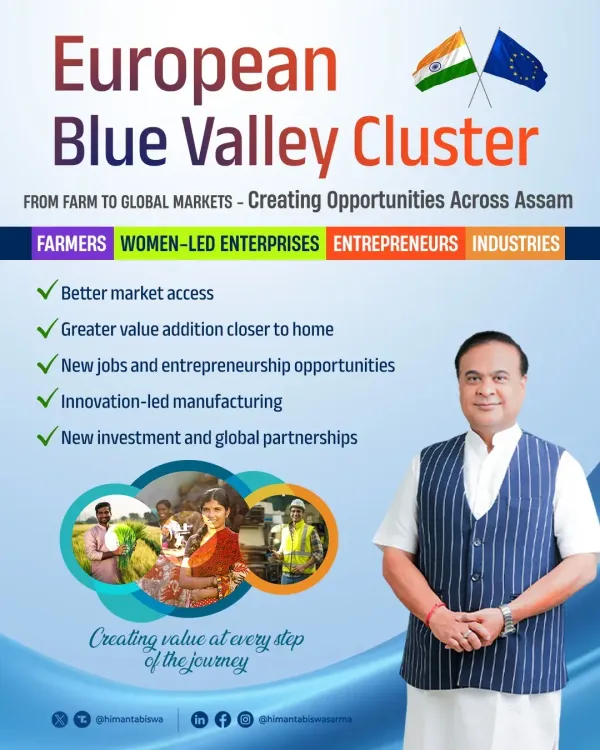
Assam Chief Minister Himanta Biswa Sarma on June 10, 2026 championed the European Blue Valley Cluster as a vehicle for connecting Assam's farmers, women entrepreneurs and youth to global markets, skills and investment, in partnership with the EU Delegation to India.
Key Takeaways
CM Himanta Biswa Sarma publicly backed the European Blue Valley Cluster on June 10, 2026 , calling it a gateway to global opportunities for Assam .
The initiative is a joint effort between the Assam government and the EU Delegation to India .
Three groups are named as primary beneficiaries: farmers , women entrepreneurs and youth .
Key goals include global market access , investment attraction and new skills acquisition .
The cluster aligns with the broader EU-India Strategic Partnership and India's push to diversify trade partners.
Specific project details, funding figures and timelines are yet to be publicly disclosed.
Assam Chief Minister Himanta Biswa Sarma on Wednesday, June 10, 2026, highlighted the transformative potential of the European Blue Valley Cluster for the state, saying the initiative would open global markets and investment channels for farmers, women entrepreneurs and youth across Assam.
Context
Posting on X, CM Sarma wrote that the 'real impact of the European Blue Valley Cluster will be seen in the opportunities it creates for the people of Assam.' He added that together with the EU Delegation to India (@EU_in_India), the state is 'building an ecosystem that enables our farmers, women entrepreneurs and youth to access global markets, attract investment and acquire new skills for the future.'
The statement positions the cluster not as a standalone project but as part of a broader economic ecosystem, with the EU acting as a co-architect alongside the Assam state government.
Policy Backdrop
The announcement fits within the long-running EU-India Strategic Partnership, first formalised at the 2004 Hague Summit, which has since included successive joint action plans covering trade, investment and skills development. Several Indian states have signed cooperation agreements with the EU since the early 2010s to attract investment and integrate into global value chains.
Assam has pursued similar outreach under its industrial and export-promotion policies, and this cluster initiative appears to be the latest expression of that strategy. The effort also sits within India's wider push to diversify trade partnerships beyond traditional markets, giving northeastern states a more visible role in the country's external economic engagement.
Stakeholders and Impact
Three groups are explicitly named as beneficiaries: Assam's farming community, women entrepreneurs and the state's youth. For farmers, global market access could mean higher export-linked prices and reduced dependence on domestic intermediaries. For women entrepreneurs, the ecosystem framing suggests structured support — possibly financing, mentorship or supply-chain linkages.
Youth skilling is the third pillar, signalling that the cluster is expected to generate not just trade flows but employment-ready capabilities. The EU's involvement lends the programme a degree of international credibility and potential access to European technical standards and markets.
What's Next
Follow-up announcements on specific investment projects, skill development centres or market-linkage pilots are expected through EU-India review mechanisms or state-level bilateral meetings. The pace at which operational details — such as participating European partners, funding commitments and implementation timelines — are disclosed will determine whether the cluster translates from vision to measurable outcomes for Assam's communities.
As CM Sarma continues to position Assam as a gateway to Southeast Asia and a node in global value chains, the European Blue Valley Cluster could become a template for similar EU-state partnerships across Northeast India.
Point of View
Gender empowerment and youth employment without being held to a single metric. The EU partnership lends international legitimacy to what is also a domestic electoral message about Assam's rising economic profile. Positioning Northeast India as a node in global value chains has been a recurring theme in both central and state policy, and Sarma is clearly seeking to own that narrative for Assam. Whether the cluster delivers measurable outcomes will depend on the operational specifics that remain to be announced.
NationPress
28 Oct 2026
Frequently Asked Questions
What is the European Blue Valley Cluster in Assam?
The European Blue Valley Cluster is an initiative jointly developed by the Assam government and the EU Delegation to India, aimed at connecting Assam's farmers, women entrepreneurs and youth to global markets, investment and skills opportunities. Specific operational details have not yet been publicly disclosed.
How will the European Blue Valley Cluster benefit Assam farmers?
CM Himanta Biswa Sarma has stated the cluster will help Assam farmers access global markets, which could mean higher export-linked prices and reduced dependence on domestic intermediaries, though detailed implementation plans are awaited.
What is the EU's role in Assam's development projects?
The EU Delegation to India is a co-partner in the European Blue Valley Cluster, reflecting the broader EU-India Strategic Partnership that has promoted trade, investment and skills cooperation with Indian states since the 2004 Hague Summit.
What does the European Blue Valley Cluster mean for Assam's youth?
CM Sarma specifically mentioned youth as beneficiaries, with a focus on acquiring 'new skills for the future,' suggesting the cluster will include skill development components aligned with global market requirements.
Is the European Blue Valley Cluster part of a larger India-EU policy?
Yes, the initiative sits within the EU-India Strategic Partnership framework and India's wider push to diversify trade partners. Several Indian states have signed EU cooperation agreements since the early 2010s, and Assam's cluster appears to be the latest such effort.