CM Himanta Welcomes EU Delegation to Assam for Bio-Economy Push
Synopsis
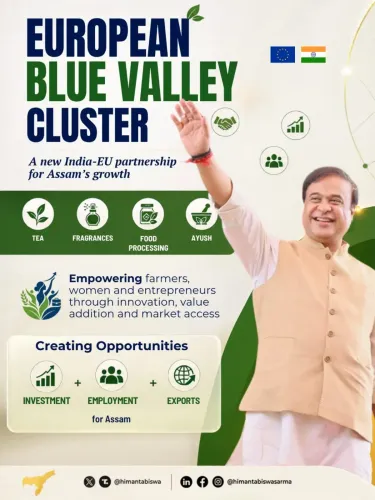
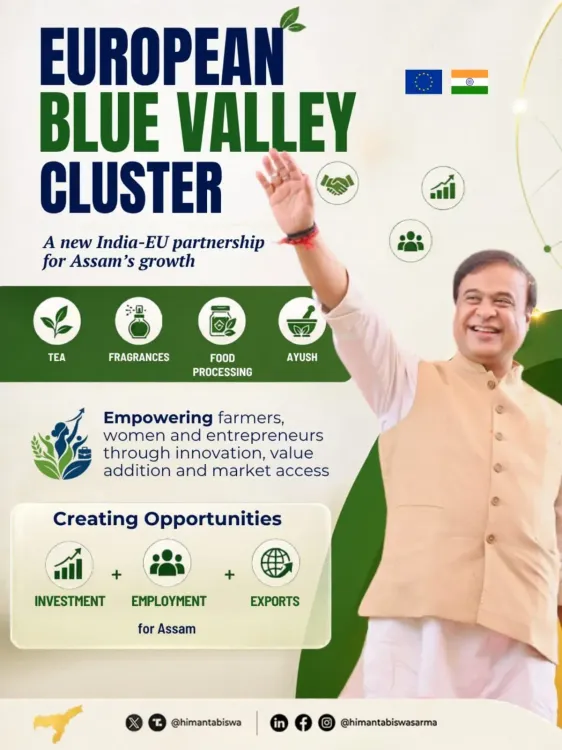
Assam Chief Minister Himanta Biswa Sarma has announced that a European Union delegation will visit Assam from 8 June 2026 to advance the European Blue Valley Cluster initiative, connecting Assam and EU industries into a single bio-based value creation system across multiple sectors.
Key Takeaways
An EU delegation begins its visit to Assam on 8 June 2026 , announced by CM Himanta Biswa Sarma .
The visit is centred on the European Blue Valley Cluster initiative , aimed at bio-based value creation.
The initiative will link complementary industrial capabilities across Assam and EU member states into a single system.
The move aligns with India's Act East Policy and the EU's Green Deal objectives for sustainable supply chains.
Sectors expected to benefit include agriculture, bio-energy, forestry and allied processing industries in Assam.
Follow-up announcements on MoUs and pilot projects are anticipated after the delegation's visit concludes.
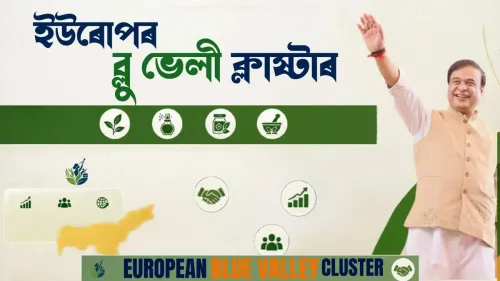
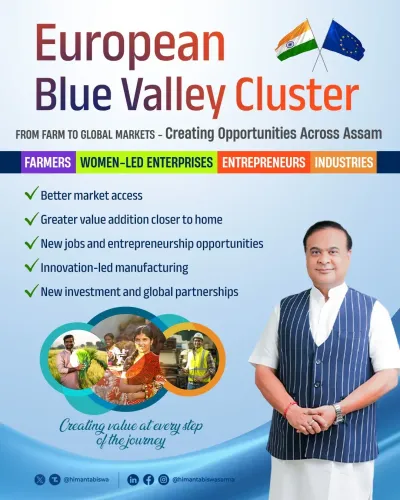
Assam Chief Minister Himanta Biswa Sarma announced on Sunday, 7 June 2026 that a European Union delegation would begin its visit to Assam the following day, marking what he described as 'the beginning of a new era in pancontinental industrial ecosystem.' The visit is centred on the European Blue Valley Cluster initiative, which aims to link complementary industrial capabilities across Assam and EU member states into a unified system for bio-based value creation.
Context
In his post, CM Sarma stated that through the European Blue Valley Cluster initiative, 'complementary industrial capabilities across Assam and EU will be connected into a single system for bio-based value creation in various sectors.' The announcement signals a deliberate effort by the Assam government to attract high-quality foreign engagement focused on sustainable industries rather than conventional manufacturing alone. The delegation visit, beginning Monday, 8 June 2026, is framed as a structural milestone rather than a ceremonial exchange.
Policy Backdrop
The visit sits within the framework of India's Act East Policy, upgraded in 2014, which has consistently encouraged northeastern states to forge economic linkages with international partners. Assam, with its rich biodiversity and agricultural base, has long been positioned as a natural candidate for bio-economy partnerships. The European Union, meanwhile, has been advancing its own Green Deal objectives, which include building sustainable supply chains with partner countries — making a bio-based collaboration with a northeastern Indian state strategically coherent for both sides.
Northeastern India has historically lagged in attracting foreign direct investment compared to western and southern states, but successive central government policies have sought to change that by designating the region as a gateway for green and knowledge-economy sectors. CM Sarma, as convenor of the North-East Democratic Alliance (NEDA), has been an active proponent of elevating the region's economic profile through both domestic and international partnerships.
Stakeholders and Impact
The primary beneficiaries of a deepened Assam–EU industrial linkage would be local industries in bio-based sectors — spanning agriculture, forestry, bio-energy, and allied processing industries — alongside EU investors seeking sustainable raw-material supply chains. Small and medium enterprises in Assam could gain access to European technology, standards, and markets if the cluster framework translates into operational pilot projects. For the EU, Assam's biodiversity-rich landscape offers a viable sourcing and co-production base aligned with its sustainability mandates.
Broader stakeholders include the central government, which has a strategic interest in demonstrating that its northeastern development push is attracting credible international partners, and communities in Assam whose livelihoods are tied to the agricultural and forest-product sectors that bio-based industries would draw upon.
What's Next
Attention will now turn to any memoranda of understanding, letters of intent, or pilot-project announcements that emerge from the delegation's visit beginning 8 June 2026. The operationalisation of the European Blue Valley Cluster initiative in Assam will depend on the specific sectors identified, the investment commitments made, and the regulatory facilitation the state government extends to incoming EU partners. A successful outcome could set a replicable template for other northeastern states seeking similar bio-economy partnerships with international blocs.
Point of View
Framing the engagement as a 'pancontinental industrial ecosystem' serves both an economic and a political purpose — demonstrating that northeastern India is drawing serious international attention under his stewardship. The European Blue Valley Cluster model, if it delivers operational linkages, could give Assam a differentiated identity within India's foreign investment landscape at a time when green and bio-based industries are attracting premium global capital. The real test, however, will be in the concrete commitments that follow the delegation's visit, as high-profile international announcements in the northeast have not always translated into ground-level investment at scale.
NationPress
22 Oct 2026
Frequently Asked Questions
What is the European Blue Valley Cluster initiative in Assam?
The European Blue Valley Cluster initiative is a framework announced by Assam CM Himanta Biswa Sarma that aims to connect complementary industrial capabilities across Assam and European Union member states into a single system for bio-based value creation across multiple sectors.
When is the EU delegation visiting Assam in 2026?
The EU delegation is scheduled to begin its visit to Assam on Monday, 8 June 2026, as announced by Chief Minister Himanta Biswa Sarma on 7 June 2026.
What is bio-based value creation and why is it relevant to Assam?
Bio-based value creation refers to industrial and economic activity derived from biological resources such as crops, forests, and organic waste. Assam's rich biodiversity and agricultural base make it a natural fit for such industries, which also align with global sustainability goals.
How does this EU visit relate to India's Act East Policy?
India's Act East Policy, upgraded in 2014, encourages northeastern states like Assam to build economic linkages with international partners. The EU delegation visit and the Blue Valley Cluster initiative are consistent with this policy by bringing a major international bloc into partnership with Assam's industrial ecosystem.
What should we watch for after the EU delegation's Assam visit?
Key developments to watch include any memoranda of understanding, letters of intent, or pilot-project announcements in bio-based manufacturing sectors that may be signed or disclosed during or after the delegation's visit to Assam.