CM Himanta's Assam Joins European Blue Valley Cluster
Synopsis
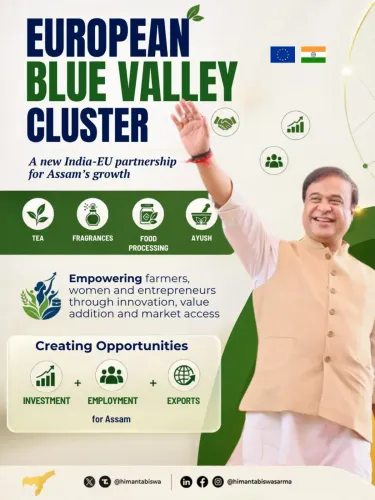
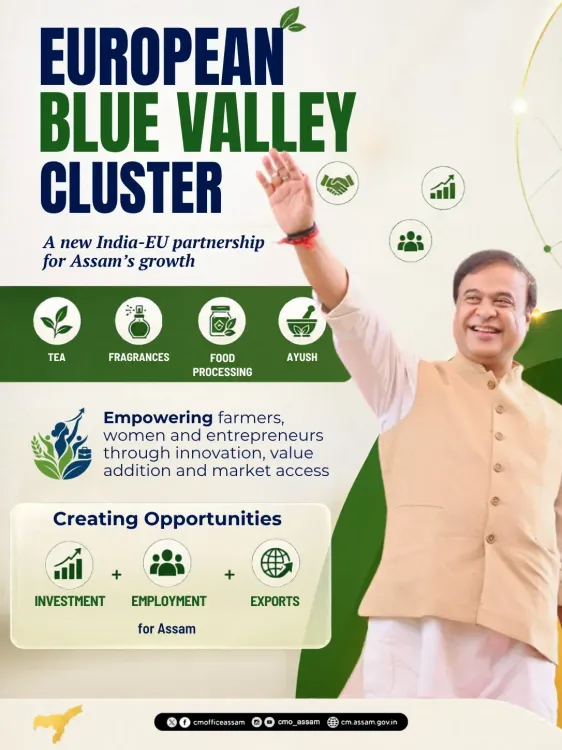
Assam's Chief Minister's Office announced on June 2, 2026, that the state is joining the European Blue Valley Cluster initiative — an Advantage Assam 2 outcome — under CM Himanta Biswa Sarma, aimed at driving innovation, entrepreneurship, and livelihood creation across the state.
Key Takeaways
The Chief Minister's Office of Assam announced the state's participation in the European Blue Valley Cluster initiative on June 2, 2026 .
The collaboration is described as a direct outcome of the Advantage Assam 2 global investors summit.
The initiative is positioned to promote innovation, entrepreneurship, and value addition in Assam's economy.
Key beneficiaries are expected to include entrepreneurs, MSMEs , and the youth workforce.
No specific investment figures, named European partners, or project timelines have been disclosed publicly.
The move aligns with India's broader Act East Policy framework encouraging international economic linkages for Northeast states.
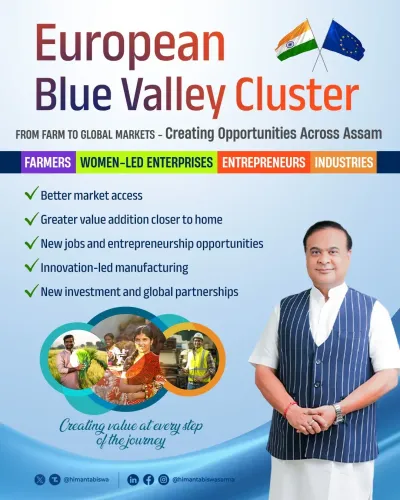
The Chief Minister's Office of Assam announced on Tuesday, June 2, 2026, that the state is entering a new international collaboration through the European Blue Valley Cluster initiative, citing it as an outcome of the Advantage Assam 2 investors summit. The partnership, under the leadership of Chief Minister Dr. Himanta Biswa Sarma, is positioned to drive innovation, entrepreneurship, and value addition across the state's economy.
Context
The Chief Minister's Office described the development as the start of 'a new growth story' for Assam, framing the European Blue Valley Cluster tie-up as a direct product of the state's sustained global outreach. The post states the collaboration will create 'new opportunities for growth and livelihoods,' signalling an intent to channel international expertise into the state's economic fabric. No specific investment figures or participating European entities were named in the announcement.
Policy Backdrop
The Advantage Assam investors summit was first held in February 2018 to project the state as a destination for domestic and foreign capital, spanning sectors from manufacturing to services. The second edition, Advantage Assam 2, has been the Sarma government's flagship platform for securing fresh global commitments, continuing that investment-attraction strategy. Assam has increasingly sought international technology and cluster partnerships under its current leadership, aiming to diversify an economy historically anchored in tea, petroleum, and agriculture.
Northeast India more broadly has seen intensified economic outreach as part of India's Act East Policy, which encourages cross-border and international economic linkages for the region. State-level investor summits and bilateral economic agreements have become a common instrument across Indian states to supplement central manufacturing and startup schemes. Assam's European cluster initiative fits within this wider pattern of sub-national diplomacy aimed at attracting technology-led growth.
Stakeholders and Impact
The initiative is expected to benefit entrepreneurs, micro, small and medium enterprises (MSMEs), and the youth workforce in Assam, according to the state government's framing. Cluster-based models typically bring together producers, suppliers, research institutions, and policymakers to build competitive industries around shared infrastructure and knowledge. If implemented at scale, such a partnership could introduce European innovation practices into Assam's emerging industrial and startup ecosystem.
Value addition — converting raw agricultural and natural resources into higher-margin processed goods — has been a stated priority for the Sarma administration, and the European Blue Valley Cluster framework is being presented as a vehicle to accelerate that transition. The livelihoods angle suggests the government anticipates job creation across both skilled and semi-skilled categories, though specific employment projections have not been disclosed.
What's Next
Observers will watch for official documentation detailing the specific projects, named European partner entities, investment commitments, and timelines attached to the European Blue Valley Cluster collaboration. Implementation milestones and any formal memoranda of understanding are yet to be made public. The depth of the partnership's impact will ultimately depend on how quickly institutional structures are established on both the Assam and European sides.
Point of View
The absence of named European counterparts, specific investment figures, or binding timelines means the announcement remains, for now, an expression of intent rather than a deliverable. The real test will be whether the cluster model produces measurable industrial activity within a credible horizon — a benchmark that previous summit outcomes have not always met transparently.
NationPress
19 Sept 2026
Frequently Asked Questions
What is the European Blue Valley Cluster initiative in Assam?
The European Blue Valley Cluster is an international collaboration that the Assam government has announced as an outcome of the Advantage Assam 2 investors summit. It is intended to promote innovation, entrepreneurship, and value addition in Assam's economy, though specific partner entities and project details have not yet been made public.
What is Advantage Assam 2?
Advantage Assam 2 is the second edition of Assam's global investors summit, organised under Chief Minister Himanta Biswa Sarma's leadership to attract domestic and foreign investment. The first edition was held in February 2018, and the second edition continued that outreach to secure fresh international economic commitments.
How will the European Blue Valley Cluster benefit Assam's people?
The state government has stated the collaboration will create new opportunities for growth and livelihoods, with entrepreneurs, MSMEs, and the youth workforce identified as primary beneficiaries. Specific employment or investment figures have not been disclosed.
What is Assam's Act East Policy connection?
Northeast Indian states, including Assam, have been encouraged under India's Act East Policy to develop cross-border and international economic linkages. Assam's European cluster partnership fits within this broader national framework for integrating the Northeast into global value chains.
Who is Chief Minister Himanta Biswa Sarma?
Dr. Himanta Biswa Sarma has served as Chief Minister of Assam since May 2021. He is a senior BJP leader who has prioritised industrialisation, foreign investment outreach, and infrastructure development as pillars of the state's economic strategy.