Assam CMO Announces European Blue Valley Cluster With EU Tie-Up

Synopsis
The Chief Minister's Office of Assam has announced a European Blue Valley Cluster Initiative in partnership with the European Union, marking a new state-level economic engagement with the 27-nation bloc and a fresh push to attract foreign capital into Assam's diversifying industrial base.
Key Takeaways
Assam will launch a European Blue Valley Cluster Initiative in partnership with the European Union.
The announcement came via the official Chief Minister's Office of Assam handle on 3 June 2026.
The project builds on the Assam Industrial and Investment Policy 2020's cluster-led approach.
It reflects a wider trend of Indian states pursuing direct economic diplomacy with the EU.
Sectoral focus, funding mechanism and timeline are expected at the formal launch.
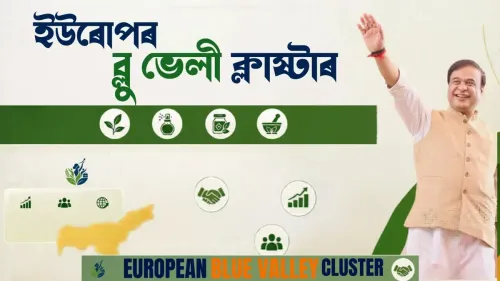
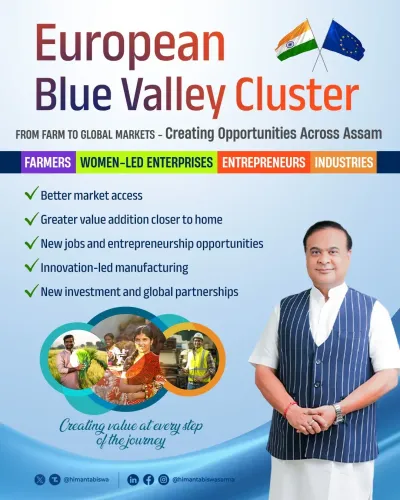
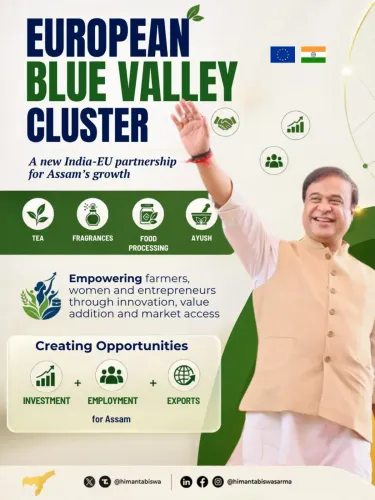
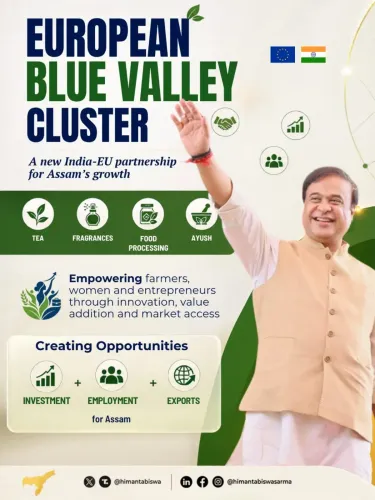
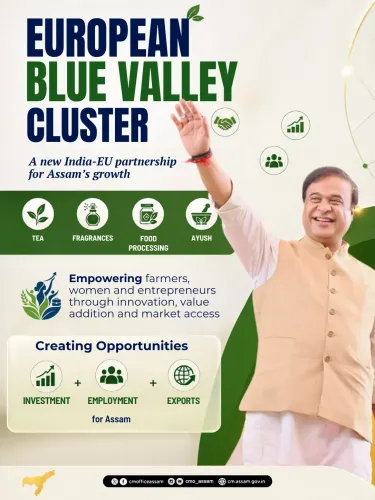
The Chief Minister's Office of Assam on Wednesday, 3 June 2026, announced that the state will launch a European Blue Valley Cluster Initiative in partnership with the European Union, signalling a fresh push to draw European capital and expertise into the Northeast's industrial base. The announcement was made via the official handle of the Government of Assam's top office in Dispur, accompanied by a visual and a link to a detailed write-up.
The post, headlined 'Assam To Launch European Blue Valley Cluster Initiative With EU Partnership', frames the project as a structured cluster-led collaboration with the 27-nation bloc. While the post itself is brief, it positions the initiative as a flagship engagement between a single Indian state and the EU.
Context
The cluster announcement comes as Assam, under Chief Minister Himanta Biswa Sarma, continues to court foreign investors to diversify the state economy beyond its legacy strengths in tea, petroleum and natural gas. Sarma, who has led the state since May 2021, has repeatedly pitched Assam as the gateway to Southeast Asia and a logistics anchor for the Northeast.
The 'Blue Valley' branding suggests an emphasis on sustainability or water-linked industries, though the post does not specify the sectoral focus. Further detail on the cluster's anchor sectors, geographic footprint within Assam, and the EU's mode of participation is expected to follow in subsequent communications from the state government.
Policy backdrop
The initiative builds on the Assam Industrial and Investment Policy 2020 and its subsequent amendments, which prioritised sector-specific clusters and offered incentives for manufacturing and services investors. Cluster-based industrialisation has emerged as a preferred model for Northeast states seeking to overcome scale and connectivity constraints by concentrating ancillary infrastructure, skilling and logistics in defined zones.
At the national level, India and the European Union have deepened cooperation across trade, green technology, digital infrastructure and research, with the EU-India Trade and Technology Council providing one umbrella for state-level partnerships. Indian states have increasingly pursued direct economic diplomacy with Brussels-based institutions and member states, alongside central agreements.
Stakeholders and impact
The primary stakeholders flagged by the Assam government's broader investment pitch include local entrepreneurs, EU investors and Assam's youth, who stand to benefit from technology transfer, jobs and supply-chain integration. For European firms, a cluster in Assam offers a foothold in a region that connects to Bangladesh, Bhutan and the wider Bay of Bengal economic geography.
For Dispur, the partnership is both an economic instrument and a diplomatic signal: it underscores Assam's intent to be measured against investment-heavy peers like Gujarat, Tamil Nadu and Karnataka in attracting marquee foreign collaborations. Success will depend on regulatory clarity, land availability and the quality of single-window clearances on the ground.
What's next
Attention will turn to the formal launch event, where the Chief Minister's Office is expected to outline the cluster's anchor sectors, funding mechanism, governance structure and timeline. Watchers will also look for any follow-up at upcoming EU-India bilateral meetings, where state-level initiatives are increasingly showcased alongside central agreements.
If the cluster materialises with concrete European anchor investors, it could become a template for other Northeast states seeking to convert geographic positioning into industrial scale — and a measurable test of Assam's ambition to be the region's preferred investment destination.
Point of View
Using cluster models to package land, incentives and skilling for foreign investors. For Assam, a visible EU partnership helps reposition the state from a resource-extraction economy toward a value-added industrial destination. The political signal is equally important: Himanta Biswa Sarma's government wants Assam benchmarked against India's top investment-magnet states, not just its Northeast peers. The real test will be conversion — whether the cluster attracts anchor European firms with concrete capex.
NationPress
18 Oct 2026
Frequently Asked Questions
What is the European Blue Valley Cluster Initiative in Assam?
It is a new industrial cluster initiative announced by the Government of Assam in partnership with the European Union. The Chief Minister's Office said the project will be launched in collaboration with the EU, though sectoral and funding details are awaited.
Who announced the Assam-EU Blue Valley Cluster partnership?
The official Chief Minister's Office of Assam announced the initiative on 3 June 2026 via its X handle, linking to a detailed write-up on the project.
Why is Assam partnering with the European Union for industrial development?
Assam is seeking to diversify beyond tea, oil and gas by attracting foreign capital and technology. An EU partnership offers access to investors, sustainability expertise and integration with global value chains.
How does this fit with Assam's existing industrial policy?
The initiative aligns with the Assam Industrial and Investment Policy 2020, which prioritised sector-specific clusters and incentives for manufacturers and service providers.
What happens next with the Blue Valley Cluster project?
The state government is expected to share the cluster's anchor sectors, governance structure, funding mechanism and timeline at a formal launch, with possible follow-up at EU-India bilateral engagements.