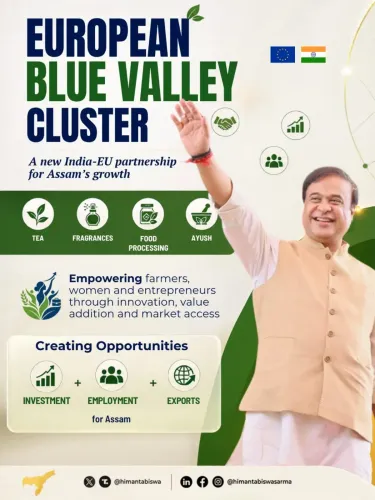
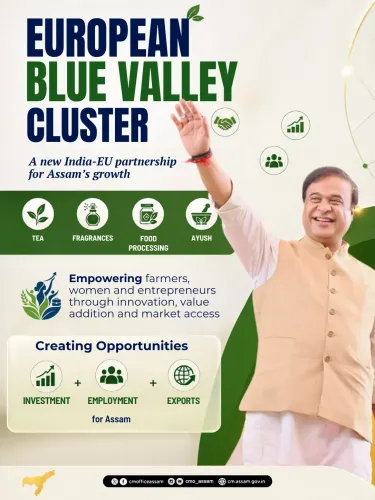
CM Himanta Launches Blue Valley Cluster, Eyes EU Farm Trade
Synopsis
Assam Chief Minister Himanta Biswa Sarma has championed the newly launched Blue Valley Cluster as a transformative India-EU cooperation platform, promising European agri-processing investment for local farmers and placing Assam on the global trade map.
Key Takeaways
Blue Valley Cluster launched in Assam as part of an India-EU agricultural cooperation initiative.
CM Himanta Biswa Sarma says the cluster opens 'immense avenues' for European companies to process Assam-grown products .
Initiative is designed to directly benefit local farmers by connecting them to European processing and market networks.
Assam has been expanding agri-processing infrastructure since 2021 under the PMFME scheme and a state agri-export policy.
India-EU BTIA negotiations, resumed in 2022 , provide the broader trade framework within which the cluster operates.
The cluster signals a strategic shift for Northeast India from raw-material supply to value-added agricultural exports.
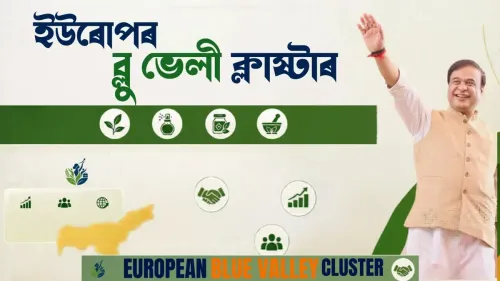
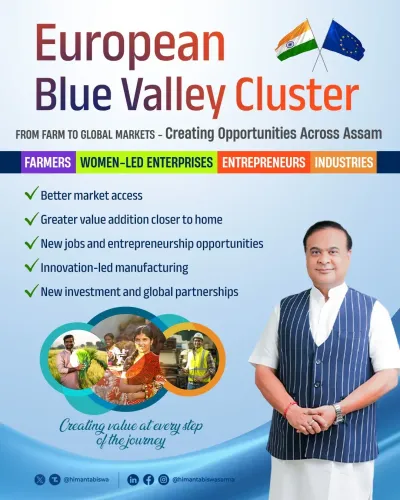
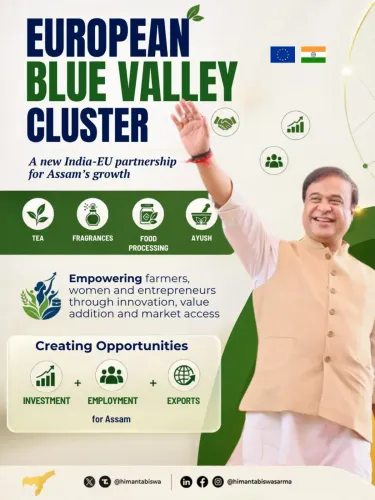
The Chief Minister's Office of Assam announced on Tuesday, 9 June 2026 that Chief Minister Dr. Himanta Biswa Sarma has underscored the significance of the newly launched Blue Valley Cluster, describing the India-EU cooperation initiative as a landmark step that will directly benefit Assam's farming communities and position the state on the global trade map.
Context
Speaking after the cluster's launch, CM Himanta Biswa Sarma highlighted that the Blue Valley Cluster opens 'immense avenues for European companies to process state-grown products.' The initiative is framed as a direct link between Assam's agricultural output — spanning tea, spices, fruits and vegetables — and European processing and market networks. The Chief Minister's Office stated that the cooperation 'successfully positions Assam on the global trade map.'
Policy Backdrop
Assam has been building agri-processing infrastructure since 2021, with food-processing clusters rolled out under the Pradhan Mantri Formalisation of Micro Food Processing Enterprises (PMFME) scheme alongside a dedicated state agri-export policy. The Blue Valley Cluster appears to extend this strategy by drawing in European capital and processing expertise, rather than limiting the state to raw-material supply chains.
At the national level, India and the European Union resumed negotiations on a Broad-based Trade and Investment Agreement (BTIA) in 2022 after nearly a decade-long pause since 2013. A key pillar of those talks involves sustainable agricultural value chains and market access for Indian produce — precisely the space the Blue Valley Cluster is designed to occupy.
Stakeholders and Impact
Local farmers are the stated primary beneficiaries. By attracting European agri-processing companies to operate within Assam, the cluster model is intended to create demand for farm produce at higher value-added price points, reducing dependence on low-margin raw exports. Agri-processing units within the cluster stand to gain technology transfers, investment and access to European distribution networks.
The Northeast India region has long sought to convert its agricultural abundance into export earnings. Initiatives like this cluster signal a shift from commodity supply toward processed-goods trade, a transition that analysts have identified as critical to raising rural incomes across the region.
What's Next
Attention will now turn to the scale of European investor commitments within the Blue Valley Cluster and the specific product categories — processed teas, spice extracts, fruit pulps — earmarked for EU markets. Any forward movement in the India-EU BTIA talks on tariff lines for processed foods could significantly amplify the cluster's commercial viability. CM Himanta Biswa Sarma's emphasis on this initiative suggests Assam intends to use the cluster as a showcase for Northeast India's export-readiness, potentially attracting further bilateral investment beyond the EU.
Point of View
Assam is trying to leapfrog the commodity-export trap that has historically limited Northeast India's agricultural earnings. The move also serves a political purpose: demonstrating that international diplomacy at the Centre translates into farm-level gains in a state where agriculture remains the dominant livelihood. If European commitments materialise at scale, Assam could emerge as a template for how Indian states leverage bilateral trade talks to attract sector-specific foreign investment.
NationPress
24 Oct 2026
Frequently Asked Questions
What is the Blue Valley Cluster in Assam?
The Blue Valley Cluster is a newly launched agri-processing initiative in Assam built around India-EU cooperation, designed to attract European companies to process state-grown agricultural products and connect local farmers to global markets.
How will the Blue Valley Cluster benefit Assam farmers?
By bringing European agri-processing firms into Assam, the cluster aims to create demand for farm produce at higher value-added prices, reducing farmers' dependence on low-margin raw exports and improving rural incomes.
What is India's trade agreement with the EU?
India and the EU are negotiating a Broad-based Trade and Investment Agreement (BTIA). Talks resumed in 2022 after a hiatus since 2013, with sustainable agricultural value chains and market access for Indian produce as key agenda items.
What crops does Assam export?
Assam's major agricultural exports include tea, spices, fruits and vegetables. The state has been developing food-processing clusters since 2021 to move from raw-material supply to value-added exports.
What schemes support agri-processing clusters in Assam?
The central government's PMFME (Pradhan Mantri Formalisation of Micro Food Processing Enterprises) scheme and Assam's own state agri-export policy, both active since 2021, have been the primary policy instruments supporting cluster development in the state.