CM Himanta Eyes EU Markets via Blue Valley Cluster
Synopsis
Assam Chief Minister Himanta Biswa Sarma has positioned the European Blue Valley Cluster as the state's gateway to EU markets, pledging that farmers, SHGs, entrepreneurs and FPOs will drive the transformation as India-EU trade collaboration deepens under PM Modi's leadership.
Key Takeaways
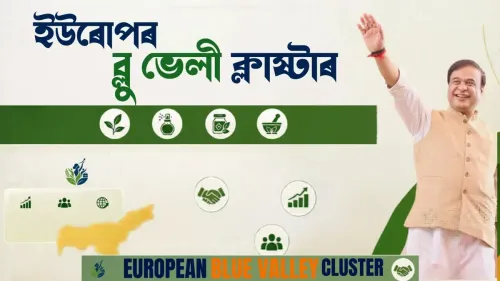
CM Himanta Biswa Sarma announced on 11 June 2026 that the European Blue Valley Cluster will be Assam's gateway to global markets.
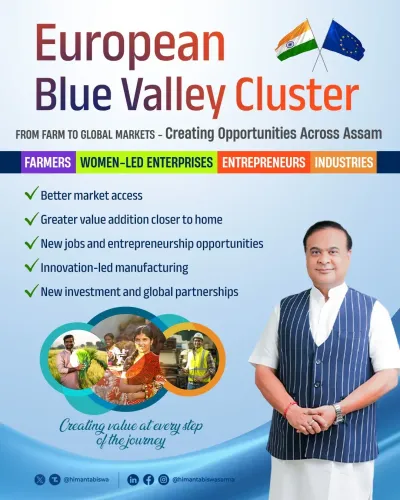
Farmers, SHGs, entrepreneurs and FPOs are named as the primary drivers of the initiative.
The cluster is framed within deepening India-EU collaboration under PM Narendra Modi .
India-EU Broad-Based Trade and Investment Agreement negotiations resumed in 2022 , raising the importance of state-level export readiness.
Assam has been building FPO and value-chain infrastructure under central schemes since 2018 , targeting tea, horticulture and bamboo exports.
The initiative aligns with India's Act East policy of integrating northeastern states into global agricultural value chains.
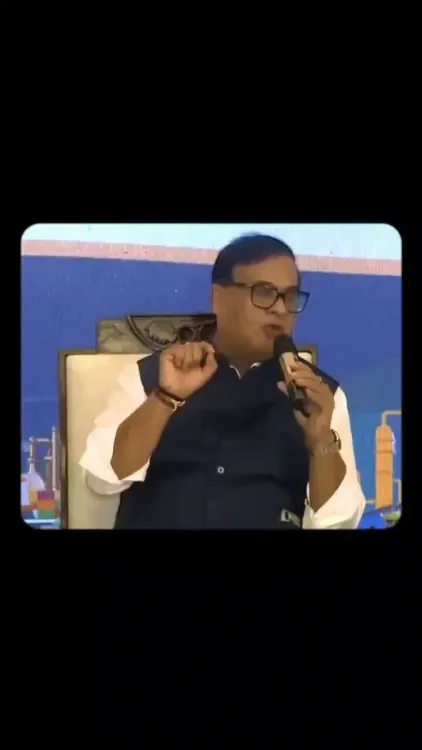
Assam Chief Minister Himanta Biswa Sarma on Thursday, 11 June 2026, declared the European Blue Valley Cluster will serve as Assam's gateway to global markets, framing the initiative as a direct outcome of deepening India-EU collaboration under Prime Minister Narendra Modi.
Context
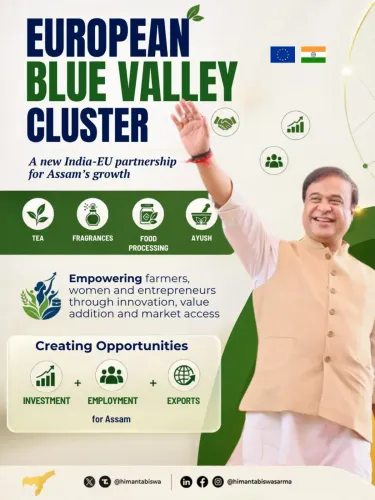
In his post, CM Sarma stated that farmers, Self-Help Groups (SHGs), entrepreneurs and Farmer Producer Organisations (FPOs) will be the 'driving force behind this transformation, taking Assam's products, stories and strengths to new global markets.' The statement positions Assam as an active participant in India's export diversification push toward the European Union, rather than a peripheral beneficiary.
The European Blue Valley Cluster is presented as a structural bridge between Assam's grassroots economic actors and international trade corridors. The cluster's framing around SHGs and FPOs signals a focus on agricultural and artisanal value chains rather than large industrial investment.
Policy Backdrop
The announcement sits within a long arc of India-EU engagement. The India-EU Strategic Partnership Joint Action Plan of 2005 and successive summits laid the groundwork for deeper trade and technology cooperation. Negotiations for the India-EU Broad-Based Trade and Investment Agreement resumed in 2022 after a prolonged pause, raising the stakes for state-level export initiatives.
Assam has promoted FPOs and value-chain clusters under central government schemes since 2018, targeting agri-exports across sectors including tea, horticulture and bamboo products. CM Sarma's framing connects this state-level groundwork directly to the bilateral trade talks being stewarded at the national level by PM Modi.
India's broader Act East policy has consistently sought to integrate northeastern states into global agricultural value chains, and the Blue Valley Cluster appears to be the latest institutional expression of that strategic intent for Assam.
Stakeholders and Impact
Assam's farming community, SHG members — a large proportion of whom are women in rural areas — entrepreneurs and FPO-affiliated producers stand to be the primary beneficiaries if the cluster delivers on its stated mandate. Access to EU markets would represent a significant upgrade in export opportunity, given the bloc's high purchasing power and premium appetite for organic and specialty products.
For FPOs in particular, a structured cluster mechanism could lower the compliance and logistics barriers that have historically kept small producer collectives out of European supply chains. The emphasis on 'products, stories and strengths' also suggests a branding and geographical-indication dimension to the initiative.
What's Next
Observers will watch for a formal rollout or funding announcement for the European Blue Valley Cluster, as well as the next India-EU Trade and Technology Council meeting, which could provide an intergovernmental platform for the initiative to be formally tabled. Whether the cluster secures a dedicated budget line in Assam's state plan or draws on central government export-promotion schemes will determine the pace of implementation.
If the cluster moves from declaration to operational status, it could serve as a replicable model for other northeastern states seeking to plug into EU-facing value chains — extending the Act East framework's commercial reach well beyond Assam's borders.
Point of View
Lending the initiative political weight beyond a routine state announcement. By foregrounding SHGs and FPOs rather than large industry, he signals that the political dividend of EU market access is intended to reach rural and women-led collectives — a messaging choice with clear electoral resonance. The move also reflects a broader BJP-governed state pattern of aligning local economic initiatives with PM Modi's bilateral diplomacy, reinforcing the Centre-state coordination story. Whether the cluster translates into verifiable export flows will be the real test of this ambition.
NationPress
26 Oct 2026
Frequently Asked Questions
What is the European Blue Valley Cluster in Assam?
The European Blue Valley Cluster is an initiative announced by Assam Chief Minister Himanta Biswa Sarma to connect Assam's farmers, SHGs, entrepreneurs and FPOs to European Union markets. Specific operational details and a formal launch timeline have not yet been publicly confirmed.
How does the Blue Valley Cluster relate to India-EU trade talks?
CM Sarma has framed the cluster as part of deepening India-EU collaboration under PM Modi. India and the EU resumed negotiations on a Broad-Based Trade and Investment Agreement in 2022, and the cluster appears designed to position Assam's producers to benefit from any resulting market access.
Who will benefit from Assam's EU export cluster?
Farmers, Self-Help Group members, entrepreneurs and Farmer Producer Organisations in Assam are identified as the primary beneficiaries, with the initiative aimed at taking Assam's agricultural and artisanal products to global markets.
What is India's Act East policy and how does Assam fit in?
India's Act East policy seeks to integrate northeastern states into regional and global economic networks. Assam, with its tea, horticulture and bamboo sectors, has been a focal point for agri-export promotion under this framework, and the Blue Valley Cluster extends that logic toward EU markets.
What role do FPOs play in Assam's export strategy?
Farmer Producer Organisations are government-promoted collectives that aggregate small farmers to improve market access and bargaining power. Assam has been building FPO capacity since 2018 under central schemes, and the Blue Valley Cluster is intended to channel their output into international value chains.