CM Himanta Leads Assam Into EU Blue Valley Cluster Tie-Up
Synopsis
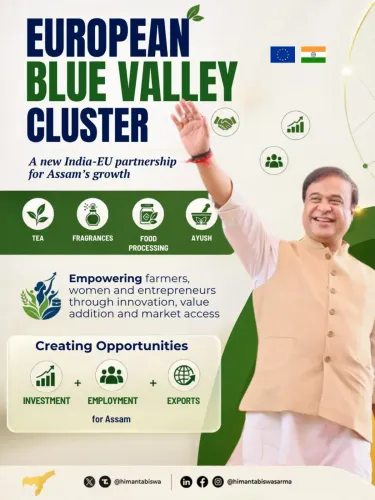
An EU delegation visited Assam on 7 June 2026 under CM Himanta Biswa Sarma's leadership, launching collaboration through the European Blue Valley Cluster to drive bio-based innovation and sustainability in the northeastern state.
Key Takeaways
The Chief Minister's Office of Assam announced an EU delegation visit on 7 June 2026 .
Himanta Biswa Sarma is leading Assam's push to strengthen global partnerships.
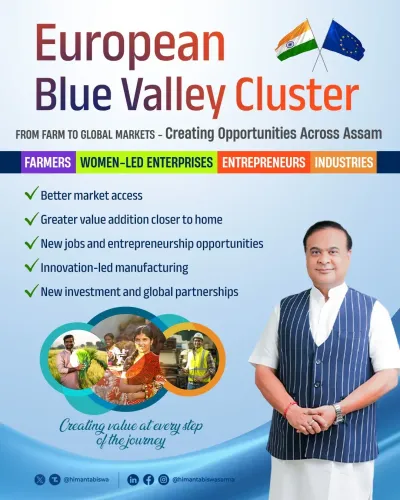
The European Blue Valley Cluster initiative will focus on connecting industrial strengths, innovation, sustainability and bio-based value creation.
The visit aligns with India's Act East Policy and the national India-EU Trade and Technology Council framework.
Primary beneficiaries include bio-based industries and MSME entrepreneurs in Assam.
Formal MOUs and pilot projects under the Blue Valley Cluster are expected to be the next milestones in 2026–27 .
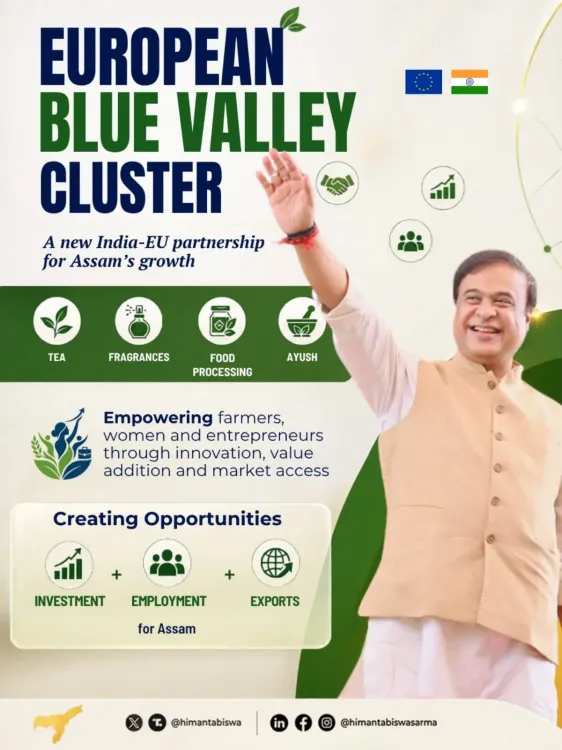
The Chief Minister's Office of Assam announced on Sunday, 7 June 2026 that an European Union delegation has visited the state under the leadership of Chief Minister Dr. Himanta Biswa Sarma, marking the launch of a new phase of Assam–EU collaboration centred on the European Blue Valley Cluster initiative.
Context
The CMO's post stated that the EU delegation's visit 'marks the beginning of a new chapter in Assam–EU collaboration, with the European Blue Valley Cluster initiative set to connect industrial strengths and drive innovation, sustainability and bio-based value creation.' The visit signals a broadening of Assam's international engagement beyond traditional South and Southeast Asian partners to include structured European industrial networks.
The European Blue Valley Cluster is a European initiative focused on linking bio-based industries, green innovation hubs and sustainable value chains. Its proposed connection with Assam would leverage the state's considerable natural assets — including its biodiversity, bamboo resources, tea sector and emerging biotechnology base — to plug into European supply-chain and research networks.
Policy Backdrop
The visit fits squarely within India's Act East Policy, upgraded in 2014, which has encouraged northeastern states to pursue connectivity, trade and investment linkages with foreign partners. Assam has hosted several foreign business delegations under this framework, progressively targeting value-added and sustainability-focused sectors.
At the national level, the India-EU Trade and Technology Council has created an institutional channel for cooperation on green economy and technology. State-level engagements such as this EU delegation visit complement that central framework by identifying specific sectoral and geographic opportunities — in this case, Assam's bio-based industries and its MSME entrepreneurial base.
CM Himanta Biswa Sarma, who has been in office since May 2021, has positioned international investment outreach as a pillar of the state's economic strategy, hosting delegations and signing agreements across infrastructure, healthcare and now green industries.
Stakeholders and Impact
The primary beneficiaries of a deepened Assam–EU partnership under the Blue Valley Cluster framework would be bio-based industries and MSME entrepreneurs in the state. Access to European innovation networks, sustainability standards and capital could help local businesses scale and integrate into global green value chains.
Broader stakeholders include Assam's farming and bamboo-cultivation communities, whose raw materials underpin bio-based manufacturing, as well as research institutions that could benefit from technology transfer and joint projects with European counterparts. The initiative also carries implications for the state's environmental governance, as bio-based value creation typically requires adherence to internationally recognised sustainability benchmarks.
What's Next
The immediate focus will be on whether the delegation visit translates into formal memoranda of understanding or pilot projects under the Blue Valley Cluster framework. Follow-up visits by EU member-state trade bodies and the identification of specific sectors — bamboo processing, tea-based biotechnology, or bio-packaging, for instance — will be closely watched through 2026–27.
If formalised, the partnership could position Assam as a model for how India's northeastern states leverage biodiversity assets to attract European capital at a time of global supply-chain diversification. The trajectory of this engagement will depend on the pace of institutional follow-through on both sides.
Point of View
Where states are increasingly acting as independent nodes in global sustainability and bio-economy networks. For CM Himanta Biswa Sarma, the engagement serves a dual purpose: economic diversification away from traditional sectors and a projection of governance credibility on the international stage. The Blue Valley Cluster link is particularly significant because it frames Assam not merely as a recipient of foreign investment but as a contributor of biodiversity and bio-based resources to European industrial value chains. Whether this visit produces durable institutional outcomes or remains a high-profile gesture will be the real test of Assam's subnational diplomacy ambitions.
NationPress
13 Sept 2026
Frequently Asked Questions
What is the European Blue Valley Cluster initiative?
The European Blue Valley Cluster is a European initiative that connects bio-based industries, green innovation hubs and sustainable value chains. Its proposed engagement with Assam aims to link the state's biodiversity and natural resources with European industrial networks to drive innovation and sustainability.
Why did the EU delegation visit Assam in June 2026?
The EU delegation visited Assam on 7 June 2026 to begin a new phase of Assam–EU collaboration, specifically to explore how the European Blue Valley Cluster initiative can connect Assam's industrial strengths with European partners in bio-based and sustainable sectors.
What is CM Himanta Biswa Sarma's role in Assam's international outreach?
Chief Minister Dr. Himanta Biswa Sarma, in office since May 2021, has made international investment outreach a key part of Assam's economic strategy, hosting foreign delegations and pursuing partnerships across infrastructure, healthcare and green industries.
How does this EU visit relate to India's Act East Policy?
India's Act East Policy, upgraded in 2014, encourages northeastern states like Assam to build trade, connectivity and investment ties with foreign partners. The EU delegation visit and the Blue Valley Cluster collaboration are direct expressions of this policy framework at the state level.
Who benefits from the Assam–EU Blue Valley Cluster partnership?
The primary beneficiaries are bio-based industries and MSME entrepreneurs in Assam, along with farming and bamboo-cultivation communities whose raw materials underpin bio-based manufacturing. Research institutions may also gain from technology transfer and joint projects with European counterparts.