EU delegation visits Assam on June 8-9 to launch Blue Valleys cluster initiative
Synopsis
The EU is not just sending diplomats to Guwahati — it is planting an industrial flag. The launch of Assam's first Blue Valley Cluster on June 9 represents the first tangible on-ground output of the 2026 EU-India Summit's Comprehensive Strategic Agenda, turning a headline agreement into a live 4P industrial hub connecting Europe, North-East India, and Bhutan.
Key Takeaways
A high-level EU Team Europe delegation will visit Guwahati, Assam on 8-9 June for bilateral talks and the Blue Valleys workshop.
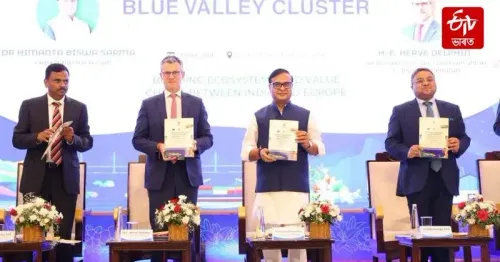
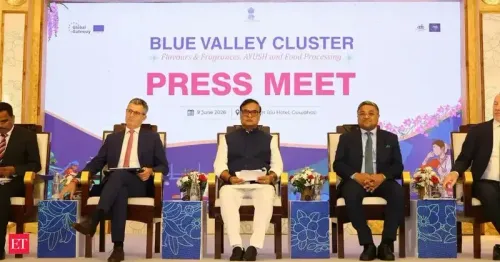
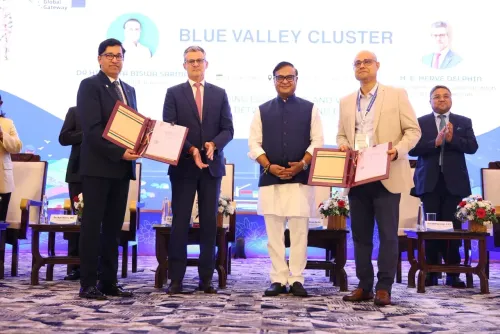
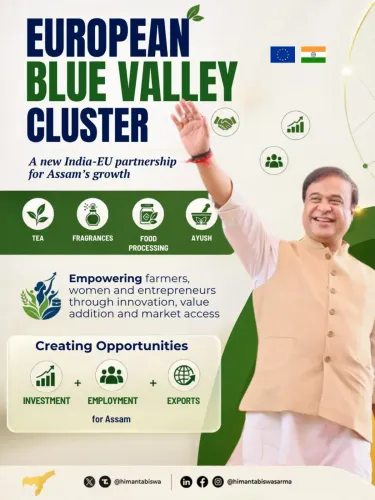
Assam's first Blue Valley Cluster — focused on fragrances, flavours, AYUSH, and food processing — will be formally launched on 9 June .
The delegation is led by EU Ambassador Hervé Delphin and includes FEBI business representatives who will meet with state officials.
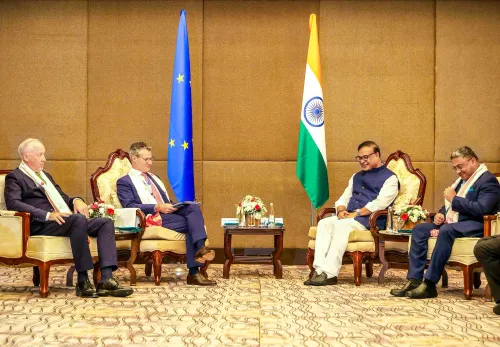
Assam CM Himanta Biswa Sarma will hold bilateral talks with the European delegation during the visit.
The delegation will also tour Tata Electronics' new semiconductor plant, underscoring the EU's interest in India's chip manufacturing sector.
The initiative covers 8 North-Eastern states and is aligned with the Comprehensive Strategic Agenda agreed at the 2026 EU-India Summit .
A high-level Team Europe delegation of the European Union (EU) will arrive in Guwahati, Assam on 8 June for a two-day visit aimed at deepening economic collaboration with India's North-Eastern states, in line with the Comprehensive Strategic Agenda agreed at the EU-India Summit earlier this year. The visit, running through 9 June, marks one of the most substantive EU engagements with the region to date.
Who Is Coming and What They Will Do
The delegation will be led by Hervé Delphin, Ambassador of the European Union to India and Bhutan, alongside ambassadors and senior representatives from EU member states and European business leaders. A separate business delegation led by the Federation of European Businesses in India (FEBI) will hold discussions with state officials to identify trade and investment opportunities.
The delegation is also scheduled to hold bilateral talks with Assam Chief Minister Himanta Biswa Sarma and will visit Tata Electronics' new semiconductor plant — a signal of the EU's interest in India's emerging chip manufacturing capacity.
The Blue Valleys Initiative Explained
On 9 June, the delegation will participate in the 'Blue Valleys: Building Ecosystems and Value Chains between India and Europe' workshop, organised by the Assam government. The event will bring together European and Indian businesses to explore partnerships in sustainable value chains, industries, and innovation.
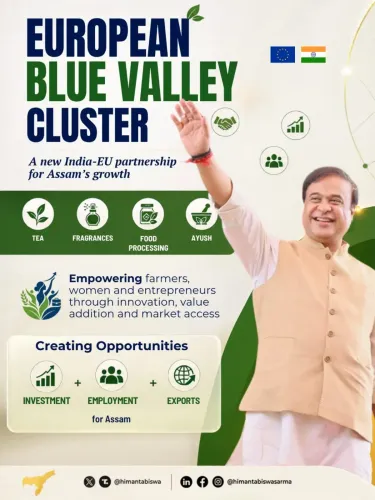
The visit will also see the launch of Assam's first Blue Valley Cluster — a new industrial hub focused on fragrances, flavours, AYUSH, and food processing. Described as a 4P (public-private-people-partnership) model, the cluster aims to connect Europe, North-East India, and Bhutan, promoting innovation, research, sustainable manufacturing, and business collaboration. The Blue Valleys initiative was formally introduced at the 2026 EU-India Summit.
According to the EU statement, the broader Blue Valleys framework promotes industrial clusters, MSME linkages, and sector-specific value-chain integration between the EU and India, with a focus on economic growth and environmental sustainability. Key sectors include clean energy, natural ingredients, bamboo-based industries, eco-friendly textiles, biotech, wellness, and smart manufacturing.
Sectors in Focus
The two-day visit will concentrate on value chains where Europe and India's North-East share strong synergies: renewable and green energy, sustainable urban infrastructure, healthcare and pharmaceuticals, semiconductors and electronics manufacturing, tea and agri-food processing, flavours and fragrances, and AYUSH. The eight states covered under the collaboration framework are Arunachal Pradesh, Assam, Manipur, Meghalaya, Mizoram, Nagaland, Sikkim, and Tripura.
What Ambassador Delphin Said
Reflecting on the significance of the visit, Ambassador Hervé Delphin said: 'North-East India and Assam at its core, has enormous potential — its resources, its skilled workforce and is already one of the fastest growing regions of India by GDP. Through initiatives like Blue Valleys, we're not just discussing cooperation; we're building real, long-term business-to-business partnerships that will drive growth for both the EU and India.'
He added that while the broad contours of EU-India ties were finalised at the summit, implementation would need to take root at the state level. 'The EU has a long-standing engagement with Assam, and we are encouraged by the advancements we're seeing through initiatives like the Blue Valley,' he said.
Broader Strategic Context
The visit also highlights the EU-India Trade and Technology Council (TTC) digital partnership and is intended to give European investors a direct look at Assam's business environment, infrastructure, and industry potential. This comes amid growing EU interest in diversifying supply chains beyond China, with India's North-East — long considered a frontier region — increasingly positioned as a corridor connecting South and Southeast Asia. The Blue Valleys pilot in Assam, if successful, is expected to serve as a replicable model for other states in the region.
Point of View
Agri-processing, and an emerging semiconductor footprint via Tata Electronics, giving Europe a multi-sector entry point. The 4P model sounds promising, but the harder test will be whether MSME linkages actually materialise or whether, as with many corridor-era announcements, the benefits accrete to large anchor firms. The real measure of Blue Valleys will be how many small producers in Meghalaya or Mizoram find a shelf in a European market two years from now.
NationPress
21 Oct 2026
Frequently Asked Questions
What is the Blue Valleys initiative being launched in Assam?
The Blue Valleys initiative is an EU-India framework that promotes industrial clusters, MSME linkages, and sector-specific value-chain integration between Europe and India's North-East. Assam's first Blue Valley Cluster, focused on fragrances, flavours, AYUSH, and food processing, will be launched on 9 June as a pilot under this initiative, which was introduced at the 2026 EU-India Summit.
Why is the EU delegation visiting Assam in June 2025?
The delegation is visiting to advance collaboration with India's North-Eastern states in line with the Comprehensive Strategic Agenda agreed at the EU-India Summit. The two-day programme includes bilateral talks with Assam CM Himanta Biswa Sarma, a business forum with FEBI, the Blue Valleys workshop, and a visit to Tata Electronics' semiconductor plant.
Which sectors does the Blue Valleys initiative cover?
The initiative focuses on clean energy, natural ingredients, bamboo-based industries, eco-friendly textiles, biotech, wellness, and smart manufacturing. The broader visit also covers renewable energy, sustainable urban infrastructure, healthcare, pharmaceuticals, semiconductors, electronics, tea, agri-food processing, flavours, fragrances, and AYUSH.
Which North-Eastern states are included in the EU collaboration framework?
The framework covers eight states: Arunachal Pradesh, Assam, Manipur, Meghalaya, Mizoram, Nagaland, Sikkim, and Tripura. Assam serves as the entry point for the pilot Blue Valley Cluster.
What is the 4P model mentioned in the Blue Valley Cluster?
The 4P model stands for public-private-people-partnership. It is the governance framework for the Blue Valley Cluster, designed to combine government funding, private enterprise, community participation, and sustainability standards to create scalable business models connecting local producers to European markets.