CM Himanta Marks World Architecture Day with Assam's Heritage
Synopsis
On World Architecture Day 2026, Assam CM Himanta Biswa Sarma highlighted the state's architectural legacy — from the Ahom-era Rang Ghar to Kamakhya Mandir — framing modern Assam's construction drive as a continuation of heritage, not a break from it.
Key Takeaways
World Architecture Day (first Monday of October) was the platform chosen by CM Himanta Biswa Sarma for the post on 5 October 2026 .
The CM cited Rang Ghar in Sibasagar, one of Asia's oldest surviving amphitheatres built during the Ahom dynasty , as a pillar of Assam's built heritage.
Kamakhya Mandir in Guwahati, a major Shakti Peetha with historic temple architecture, was the second landmark invoked.
Sarma framed modern development through the 'Vikas aur Virasat' (development and heritage) lens, a recurring BJP governance motif.
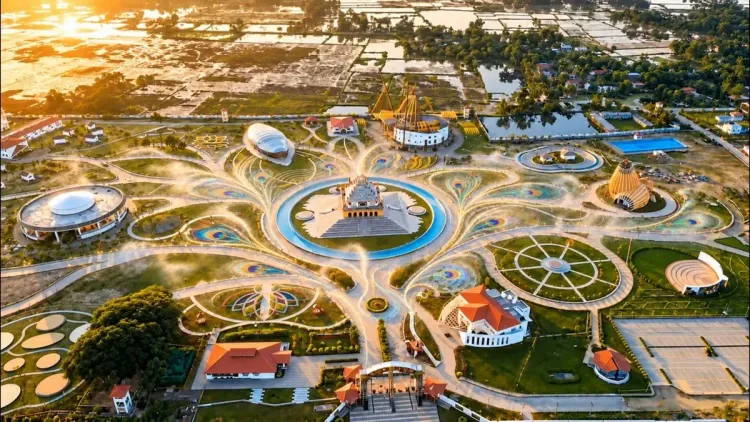
A video was shared alongside the post showcasing contemporary structures in Assam designed to reflect this dual legacy.
From the ancient royal amphitheatre of Rang Ghar to the sacred sanctum of Kamakhya Mandir, Assam has carried an architectural identity that stretches back centuries — and on World Architecture Day, 5 October 2026, Assam Chief Minister Himanta Biswa Sarma made the case that the state is still very much building on that foundation.
Rang Ghar and Kamakhya: the pillars of a living tradition
Sarma anchored his message in two of Assam's most iconic structures. The Rang Ghar in Sibasagar, built during the Ahom dynasty in the 18th century, is one of the oldest surviving amphitheatres in Asia — a two-storeyed pavilion of brick and lime where royalty once watched buffalo fights and other sports. Kamakhya Mandir, perched on Nilachal Hill in Guwahati, is among the most venerated Shakti Peethas in the country, its curvilinear shikhara a landmark of early medieval temple architecture. Together, they represent the twin streams — royal civic planning and sacred craftsmanship — that have defined Assamese built heritage.
The 'Vikas and Virasat' frame: what the CM is signalling
Sarma's post explicitly invokes the phrase 'Vikas aur Virasat' — development and heritage — a framing that has become prominent in BJP governance discourse, asserting that modernity and cultural legacy are not competing values but complementary ones. The chief minister shared a video showcasing contemporary construction and design projects in Assam that, by his account, consciously draw from this inherited aesthetic vocabulary. It is a political and cultural argument: that new Assam is not erasing the old, but extending it.
Why architecture as a governance message works
Choosing World Architecture Day — observed annually on the first Monday of October — as the platform is deliberate. The day, designated by the International Union of Architects, gives leaders a globally recognised peg to frame local infrastructure investment in civilisational terms. For a state like Assam, whose Ahom-era monuments are on India's tentative UNESCO World Heritage list, drawing a direct line between ancient craftsmanship and present-day construction carries both cultural weight and soft-power potential.
The broader subtext: governance in the Northeast is increasingly framed around identity, pride, and belonging — and pointing to skylines as proof of continuity is as much a political statement as it is an architectural one.
Point of View
He positions the BJP-led administration as a custodian of Assamese civilisational identity, not merely a builder of roads and bridges. The 'Vikas aur Virasat' frame has become a reliable tool across BJP-governed states to neutralise the narrative that development erases culture. For Assam specifically — where identity, indigeneity, and history are politically charged — linking skylines to sacred and royal landmarks is a calculated bid for cultural legitimacy as much as civic pride.
NationPress
5 Oct 2026
Frequently Asked Questions
What is World Architecture Day and when is it celebrated?
World Architecture Day is observed on the first Monday of October each year, designated by the International Union of Architects. In 2026 it falls on 5 October .
What is Rang Ghar and why is it significant?
Rang Ghar in Sibasagar, Assam , is an 18th-century royal amphitheatre built during the Ahom dynasty. It is considered one of the oldest surviving amphitheatres in Asia and a key example of Ahom civic architecture.
Why did CM Himanta Biswa Sarma post about architecture today?
Sarma used World Architecture Day 2026 to highlight Assam's heritage landmarks and argue that modern construction in the state consciously continues the legacy of structures like Rang Ghar and Kamakhya Mandir .
What does 'Vikas aur Virasat' mean in the context of this post?
Vikas aur Virasat means 'development and heritage' — a framing used to argue that modern infrastructure and cultural legacy are complementary, not conflicting, goals.
Is Kamakhya Mandir a UNESCO World Heritage Site?
Kamakhya Mandir is not yet a UNESCO World Heritage Site, but Assam's Ahom-era monuments, including Rang Ghar , are on India's tentative UNESCO World Heritage list.