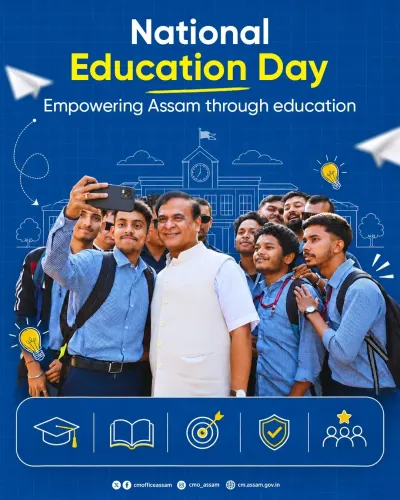
CM Himanta highlights Assam child welfare schemes on World Children's Day

Synopsis
On World Children's Day, Assam CM Himanta Biswa Sarma highlighted state schemes including Nijut Moina, Nijut Babu, free textbooks, bicycles, and scholarships as the government's commitment to ensuring no child's dreams are held back by poverty or circumstance.
Key Takeaways
World Children's Day (20 November) prompted Assam CM Himanta Biswa Sarma to reaffirm the state's child-welfare agenda.
The CM cited Nijut Moina and Nijut Babu as flagship education-support schemes under his administration.
Free textbooks, bicycles, and scholarships are part of the state's toolkit to reduce school dropout rates.
Assam has a long history of running education-support programmes; the Sarma government has continued and rebranded several of these initiatives.
The state's human-development indicators — enrolment trends, scheme coverage, and learning outcomes — will be the real measure of these commitments.
On World Children's Day, 20 November 2026, Assam Chief Minister Himanta Biswa Sarma made a pointed pledge: no child in Assam should have their aspirations crushed by circumstance — and named the state programmes he says are turning that promise into policy.
Nijut Moina, Nijut Babu and a basket of benefits
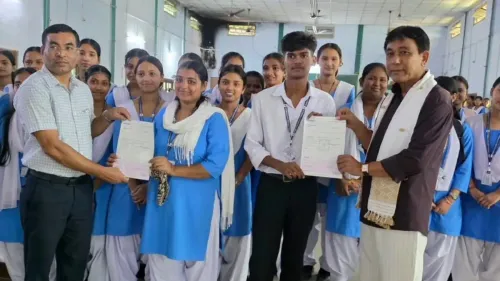
In his post, CM Sarma cited Nijut Moina and Nijut Babu alongside a clutch of support measures — free textbooks, bicycles, and scholarships — as the state's active toolkit for keeping children in school. The framing is deliberate: each item in the list targets a specific dropout trigger, whether the cost of learning materials, the distance to a school, or the financial calculus a family makes when fees loom larger than futures.
Assam governments have run education-support programmes along these lines for years, distributing free textbooks and bicycles — particularly for girls — to prop up enrolment and chip away at dropout rates. The Sarma administration has continued and, in several cases, rebranded these interventions as flagship welfare measures, folding them into a broader human-development push for India's North-East.
Why November 20 carries extra weight
World Children's Day, observed every 20 November, marks the anniversary of the United Nations adoption of the Declaration of the Rights of the Child in 1959 and the Convention on the Rights of the Child in 1989. For state governments, the date is a natural stage — a moment to signal both moral commitment and administrative activity on child welfare.
In Assam, where rural enrolment gaps and early-dropout pressures remain live challenges, the symbolism carries real stakes. Sarma's post lands the message squarely in that frame: the schemes are not charity, they are infrastructure for ambition.
What the state's budget priorities will reveal
The real test, as always, lies in allocations and outcomes. Analysts tracking Assam's human-development indicators will watch annual school-enrolment trends, scheme-coverage data, and learning-outcome reports to judge whether the welfare architecture the CM described is expanding in reach or flattening. The language of 'every child' is universal; the numbers will be specific.
Until then, CM Sarma's World Children's Day message does exactly what it sets out to do — stake a governance identity around child welfare and remind the state's schoolchildren, and their parents, that the administration is watching the scoreboard.
Point of View
The CM is signalling programmatic intent and inviting accountability. The broader pattern — state governments using UN observance days to consolidate welfare messaging — reflects a maturing political playbook where symbolic occasions are leveraged to reinforce policy identity and shore up electoral goodwill among beneficiary communities.
NationPress
20 Nov 2026
Frequently Asked Questions
What is Nijut Moina scheme in Assam?
Nijut Moina is an Assam government education-support scheme cited by CM Himanta Biswa Sarma as part of the state's efforts to keep children — particularly girls — in school. Specific details of its current scale are not yet fully in public record.
What is Nijut Babu scheme in Assam?
Nijut Babu is another Assam welfare initiative mentioned by CM Sarma alongside Nijut Moina as part of a broader child and education support package that includes free textbooks, bicycles, and scholarships.
Why is World Children's Day celebrated on 20 November?
World Children's Day falls on 20 November because it marks the dates on which the United Nations adopted the Declaration of the Rights of the Child in 1959 and the Convention on the Rights of the Child in 1989.
What free benefits does the Assam government give to school students?
The Assam government, under CM Himanta Biswa Sarma, provides free textbooks, bicycles, and scholarships to students as part of its child welfare and education-support framework aimed at reducing dropout rates.
What is Himanta Biswa Sarma's role in North-East India politics?
Himanta Biswa Sarma has served as Chief Minister of Assam since May 2021 and is a senior BJP leader. He also serves as the convenor of the North-East Democratic Alliance (NEDA) , making him a central political figure across the region.