CM Himanta eases land rules for Assam's young entrepreneurs
Synopsis
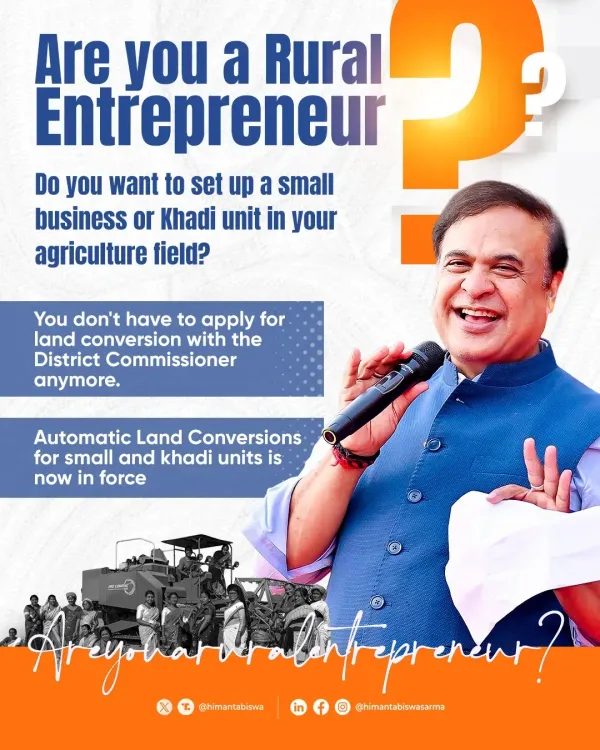
Assam Chief Minister Himanta Biswa Sarma has announced that eligible youth can now set up small business units on their agricultural land without seeking land conversion approvals, removing a long-standing procedural barrier to rural entrepreneurship in the state.
Key Takeaways
Assam CM Himanta Biswa Sarma announced on 7 July 2026 that eligible youth can set up small units on agricultural land without land conversion approvals.
The move is part of Assam's Ease of Doing Business agenda, aligned with the national EoDB programme launched in 2015 .
The reform removes a procedural requirement — not merely speeds it up — for qualifying small enterprises on agricultural holdings.
Primary beneficiaries are young landowners in Assam's rural and semi-urban areas seeking to start agro-processing, artisan, or light manufacturing units.
Formal government orders detailing eligibility criteria, unit-size caps, and district-level rollout are yet to be issued.
The policy could serve as a model for other northeastern states under the North-East Democratic Alliance (NEDA) framework.
Assam Chief Minister Himanta Biswa Sarma announced on Monday, 7 July 2026, that eligible youth in the state can now establish small business units on their agricultural land without requiring land conversion approvals — a significant regulatory relaxation aimed at lowering entry barriers for first-time entrepreneurs in rural and semi-urban areas.
Context
In his post, CM Sarma framed the move squarely within the state's Ease of Doing Business (EoDB) agenda, stating: 'Our vision of Ease of Doing Business is to make it simpler for people to pursue their entrepreneurial dreams.' The announcement specifically targets 'eligible enterprising youth' who own agricultural land but have historically been deterred by the time-consuming and often costly process of obtaining land-use conversion certificates before setting up any productive unit.
Land conversion approvals in Assam, as in most Indian states, have traditionally required applicants to navigate multiple departments — revenue, agriculture, and local bodies — before a plot classified as agricultural could legally host a commercial or industrial structure. That procedural burden has long been cited as a key friction point for micro and small enterprises in the state's rural economy.
Policy Backdrop
The move aligns Assam with the broader national Ease of Doing Business programme launched by the Government of India in 2015, which ranks states on metrics including single-window clearances and land-related approvals. Assam has progressively recalibrated its state-level rules to improve its standing on this framework and to attract investment into its micro, small and medium enterprise (MSME) sector.
Successive administrations in the state have experimented with relaxed land-conversion norms to encourage local manufacturing without triggering large-scale land acquisition. The latest announcement by CM Sarma appears to extend that trajectory by carving out an explicit exemption for small units set up by youth on their own agricultural holdings — removing a procedural gate rather than merely speeding it up.
CM Sarma has served as Chief Minister of Assam since May 2021 and also convenes the North-East Democratic Alliance (NEDA), giving him a platform to position Assam as a regulatory reform model for the wider northeastern region.
Stakeholders and Impact
The primary beneficiaries are young residents of Assam who hold agricultural land — a demographic that has historically lacked capital for formal industrial plots or the bureaucratic bandwidth to pursue conversion approvals. By removing that requirement for qualifying small units, the policy could meaningfully reduce both the cost and the time-to-launch for agro-processing, artisan manufacturing, and rural service enterprises.
Small entrepreneurs and self-help groups operating in Assam's rural districts stand to gain the most, particularly in sectors such as food processing, handicrafts, and light fabrication where modest land footprints are the norm. The reform may also reduce informal or undeclared business activity that has persisted partly because formalisation demanded land-conversion paperwork that small operators could not easily obtain.
What's Next
The critical next step will be the issuance of formal government orders specifying eligibility criteria — including age bands, land-ownership thresholds, permissible unit types, and size caps — along with district-level implementation mechanisms. Clarity on which categories of agricultural land qualify, and whether the exemption applies uniformly across all Assam districts or only in designated zones, will determine how widely the benefit is actually accessed.
If the rollout is accompanied by a streamlined registration portal and awareness drives in Assam's rural blocks, the reform could become a replicable template for other northeastern states within the NEDA umbrella — and a data point in the national EoDB rankings for the next assessment cycle.
Point of View
The BJP-led state government is simultaneously advancing a national party priority and differentiating Assam within the northeastern political economy. The reform's real test will lie in implementation: whether eligibility criteria are drawn broadly enough to be genuinely inclusive, or narrowly enough to limit fiscal and administrative risk. If formal orders follow quickly and are accompanied by ground-level outreach, this could meaningfully shift Assam's MSME formation numbers and offer CM Sarma a concrete governance credential ahead of the next electoral cycle.
NationPress
6 Jul 2026
Frequently Asked Questions
What did Assam CM Himanta Biswa Sarma announce about agricultural land?
CM Himanta Biswa Sarma announced that eligible youth in Assam can now set up small business units on their agricultural land without needing to obtain land conversion approvals, reducing a key bureaucratic hurdle for rural entrepreneurs.
Who benefits from Assam's new land conversion exemption for small businesses?
The primary beneficiaries are young residents of Assam who own agricultural land and want to start small enterprises such as agro-processing units, artisan workshops, or light manufacturing businesses without going through the formal land-conversion process.
What is the Ease of Doing Business programme in India?
The national Ease of Doing Business programme was launched by the Government of India in 2015 to rank states on metrics such as single-window clearances and land-related approvals, encouraging states to lower regulatory barriers for businesses.
Does this mean agricultural land in Assam can now be used freely for commercial purposes?
No. The exemption applies specifically to eligible youth setting up small units, and formal government orders are still awaited to define eligibility criteria, permissible unit types, and size caps — so the scope is not unlimited.
How does this policy fit into Assam's broader economic reforms under Himanta Biswa Sarma?
Since becoming Chief Minister in May 2021, CM Sarma has progressively aligned Assam's state rules with the national EoDB framework. This latest move continues that pattern by removing a procedural gate — rather than just simplifying it — for small rural enterprises.