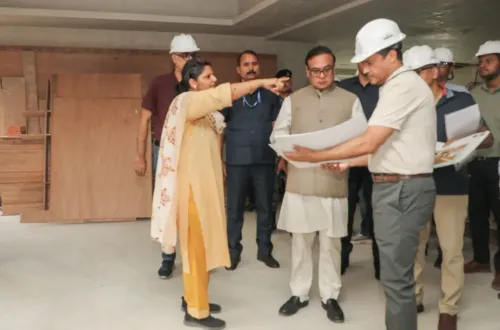
CM Himanta Expands Assam Bhawan Network Across India

Synopsis
Assam Chief Minister Himanta Biswa Sarma has announced the renovation and construction of new Assam Bhawans across multiple Indian states, addressing long-standing accommodation challenges for Assam's students, patients and government officials travelling outside the state.
Key Takeaways
CM Himanta Biswa Sarma announced on 25 May 2026 that Assam is renovating existing Bhawans and building new ones in multiple states.
The initiative targets three groups: students , patients , and government officials travelling outside Assam.
Assam Bhawans are state-owned guest houses that provide affordable accommodation to Assam residents in major Indian cities.
No specific cities, states, budgets, or timelines have been disclosed in the announcement.
Northeast Indian states depend more heavily on such outstation facilities given their geographic distance from major metros.
Detailed project specifics are expected in upcoming Assam assembly sessions or state budget documents.
Assam Chief Minister Himanta Biswa Sarma announced on Sunday, 25 May 2026 that the state government is renovating existing Assam Bhawans and constructing new ones across multiple Indian states, citing persistent accommodation difficulties faced by students, patients, and officials travelling outside Assam.
Context
In his post, CM Sarma acknowledged that finding 'meaningful accommodation' has 'always been a teething issue' for Assam residents travelling out of state for education, medical care, or official work. The announcement frames the Bhawan expansion as a direct government response to a long-standing, practical grievance. The post was accompanied by a video, suggesting a visual walkthrough of ongoing renovation or construction work.
Assam Bhawans are state-owned guest houses operated by the Assam government in major Indian cities. They serve as affordable, familiar stopgaps for Assam's citizens navigating unfamiliar cities, often under stressful circumstances such as medical emergencies or competitive examinations.
Policy Backdrop
Indian state governments have maintained such outstation facilities — variously called bhawans or sadans — since the decades following independence, primarily in New Delhi and major metros. These properties address the practical demands of inter-state mobility: students sitting entrance exams, patients seeking specialist care at referral hospitals, and government officers on official deputation.
Assam's current drive continues a pattern of periodic upgrades that multiple state governments undertake to keep ageing properties functional and capacious enough for growing demand. Northeast India states, given their geographic distance from major metros, have historically relied more heavily on such facilities than states closer to Delhi or Mumbai.
Stakeholders and Impact
The three primary beneficiary groups identified by CM Sarma are students, patients, and government officials. Students from Assam travelling to cities such as Delhi, Vellore, or Mumbai for higher education or competitive exams often face acute affordability and safety concerns when seeking private accommodation. Patients — frequently accompanying family members to large medical centres outside the state — represent perhaps the most vulnerable segment, for whom secure and affordable lodging can meaningfully affect health outcomes.
State officials on short-term deputation benefit from reduced travel costs to the exchequer when government-owned accommodation is available. The broader signal from this initiative is that the Sarma government is treating out-of-state welfare infrastructure as a governance priority alongside in-state development.
What's Next
The announcement does not specify which states or cities have been selected for new construction or renovation, nor does it provide timelines, budget allocations, or completion schedules. Detailed disclosures are expected through upcoming Assam Legislative Assembly sessions or state budget documents. Watchers of Assam governance will look for procurement notices, foundation-laying ceremonies, and departmental budget line items that give concrete shape to the commitment made in this post.
If executed at scale, an upgraded Bhawan network would strengthen the soft-infrastructure safety net for Assam's citizens navigating life events that routinely take them far from home — a quiet but consequential dimension of state welfare delivery.
Point of View
Vocal, and electorally relevant. Framing accommodation as a 'teething issue' the government is now fixing positions the initiative as responsive rather than routine. For a state that sends a disproportionately large share of its youth and ailing population to metros for education and healthcare, outstation welfare infrastructure carries real political weight. The announcement also fits a broader pattern of Northeast chief ministers asserting their states' presence and legitimacy in national civic life.
NationPress
8 Oct 2026
Frequently Asked Questions
What are Assam Bhawans and who can use them?
Assam Bhawans are official guest houses operated by the Assam government in major Indian cities, available to Assam residents including students, patients, and government officials travelling outside the state for education, medical treatment, or official duties.
Why is Assam building new Bhawans in other states?
CM Himanta Biswa Sarma cited persistent difficulty in finding affordable and reliable accommodation as the reason, particularly for students appearing for exams, patients visiting referral hospitals, and officials on deputation.
Which states will get new or renovated Assam Bhawans?
The announcement does not specify the states or cities selected. Details on locations, timelines, and budgets are expected to emerge through upcoming Assam assembly sessions or state budget disclosures.
How does this compare to what other states do?
Most Indian state governments maintain similar outstation facilities — bhawans or sadans — in New Delhi and major metros. Assam's current drive follows a well-established pattern of periodic upgrades to keep these properties functional.
What is the significance of this move for Assam students and patients?
Students travelling to cities like Delhi or Mumbai for exams, and patients accompanying family to specialist hospitals, often face acute affordability and safety concerns; upgraded Bhawans would provide a government-backed, cost-effective alternative.