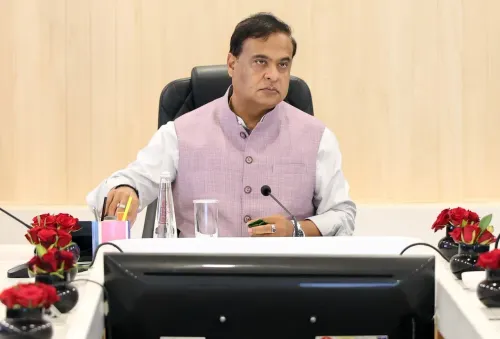
CM Himanta Eyes 27 Lakh Hectare Irrigation Push via PM KUSUM

Synopsis
Assam Chief Minister Himanta Biswa Sarma on 1 July 2026 announced plans to expand state irrigation coverage to over 27 lakh hectares, naming the central PM KUSUM solar pump scheme as a primary vehicle to ensure year-round cropping and enhanced farmer incomes across the flood-prone northeastern state.
Key Takeaways
Assam CM Himanta Biswa Sarma has set a target of expanding irrigation facilities to over 27 lakh hectares in the state.
PM KUSUM (Pradhan Mantri Kisan Urja Suraksha evam Utthaan Mahabhiyan), launched in 2019 , is the central scheme being leveraged to rapidly scale solar water pump coverage.
The scheme's national mandate includes installing 17.5 lakh standalone solar pumps and solarising 10 lakh grid-connected pumps across India.
Assam's irrigation deficit is driven by hilly terrain, annual floods, and monsoon variability that limit farmers to largely rain-fed, single-season cultivation.
The initiative aims to enable year-round farm output and reduce dependence on costly diesel pumps, directly benefiting small and marginal farmers.
Implementation progress under PM KUSUM Component-B and Component-C in Assam will be the key metric to watch going forward.
Assam Chief Minister Himanta Biswa Sarma on Wednesday, 1 July 2026, announced that the state government is actively working to close its irrigation gap and expand agricultural irrigation facilities to cover over 27 lakh hectares, with PM KUSUM — the central solar pump scheme — identified as a key instrument for achieving year-round farm output and higher farmer incomes.
Context
Posting on X, Sarma stated: 'We're working towards closing the irrigation gap in Assam and expand irrigation facilities to 27+ lakh hectares. PM KUSUM is an excellent scheme in this regard and we want to rapidly expand the solar water pump coverage across Assam to ensure year-long farm output and enhanced income.'
The announcement signals a policy priority for the BJP-led Assam government as it seeks to reduce the state's dependence on erratic monsoon rainfall, which has historically constrained agricultural productivity across the northeastern state.
Policy Backdrop
PM KUSUM — the Pradhan Mantri Kisan Urja Suraksha evam Utthaan Mahabhiyan — was launched in 2019 by the Ministry of New and Renewable Energy with a national mandate to install 17.5 lakh standalone solar pumps and solarise 10 lakh grid-connected pumps for farmers across India.
The scheme subsidises solar pumps, cutting farmers' dependence on expensive diesel-powered alternatives and reducing carbon emissions. Its Component-B targets standalone solar pumps, while Component-C focuses on solarising existing grid-connected agricultural pump sets — both directly relevant to Assam's irrigation ambitions.
Separately, the Pradhan Mantri Krishi Sinchayee Yojana (PMKSY), launched in 2015, has sought to expand cultivable area under assured irrigation and improve water-use efficiency — a national framework within which state-level efforts like Assam's now sit.
Stakeholders and Impact
Assam's agriculture sector is dominated by small and marginal farmers who remain heavily reliant on rain-fed cultivation. The state's geography — marked by hilly terrain, annual flood cycles, and monsoon variability — has long suppressed irrigation coverage, leaving large tracts of farmland dependent on a single cropping season.
Expanding solar pump coverage under PM KUSUM would directly benefit these farmers by enabling irrigation during dry spells, supporting multiple cropping cycles, and reducing input costs tied to diesel pumps. Northeastern states have progressively aligned their irrigation and renewable-energy plans with central programmes to address precisely these constraints.
The broader push for solar-powered irrigation also fits into a national pattern, active since 2015, of integrating clean energy into agriculture to simultaneously address rural income gaps and emissions reduction targets.
What's Next
Attention will now turn to state-level implementation: specifically, the annual installation targets and actual deployment progress under PM KUSUM Component-B and Component-C in Assam. The government's ability to coordinate with central ministries, manage land and grid infrastructure, and reach remote farming communities will determine how quickly the 27+ lakh hectare goal translates from ambition to irrigated acreage.
If the rollout accelerates, it could serve as a model for other flood-prone and hilly northeastern states grappling with similar irrigation deficits — and reinforce Sarma's position as a key architect of development policy across the North-East Democratic Alliance (NEDA) bloc.
Point of View
Making delivery critical. The solar pump push also fits a wider northeastern strategy of converting climate vulnerability — floods, erratic rain — into an argument for renewable-energy infrastructure investment. How swiftly the state converts this stated priority into sanctioned targets and on-ground installations will determine whether the announcement marks a genuine policy inflection or remains aspirational.
NationPress
1 Jul 2026
Frequently Asked Questions
What is PM KUSUM and how does it help Assam farmers?
PM KUSUM (Pradhan Mantri Kisan Urja Suraksha evam Utthaan Mahabhiyan) is a central government scheme launched in 2019 that subsidises solar-powered water pumps for farmers, reducing their dependence on costly diesel pumps and enabling irrigation even outside the monsoon season. For Assam farmers, it offers a route to year-round cropping and more stable incomes.
What is Assam's irrigation target announced by CM Himanta Biswa Sarma?
Chief Minister Himanta Biswa Sarma announced on 1 July 2026 that Assam is working to expand its irrigation coverage to over 27 lakh hectares, using PM KUSUM solar pumps as a key instrument.
Why does Assam have a low irrigation coverage?
Assam's irrigation coverage has historically been constrained by its hilly terrain, annual flooding, and monsoon variability, which together make large-scale conventional irrigation infrastructure difficult to build and maintain, leaving most farmers dependent on rain-fed cultivation.
What are PM KUSUM Component-B and Component-C?
Component-B of PM KUSUM targets the installation of standalone solar-powered water pumps for individual farmers, while Component-C focuses on solarising existing grid-connected agricultural pump sets — both are directly relevant to Assam's plan to expand irrigation through solar energy.
How does Assam's irrigation push connect to national agricultural policy?
Assam's drive aligns with two central schemes: PM KUSUM (2019) for solar pump deployment and the Pradhan Mantri Krishi Sinchayee Yojana (2015), which seeks to expand assured irrigation coverage and improve water-use efficiency across India, providing both funding frameworks and policy backing for state-level efforts.