CM Himanta eyes agarwood mission to drive Assam's economy
Synopsis
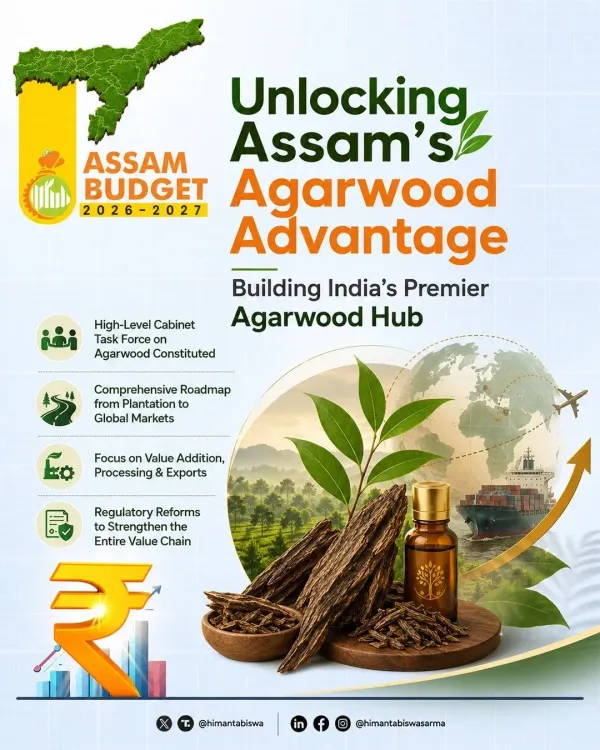
Assam Chief Minister Himanta Biswa Sarma has announced a state mission to leverage Assam's agarwood resources for economic growth, with details expected in the Assam Budget 2026. The move targets small cultivators, forest communities, and high-value export markets in the Middle East and Asia.
Key Takeaways
CM Himanta Biswa Sarma announced on 10 July 2026 that Assam is developing a dedicated agarwood mission.
The initiative is linked to the Assam Budget 2026 , where specific allocations and targets are expected to be disclosed.
Agarwood from Aquilaria trees is one of the world's most valuable non-timber forest products, with major demand in the Middle East, Southeast Asia, and East Asia .
Wild harvest is restricted under CITES and Indian wildlife law; cultivated plantation is the only legally scalable commercial route.
Key beneficiaries include small cultivators and forest-dependent communities across districts such as Nagaon, Golaghat, Jorhat, and Tinsukia .
The mission continues Assam's broader push to diversify revenue beyond tea, petroleum, and coal .
Assam Chief Minister Himanta Biswa Sarma announced on Friday, 10 July 2026 that the state is developing a dedicated mission to harness its agarwood resources as a driver of economic growth, signalling that the initiative will feature in the Assam Budget 2026.
Context
Agarwood — the dark, resin-saturated heartwood produced by Aquilaria trees — is among the world's most valuable non-timber forest products, commanding premium prices in global fragrance and traditional-medicine markets. Assam holds one of India's most significant natural and cultivated stands of these trees, giving the state a structural advantage that successive administrations have sought, with varying success, to translate into broad-based income.
In his post, Sarma stated that 'Assam is working on a mission to utilise its vast agarwood resources to boost economic development,' tying the effort explicitly to the upcoming state budget under the hashtag #AssamBudget2026.
Policy Backdrop
Agarwood development in Assam sits at the intersection of forest policy, wildlife-protection law, and international trade rules. Wild harvest of Aquilaria species is tightly regulated under the Convention on International Trade in Endangered Species (CITES) and India's own wildlife-protection framework, making cultivated plantation the only legally scalable route to commercialisation.
State governments have periodically promoted agarwood cultivation as part of a broader push to diversify Assam's economy beyond its traditional pillars of tea, petroleum, and coal. The current administration has emphasised increasing own-source revenue through plantation industries and value-addition, and a formalised mission would mark a more structured commitment to that goal. Regulatory clarity on cultivation permits, processing, and export procedures will be central to whether the initiative delivers measurable returns to farmers and forest-dependent communities.
Stakeholders and Impact
The communities most directly affected are the small cultivators and forest-dependent households across Assam's districts where Aquilaria trees grow, including parts of Nagaon, Golaghat, Jorhat, and Tinsukia. A well-structured mission could open formal market linkages, credit access, and export channels that have historically been out of reach for individual growers.
Beyond the farm gate, a state-backed agarwood value chain could stimulate downstream industries — distillation, packaging, and export logistics — generating employment in semi-urban centres. International buyers in the Middle East, Southeast Asia, and East Asia represent the primary demand pool for high-grade agarwood oil and chips, making export facilitation a key variable in the mission's success.
What's Next
The specifics of the mission — including any dedicated budget outlay, institutional structure, and regulatory amendments — are expected to be disclosed when Assam presents its 2026 state budget. Watchers will look for concrete allocations, targets for cultivated acreage, and any proposed changes to permit and export procedures that would make the legal supply chain more accessible to small growers.
If the mission delivers a coherent policy framework, it could position Assam as a model for other northeastern states seeking to monetise high-value forest products within conservation guardrails — a template with implications for the wider North-East Democratic Alliance (NEDA) region that CM Sarma convenes.
Point of View
Allowing the Sarma administration to frame the upcoming state budget as forward-looking and resource-smart rather than merely incremental. Tying a high-value forest product to a formal 'mission' framework follows the Central Government's playbook of branding sectoral pushes — a rhetorical move that also raises accountability stakes, since a named mission invites scrutiny of eventual outcomes. For CM Sarma, who convenes the NEDA bloc, demonstrating an economic diversification model in Assam carries political value beyond the state's borders. The real test will be whether the budget delivers regulatory simplification and credit access that actually reaches small cultivators, or whether the mission remains aspirational.
NationPress
10 Jul 2026
Frequently Asked Questions
What is the Assam agarwood mission announced by CM Himanta?
Chief Minister Himanta Biswa Sarma announced on 10 July 2026 that Assam is working on a mission to commercially develop its agarwood resources to boost the state economy, with details expected in the Assam Budget 2026.
What is agarwood and why is it valuable?
Agarwood is the dark, resin-rich heartwood formed inside Aquilaria trees and is among the world's most expensive non-timber forest products, prized in the fragrance, incense, and traditional-medicine industries, especially in the Middle East and East Asia.
Is agarwood cultivation legal in Assam?
Yes, cultivated agarwood is legal in Assam; however, wild harvest of Aquilaria species is tightly regulated under CITES and India's Wildlife Protection Act, making plantation-based cultivation the only viable commercial route.
Who benefits from Assam's agarwood mission?
The primary beneficiaries are small cultivators and forest-dependent communities in Assam's agarwood-growing districts, along with downstream industries such as oil distillation, packaging, and export logistics.
When will the Assam agarwood mission details be announced?
Specific allocations, targets, and regulatory measures are expected to be revealed when Assam presents its Budget 2026, following CM Sarma's announcement on 10 July 2026.