CM Himanta Invokes Ambedkar to Highlight Assam's Social Justice Push
Synopsis
Assam Chief Minister Himanta Biswa Sarma, citing Ambedkar's vision, has reaffirmed the state's push to bring educational, employment and social opportunities to marginalised communities as part of its growth agenda.
Key Takeaways
CM Himanta Biswa Sarma posted on 27 May 2026 invoking Dr B.R.
Ambedkar's vision as the ideological basis for Assam's social justice initiatives.
The statement covers three pillars — education, jobs and social opportunities — targeted at the less privileged.
Assam has significant SC, ST and OBC populations who are the primary intended beneficiaries of these measures.
The government frames welfare as integral to the Assam Growth story rather than standalone redistribution.
The BJP-led administration has operated targeted scholarships, skill programmes and recruitment drives for marginalised communities since 2016 .
Upcoming state budget allocations and recruitment notifications will be the key indicators of follow-through on these commitments.
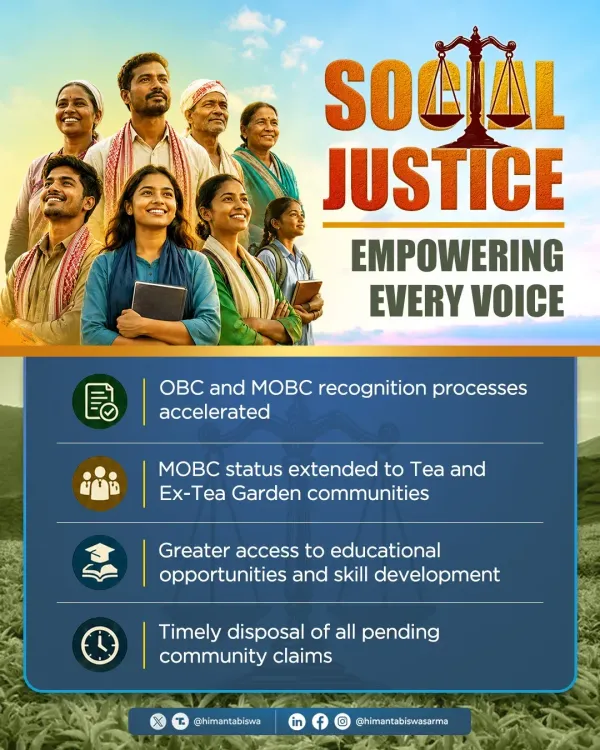
Assam Chief Minister Himanta Biswa Sarma on Wednesday, 27 May 2026, reaffirmed the state government's commitment to social justice, citing the vision of Dr B.R. Ambedkar as the guiding force behind a range of measures aimed at expanding educational, employment and social opportunities for the state's less privileged communities.
Context
In his post, Sarma stated that Assam has 'taken all efforts to ensure social justice for our people,' invoking Ambedkar's legacy as the ideological anchor. He added that 'several steps have been taken to take educational, jobs and social opportunities to the less privileged and make them an integral part of the Assam Growth story.' The statement frames welfare not as standalone redistribution but as a structural component of the state's broader economic expansion.
Ambedkar, the principal architect of the Indian Constitution, built the foundational framework of reservations and affirmative action for Scheduled Castes, Scheduled Tribes and other marginalised groups — a legacy that successive state governments across India have cited when announcing targeted welfare measures.
Policy Backdrop
Since 1950, the Constitution of India has mandated reservations in education, public employment and legislatures for SC and ST communities. Assam, home to significant Scheduled Caste, Scheduled Tribe and OBC populations, has operated dedicated development corporations and implemented central reservation policies since statehood, with periodic enhancements under successive administrations.
Under the BJP-led government — first from 2016 and with Sarma as Chief Minister since 2021 — the state has periodically announced targeted scholarships, skill-development programmes and recruitment drives for marginalised communities. These welfare measures have coexisted with the administration's wider policy agenda on land rights, illegal immigration and cultural identity, which also intersect with the same demographic groups.
Stakeholders and Impact
The primary beneficiaries of the policies referenced by Sarma are members of SC, ST and OBC communities across Assam — communities that have historically faced barriers to quality education and formal employment. By framing their inclusion as integral to the 'Assam Growth story,' the government signals a development model that ties social equity to economic productivity.
Civil society groups and community organisations working with marginalised populations in the state will be watching for concrete budget allocations and recruitment notifications in the coming fiscal cycle that give measurable shape to the commitments outlined in the Chief Minister's statement.
What's Next
Observers will look to upcoming state budget sessions and assembly proceedings for specific scheme announcements, allocation figures and recruitment calendars for reserved categories. Any new Ambedkar-themed welfare initiative — a recurring feature of BJP-governed states around the constitutional architect's birth and death anniversaries — could follow in the near term. The broader test will be whether the stated policy intent translates into verifiable outcomes in educational enrolment, government employment and social mobility data for Assam's least privileged citizens.
Point of View
The Chief Minister aligns Assam's welfare narrative with the broader 'development for all' arc that has defined the party's governance pitch in the Northeast. The statement arrives without specific programme details, which leaves it open to being read as either a substantive policy signal ahead of a budget session or a routine affirmation of existing commitments. The real political weight will be determined by what concrete allocations and outcomes follow in the coming legislative cycle.
NationPress
20 Oct 2026
Frequently Asked Questions
What has Assam done for social justice under CM Himanta Biswa Sarma?
Under Chief Minister Himanta Biswa Sarma, Assam has pursued targeted measures in education, employment and social access for SC, ST and OBC communities, framing their inclusion as central to the state's growth agenda. Specific scheme details and budget figures are expected to be confirmed in upcoming legislative sessions.
Why did CM Himanta invoke Ambedkar in his social justice post?
Sarma cited Dr B.R. Ambedkar as the ideological inspiration for Assam's welfare measures because Ambedkar, as the principal architect of the Indian Constitution, established the foundational framework of reservations and affirmative action for marginalised communities that all state governments operate under.
Who benefits from Assam's social justice and welfare schemes?
The primary beneficiaries are members of Scheduled Caste, Scheduled Tribe and Other Backward Class communities in Assam, who have historically faced barriers to quality education and formal employment opportunities.
What is the Assam Growth story mentioned by CM Himanta?
The 'Assam Growth story' is the Sarma government's framing of the state's development trajectory, in which social inclusion of the less privileged is presented as an integral component of economic expansion rather than a separate welfare objective.
What welfare schemes exist for SC ST communities in Assam?
Assam has operated Scheduled Caste and Scheduled Tribe development corporations and implemented central reservation policies since statehood. The BJP-led administration has additionally run targeted scholarships, skill-development programmes and recruitment drives for marginalised communities since 2016.