CM Himanta Reaffirms Assam's Welfare Scheme Commitment
Synopsis
Assam Chief Minister Himanta Biswa Sarma on 7 June 2026 reaffirmed the state's commitment to continuing all welfare schemes, signalling policy continuity ahead of the 2026 assembly elections and reinforcing the BJP-led government's focus on social programme delivery in the north-east.
Key Takeaways
Assam CM Himanta Biswa Sarma publicly committed on 7 June 2026 to continuing all state welfare schemes.
The statement comes ahead of the 2026 Assam assembly elections , making it politically significant.
Assam has implemented central schemes such as PMAY and Ayushman Bharat alongside state-level welfare supplements since 2016 .
Sarma has governed Assam since May 2021 and has consistently prioritised welfare delivery as a governance pillar.
Women beneficiaries form a key constituency directly affected by the continuity of these programmes.
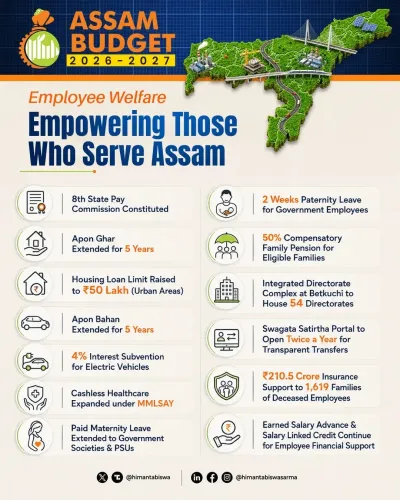
The next state budget will be the key test of how this commitment is backed by fiscal allocations.
Assam Chief Minister Himanta Biswa Sarma on Sunday, 7 June 2026, reaffirmed that Assam will continue all its welfare schemes aimed at improving the lives of its people, signalling policy continuity as the state approaches a critical electoral cycle.
Context
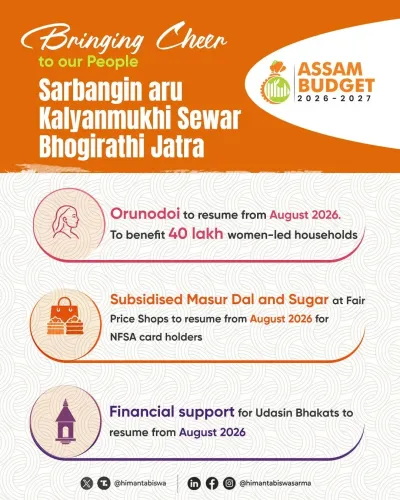
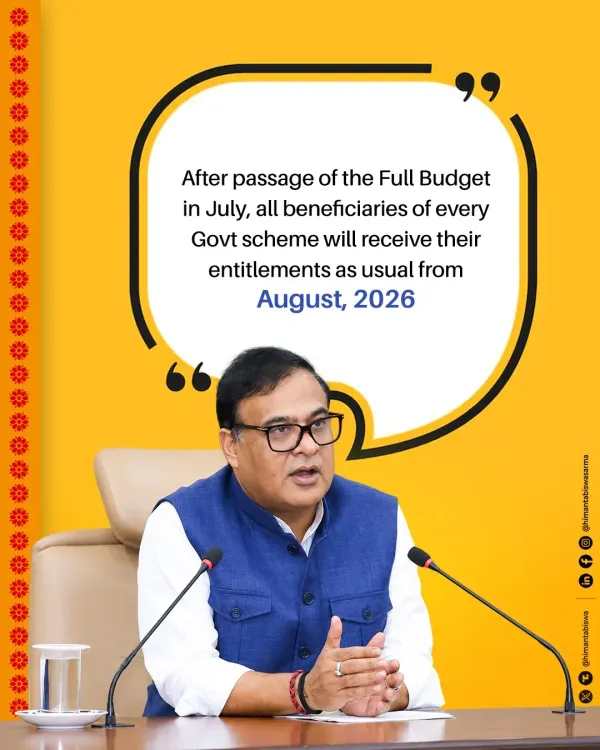
In a post on X, Sarma stated: 'Assam is committed to continue with all its welfare schemes for the betterment of our people.' The statement, though brief, carries significant political weight given that the 2026 Assam assembly elections are on the horizon and welfare delivery has been a cornerstone of the BJP-led government's public messaging since it came to power in 2016.
The declaration comes as state governments across India face scrutiny over beneficiary list rationalisation and fiscal sustainability of social programmes. By publicly affirming continuity, Sarma is addressing potential anxieties among scheme beneficiaries about possible rollbacks.
Policy Backdrop
Since Sarma assumed office as Chief Minister in May 2021, the government has consistently positioned itself as a steward of both central and state-level welfare initiatives. Central schemes such as Pradhan Mantri Awas Yojana (PMAY) and Ayushman Bharat have been actively implemented in Assam, supplemented by state-specific programmes targeting women, farmers, and economically weaker sections.
The earlier BJP-led administration in Assam (2016–2021) laid the groundwork by expanding the reach of central schemes while introducing state-level additions. The Sarma government inherited this architecture and, after the 2021 elections, pledged to review and rationalise — but not dismantle — existing programmes. Sunday's statement reinforces that position.
Assam has historically used welfare delivery as a primary governance instrument to address persistent gaps in poverty, public health, and gender equity, a pattern mirrored across BJP-ruled north-eastern states under the umbrella of the North-East Democratic Alliance (NEDA), which Sarma convenes.
Stakeholders and Impact
The primary beneficiaries of this commitment are Assam's millions of residents enrolled in state and centrally sponsored welfare programmes, with women beneficiaries forming a particularly significant constituency. For this group, assurances of continuity translate directly into household-level economic security.
Politically, the statement is also directed at the broader electorate ahead of the assembly elections. Welfare delivery has been a key differentiator for the BJP in the north-east, and any perception of scheme discontinuation could erode support in rural and semi-urban constituencies where programme benefits are most visible.
What's Next
The next major indicator of how this commitment translates into fiscal action will be Assam's forthcoming state budget, where welfare allocations will be closely watched by policy observers and opposition parties alike. Any fresh directives on scheme rationalisation or new beneficiary enrolment drives will signal the operational depth behind Sunday's declaration.
With the 2026 assembly elections drawing closer, the Sarma government's ability to demonstrate tangible welfare outcomes — rather than just affirm intent — will likely determine the political dividend of this public commitment.
Point of View
Likely designed to neutralise any opposition narrative around scheme rollbacks as the 2026 electoral season heats up. It fits a broader pattern across BJP-governed north-eastern states where welfare delivery and political consolidation are treated as inseparable strategies. The statement also reflects the NEDA model of governance — using social programme continuity to build durable cross-community coalitions in a region with historically volatile electoral alignments. The real test will be whether the next budget translates this rhetoric into ring-fenced allocations.
NationPress
22 Oct 2026
Frequently Asked Questions
What did Assam CM Himanta Biswa Sarma say about welfare schemes?
On 7 June 2026, CM Himanta Biswa Sarma stated that Assam is committed to continuing all its welfare schemes for the betterment of its people, reaffirming policy continuity.
Which welfare schemes are running in Assam under the BJP government?
Assam has been implementing central schemes such as Pradhan Mantri Awas Yojana and Ayushman Bharat alongside state-level welfare programmes targeting women, farmers, and economically weaker sections since 2016.
Why is Himanta Biswa Sarma reaffirming welfare schemes in 2026?
The 2026 Assam assembly elections are approaching, and publicly affirming welfare continuity helps the BJP-led government reassure beneficiaries and reinforce its governance record ahead of the polls.
Who benefits from Assam's state welfare schemes?
The primary beneficiaries include millions of Assam residents enrolled in state and centrally sponsored programmes, with women beneficiaries forming a particularly significant group.
What is the North-East Democratic Alliance and what is Sarma's role?
The North-East Democratic Alliance (NEDA) is a regional political alliance of north-eastern parties; Himanta Biswa Sarma serves as its convenor and uses it to coordinate governance and electoral strategy across the region.