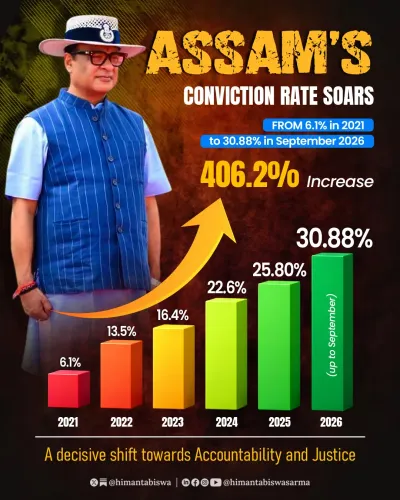
CM Himanta Flags Faster Probes, Rising Convictions in Assam

Synopsis
Assam Chief Minister Himanta Biswa Sarma on November 5, 2026 publicly claimed faster investigations, rising conviction rates, and declining crime in Assam, framing it as proof of five years of sustained law-and-order reform under the BJP-led state government.
Key Takeaways
Assam Chief Minister Himanta Biswa Sarma posted on November 5, 2026 claiming measurable improvements in the state's criminal justice indicators.
Sarma stated that investigations are moving faster, conviction rates are climbing, and crime rates are declining across Assam .
The post follows a consistent pattern of the BJP-led Assam government using public data messaging to highlight law-and-order outcomes since May 2021 .
Policing reforms and anti-crime drives — including against narcotics networks in the Northeast — have been central to the administration's governance agenda.
Official Assam police annual crime statistics, when published, will be the key public benchmark for verifying these claimed trends.
Crime in Assam is running out of room to hide — and Assam Chief Minister Himanta Biswa Sarma made sure everyone knows it. In a pointed post on X on Thursday, November 5, 2026, Sarma declared that investigations are moving faster, conviction rates are climbing, and overall crime rates are on the decline across the state, closing with a direct warning to would-be offenders: 'Assam is WATCHING.'
Five Years of Law-and-Order Reform Come Into Focus
When Sarma took office as Chief Minister of Assam in May 2021, law-and-order reform sat near the top of the BJP-led government's agenda. Police modernisation, faster investigation protocols, and a sustained crackdown on organised crime — including narcotics networks that have long plagued the Northeast — became the stated pillars of that effort. Thursday's post reads as a scorecard moment: a public claim that the machinery is delivering results.
Assam, a state with a complex history of insurgency and illegal immigration, has seen successive governments wrestle with the gap between policing ambition and ground reality. The Sarma administration has repeatedly used public data points and social media messaging to signal that this government is different — that the numbers, not just the rhetoric, are moving.
The Governance Narrative Behind the Numbers
The post is part of a broader, deliberate pattern. Since 2021, the state government has periodically highlighted criminal justice metrics — conviction rates, case clearance timelines, seizure figures — as proof of institutional effectiveness. It is a messaging strategy that ties bureaucratic performance to political credibility, inviting voters to judge the administration by outcomes rather than promises alone.
The sharp, confrontational tone — 'consider this your not-so-friendly reminder' — also signals something beyond routine governance communication. It is addressed as much to criminals as to citizens, a public assertion of state authority that doubles as reassurance to residents who have lived with crime and instability. In Northeast India, where the perception of state capacity matters as much as its reality, that signal carries weight.
The next concrete test will come when official Assam police crime statistics are formally published — figures that will either anchor these claims or invite scrutiny. Until then, the government has staked its credibility on the trajectory it has described. Watch this space.
Point of View
' the Chief Minister anchors the BJP's Assam narrative firmly in outcomes-based accountability rather than ideology alone. This mirrors a wider BJP playbook of deploying data-forward communication to consolidate law-and-order credibility. The real test arrives when independently verified state crime statistics are published — if the numbers hold, it strengthens a template other Northeast BJP governments may replicate.
NationPress
5 Nov 2026
Frequently Asked Questions
What did Assam CM Himanta Biswa Sarma say about crime in the state?
On November 5, 2026, Sarma posted that investigations in Assam are moving faster, conviction rates are rising, and overall crime rates are declining, warning criminals that 'Assam is WATCHING.'
Has crime actually decreased in Assam under Himanta Biswa Sarma?
The Sarma-led government has consistently claimed improvements in criminal justice metrics since 2021, but independently verified official crime statistics for 2026 are yet to be formally published and confirmed.
What law-and-order reforms has the Assam government undertaken since 2021?
Since taking office in May 2021, the BJP government under Sarma has focused on police modernisation, faster investigation protocols, and sustained crackdowns on organised crime and narcotics networks in the Northeast.
Why does Assam's law-and-order situation matter for the Northeast?
Assam has a complex history of insurgency and illegal immigration, and the state's policing performance influences security perceptions across the broader Northeast region, making it a politically significant indicator.
When will official Assam crime statistics confirm these trends?
The Assam police annual crime report and state crime statistics, when formally released, will be the primary public benchmark for verifying the trends the Chief Minister has claimed.