CM Himanta Frames Assam's Shift: Conflict to Bullet Trains
Synopsis
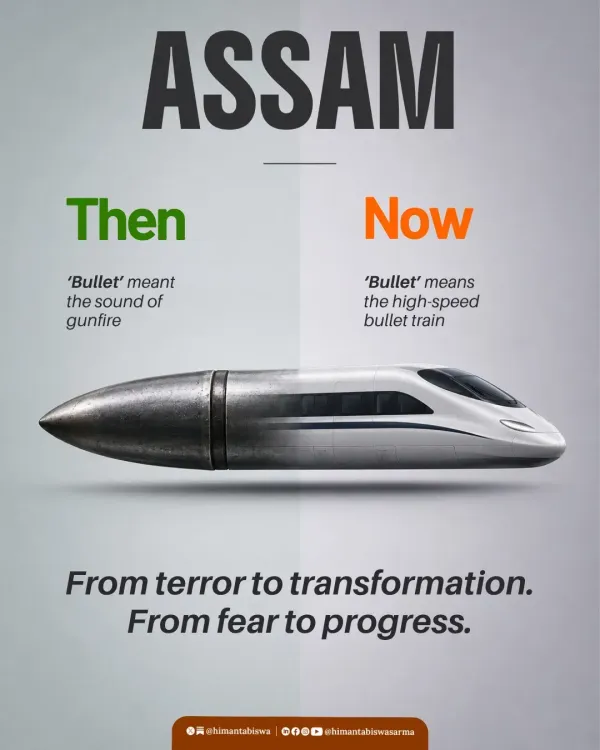
Assam CM Himanta Biswa Sarma on November 4, 2026 declared that Assam has journeyed from decades of insurgency to bullet-train-speed development, anchoring his vision of a transformed Northeast in the peace accords and connectivity push of recent years.
Key Takeaways
Assam CM Himanta Biswa Sarma posted on November 4, 2026 contrasting Assam's insurgency past with its development-focused present.
The Assam Accord of 1985 and the Bodo Peace Accord of 2020 form the documented peace foundation beneath his claim.
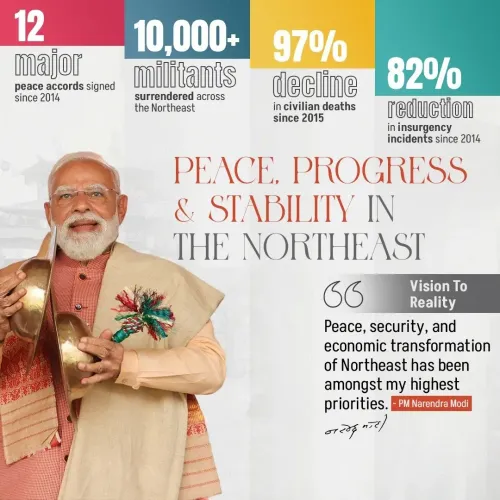
Northeast India has seen a sharp decline in insurgency incidents since 2014 , enabling an accelerated infrastructure push.
Sarma, as convenor of NEDA , frames Assam's transformation as part of a broader Northeast integration narrative.
High-speed rail connectivity for Assam remains an aspirational framing; specific bullet-train project timelines are not confirmed on public record.
From armed insurgency to infrastructure ambition — Assam Chief Minister Himanta Biswa Sarma distilled his state's transformation into a single sweeping image on Wednesday, November 4, 2026, declaring that Assam has moved 'from decades of unrest to dreams to the speed of bullet trains.'
The arc from agitation to accord
The contrast Sarma drew is not rhetorical flourish — it has a documented history. Assam spent much of the late 20th century under the shadow of the Assam Agitation, which culminated in the Assam Accord of 1985, addressing citizenship and immigration grievances that had fractured the state's social fabric. The wounds did not heal overnight. In Bodoland, armed conflict persisted for decades until the Bodo Peace Accord of 2020 granted greater autonomy and development packages to communities that had known little but violence for a generation.
That lineage of peace processes forms the foundation beneath Sarma's claim. Each accord did not just silence guns — it opened the door for roads, rail, and economic projects that insurgency had made impossible.
Northeast's connectivity push and what 'bullet trains' signal
Northeast India has recorded a sharp decline in insurgency incidents since 2014, running parallel to a central and state-level push on connectivity and rail modernisation. Where military convoys once moved through conflict corridors, project engineers now survey rail alignments. Sarma's invocation of bullet-train speed — even as a metaphor — signals where the political imagination of Assam's leadership is now pointed: not at security crackdowns, but at fast infrastructure as the proof-of-peace dividend.
The Chief Minister has consistently framed development spending as the irreversible lock on the peace process — the argument being that prosperity makes a return to conflict structurally harder. 'This is the new Assam,' he wrote, a phrase that doubles as both a governing philosophy and an electoral promise.
Sarma's NEDA role and the larger Northeast narrative
As convenor of the North-East Democratic Alliance (NEDA), Sarma carries a mandate that extends beyond Guwahati. His framing of Assam's transformation feeds directly into a broader BJP political thesis — that the Northeast's integration into the national mainstream is an achievement of the post-2014 governance era. Each infrastructure milestone in the region is pitched as evidence for that thesis, and each such post reinforces that narrative for audiences well beyond Assam's borders.
The question that follows is whether the speed of ambition matches the speed of delivery. Railway upgradation projects are advancing across the Northeast, but high-speed corridors linking Assam with the rest of India remain a vision under active discussion rather than a confirmed timeline. The political signalling is clear; the engineering calendar is still being written.
Point of View
Pre-empting the opposition's development-deficit critique by reframing the entire post-accord era as proof of governance. The bullet-train metaphor is not accidental — it imports the optics of PM Modi's signature infrastructure identity into a Northeast context, reinforcing the BJP's national narrative at a regional level. As NEDA convenor, Sarma is simultaneously speaking to Assam voters and to the alliance's broader Northeast constituency. The gap between aspirational framing and confirmed project timelines, however, is the pressure point critics will probe.
NationPress
5 Nov 2026
Frequently Asked Questions
What did Assam CM Himanta Biswa Sarma say about Assam's development?
On November 4, 2026, CM Sarma wrote that Assam had moved 'from decades of unrest to dreams to the speed of bullet trains,' framing the state's journey from insurgency to development-focused governance as a defining transformation.
What is the history of insurgency in Assam?
Assam witnessed prolonged unrest through movements like the Assam Agitation, resolved by the Assam Accord of 1985, and Bodoland insurgency, addressed by the Bodo Peace Accord of 2020, which granted autonomy and development packages to affected communities.
Is there a bullet train project planned for Assam?
Specific bullet-train project details or confirmed timelines for Assam are not on established public record as of now; CM Sarma's reference to bullet-train speed is widely understood as a metaphor for the state's accelerated development ambitions.
What is NEDA and what is Himanta Biswa Sarma's role in it?
NEDA, the North-East Democratic Alliance, is a BJP-led political alliance of regional parties across the Northeast. Himanta Biswa Sarma serves as its convenor and uses the platform to coordinate governance narratives across the eight northeastern states.
How has Northeast India changed since 2014 in terms of security and infrastructure?
Northeast India has recorded a sharp decline in insurgency incidents since 2014, with both central and state governments significantly ramping up rail modernisation, road connectivity, and economic projects following successive peace agreements.