CM Himanta: Govt Now Funds 59.5% of Assam's Health Spend
Synopsis
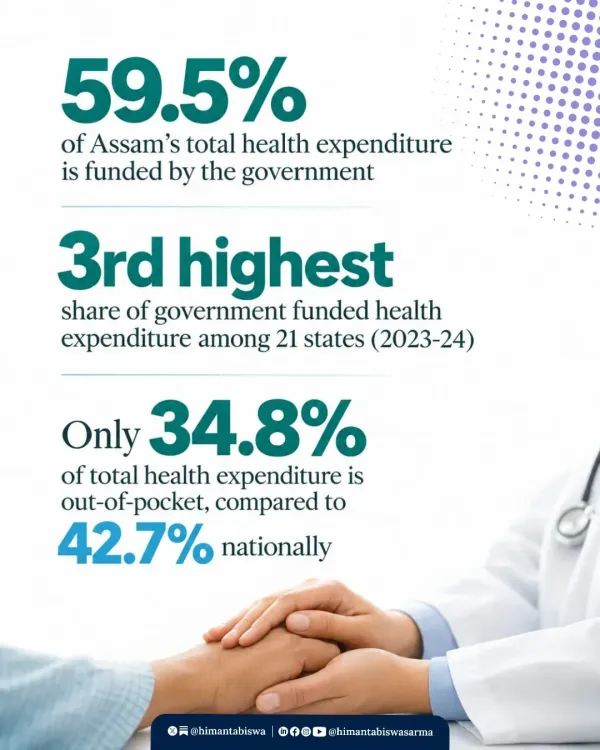
Assam Chief Minister Himanta Biswa Sarma highlighted that the government now funds 59.5% of the state's total health expenditure, per the latest National Health Accounts estimates, underscoring the administration's drive to reduce out-of-pocket costs and expand affordable healthcare access for every family.
Key Takeaways
The Assam government now funds 59.5% of the state's total health expenditure, according to the latest National Health Accounts estimates cited by CM Sarma.
A higher government share directly reduces out-of-pocket spending by families, lowering the risk of catastrophic medical expenses.
The shift aligns with National Health Policy 2017 's target of raising the public share of health spending to 2.5% of GDP .
Ayushman Bharat Pradhan Mantri Jan Arogya Yojana (launched 2018 ) has been a key national instrument expanding publicly funded coverage to low-income households.
Multiple Indian states have reported similar upward shifts in successive National Health Accounts releases, reflecting a broader national trend toward universal health coverage.
The next state budget health allocation and forthcoming National Health Accounts release will indicate whether Assam's public share continues to grow.
Assam families are paying less out of their own pockets for healthcare — and Assam Chief Minister Himanta Biswa Sarma wants them to know exactly why. Citing the latest National Health Accounts estimates, the Chief Minister on Friday, 20 November 2026, announced that the state government now shoulders 59.5% of Assam's total health expenditure, a milestone he says reflects a deliberate policy shift toward affordable, accessible care for every family.
What the 59.5% figure actually means for Assam households
Out-of-pocket health spending has long been a driver of household debt and poverty in India's lower-income states. When governments fund a larger share of total health expenditure, families face fewer catastrophic medical bills — the kind that force a family to sell assets or borrow at ruinous rates to pay for a surgery or a prolonged illness. At 59.5% government share, Assam is signalling that more than half the state's health cost burden has shifted from individual families to the public exchequer.
The National Health Accounts framework, maintained by the Union Ministry of Health and Family Welfare, periodically maps total health expenditure by source across all states, making it one of the few standardised tools to track exactly this kind of shift. Each successive release has shown a gradual national trend of rising public share — and states like Assam pointing to their own numbers signals that the trend is now being claimed as a governance achievement at the state level.
Assam's push inside a national health financing drive
The backdrop matters. National Health Policy 2017 set an explicit target: raise government health expenditure to 2.5% of GDP while driving down out-of-pocket payments. Ayushman Bharat Pradhan Mantri Jan Arogya Yojana, launched in 2018, extended publicly funded health insurance to low-income households across the country, adding a crucial demand-side lever to the supply-side expansion of public facilities.
Assam's claim of a 59.5% government share fits squarely into this national trajectory. Multiple states have reported similar upward shifts in successive National Health Accounts releases as insurance enrolment rises and primary health infrastructure improves. For a northeastern state historically constrained by geography and connectivity, reaching this share is not a trivial administrative outcome.
CM Sarma's healthcare vision and what comes next
Himanta Biswa Sarma, who has served as Chief Minister since 2021 and also convenes the North-East Democratic Alliance (NEDA), has repeatedly positioned healthcare access as a flagship governance priority. Friday's post frames the statistic not as an end point but as evidence of direction — 'quality healthcare that is affordable and accessible for every family,' in his words.
The numbers to watch next: Assam's health allocation in the coming state budget, and the subsequent National Health Accounts release, which will show whether the 59.5% share holds or climbs further. If it does, Assam's model could become a reference point for other northeastern and aspirational states navigating the same out-of-pocket crisis.
Point of View
Raising the public share of health spending carries added political weight: it speaks directly to a population where household medical costs have historically contributed to rural indebtedness. If subsequent National Health Accounts releases validate continued progress, Assam's model could become a template cited in northeast-focused policy discussions ahead of future assembly cycles.
NationPress
20 Nov 2026
Frequently Asked Questions
What does it mean that Assam's government funds 59.5% of health expenditure?
It means the state and central government together bear 59.5% of all health costs in Assam, so individual families pay a smaller share from their own pockets, reducing the risk of catastrophic medical bills.
What is the National Health Accounts framework in India?
The National Health Accounts is a framework maintained by the Union Ministry of Health and Family Welfare that periodically estimates total health expenditure across India, broken down by source — government, households, employers, and others — allowing state-by-state comparisons.
How does Assam's health spending share compare to national targets?
India's National Health Policy 2017 set a target of raising government health expenditure to 2.5% of GDP; Assam's reported 59.5% government share of total state health expenditure reflects progress toward reducing out-of-pocket costs in line with that national direction.
What is Ayushman Bharat and how does it affect Assam?
Ayushman Bharat Pradhan Mantri Jan Arogya Yojana, launched in 2018, provides publicly funded health insurance to low-income households nationwide. In Assam, enrolment under the scheme contributes to shifting health costs from families to government sources.
Who is Himanta Biswa Sarma and what is his role in Assam's health policy?
Himanta Biswa Sarma has been Chief Minister of Assam since 2021 and is a BJP leader who also convenes the North-East Democratic Alliance (NEDA). He has positioned affordable healthcare access as a central governance priority of his administration.