CM Himanta flags North East connectivity revolution under Modi
Synopsis
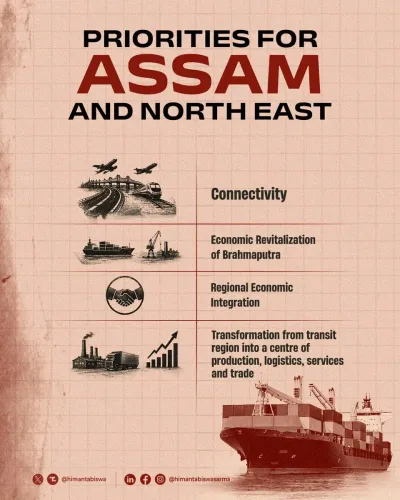
Assam CM Himanta Biswa Sarma on 13 June 2026 declared a 'connectivity revolution' across North East India, pointing to integrated investments in roads, railways, airports and waterways guided by PM Modi's Act East vision and Bharatmala Pariyojana.
Key Takeaways
Assam CM Himanta Biswa Sarma on 13 June 2026 described a multimodal 'connectivity revolution' unfolding across North East India .
Investments span all four transport modes: roads, railways, airports and waterways , covering Assam and neighbouring states.
The push is anchored in PM Narendra Modi 's Act East Policy (announced 2014 ) and Bharatmala Pariyojana (launched 2015 ).
SARDP-NE , approved in 2005 , provided the foundational road network now being upgraded with rail and waterway layers.
As NEDA convenor , CM Sarma coordinates implementation across all eight North Eastern states .
Sustained investment could position the North East as a key transit corridor between South Asia and Southeast Asia .
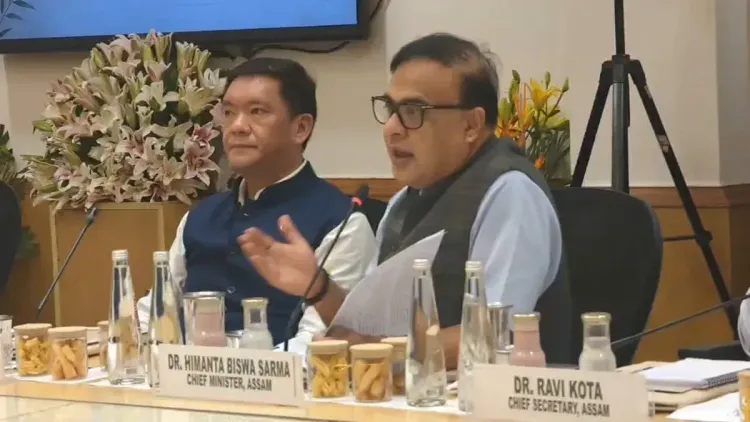
Assam Chief Minister Himanta Biswa Sarma on Saturday, 13 June 2026, highlighted what he described as a 'connectivity revolution' unfolding across North East India, citing accelerating investments in roads, railways, airports and waterways that are linking Assam and its neighbouring states into a more integrated regional network.
Context
CM Sarma stated that the investments span all four major transport modes — road, rail, air and inland waterway — and are 'knitting the region together like never before.' He attributed the momentum to the vision of Prime Minister Narendra Modi, framing the push as a deliberate, integrated strategy rather than a collection of standalone projects. The post was accompanied by a video, underscoring the visual scale of ongoing work across the region.
The North East, comprising eight states, has historically faced connectivity deficits rooted in its difficult terrain, sparse population density and distance from the national economic core. Bridging that gap has been a stated priority for successive governments, but the current phase is notable for its multimodal emphasis.
Policy Backdrop
Modi's Act East Policy, announced in 2014, reoriented India's strategic and economic engagement toward Southeast Asia, with improved North East connectivity as a foundational pillar. Physical links to ASEAN nations through Myanmar and Bangladesh depend directly on the quality of roads, rail and waterway networks within the region itself.
Two major programmes underpin the current build-out. Bharatmala Pariyojana, launched in 2015, incorporated multiple highway corridors across the North Eastern states into a national network. The older Special Accelerated Road Development Programme for North East (SARDP-NE), approved in 2005 and expanded in subsequent years, laid the groundwork for the arterial routes now being upgraded or completed. The present phase layers railways and inland waterways onto that road foundation.
As convenor of the North-East Democratic Alliance (NEDA), CM Sarma plays a central coordinating role among the region's state governments, making his assessment of regional progress politically significant beyond Assam's borders.
Stakeholders and Impact
The primary beneficiaries of improved connectivity are the roughly 50 million residents of the North East, who stand to gain faster access to markets, healthcare and employment. Regional traders and small businesses are expected to see lower logistics costs as multimodal corridors reduce dependence on single-road routes that are vulnerable to landslides and seasonal disruptions.
Tourism operators across states such as Meghalaya, Arunachal Pradesh, Sikkim and Assam itself have a direct stake in airport upgrades and improved road access to heritage and natural sites. Inland waterway development along the Brahmaputra and its tributaries also opens freight and passenger options that road and rail cannot easily replicate in flood-prone zones.
Strategically, the connectivity push strengthens India's hand in managing its borders with China, Myanmar and Bangladesh, enabling faster troop and supply movement alongside civilian economic benefits.
What's Next
Attention will turn to budgetary allocations and project completion timelines for railway lines and inland waterway terminals in the 2025-26 fiscal year. State-level coordination under NEDA will be a key mechanism for tracking whether the integrated multimodal vision translates into on-ground delivery across all eight North Eastern states.
If the current investment pace is sustained, the North East could emerge as a functional transit corridor linking South Asia to Southeast Asia — a strategic and economic outcome that would reshape the region's role in India's broader foreign and trade policy.
Point of View
The message reinforces the Centre-state alignment that NEDA was designed to project. The shift from single-mode road projects to integrated road-rail-air-waterway corridors also marks a strategic maturation in how India is approaching its Act East commitments. Whether on-ground delivery matches the political messaging will be the real test, particularly on railway lines and inland waterway terminals where timelines have historically slipped.
NationPress
13 Sept 2026
Frequently Asked Questions
What is the connectivity revolution CM Himanta Biswa Sarma is talking about in North East India?
CM Sarma is referring to a large-scale, multimodal infrastructure push across the eight North Eastern states that includes simultaneous investments in roads, railways, airports and inland waterways, framed as an integrated strategy under PM Modi's Act East Policy.
What is the Act East Policy and how does it relate to North East infrastructure?
The Act East Policy, announced by PM Modi in 2014, aims to strengthen India's economic and strategic ties with Southeast Asia. Improved physical connectivity within North East India — through roads, rail and waterways — is a prerequisite for opening viable trade and transit routes toward ASEAN nations.
What is Bharatmala Pariyojana and does it cover North East India?
Bharatmala Pariyojana is a national highway development programme launched in 2015. It explicitly incorporates multiple highway corridors across the North Eastern states, making it one of the primary vehicles for the road-connectivity component CM Sarma highlighted.
What is NEDA and what role does CM Himanta Biswa Sarma play in it?
NEDA, the North-East Democratic Alliance, is a political alliance of BJP and like-minded parties governing states in the North East. CM Himanta Biswa Sarma serves as its convenor, giving him a coordinating role across the region's state governments on shared priorities including infrastructure.
Which states in North East India benefit from the current infrastructure investments?
The investments cover all eight North Eastern states — Assam, Arunachal Pradesh, Meghalaya, Manipur, Mizoram, Nagaland, Sikkim and Tripura — with Assam serving as the regional hub for many road, rail and waterway corridors.