CM Himanta Honours Bordoloi as Architect of Assam's Integration
Synopsis
CM Himanta Biswa Sarma, in his official speech anthology, calls Lokapriya Gopinath Bordoloi a towering personality without whom Assam's history cannot be written, crediting his 1947-era leadership for keeping the state an integral part of India.
Key Takeaways
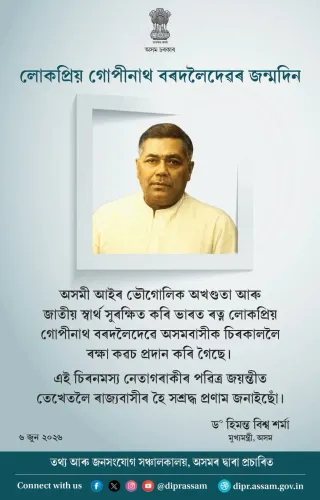
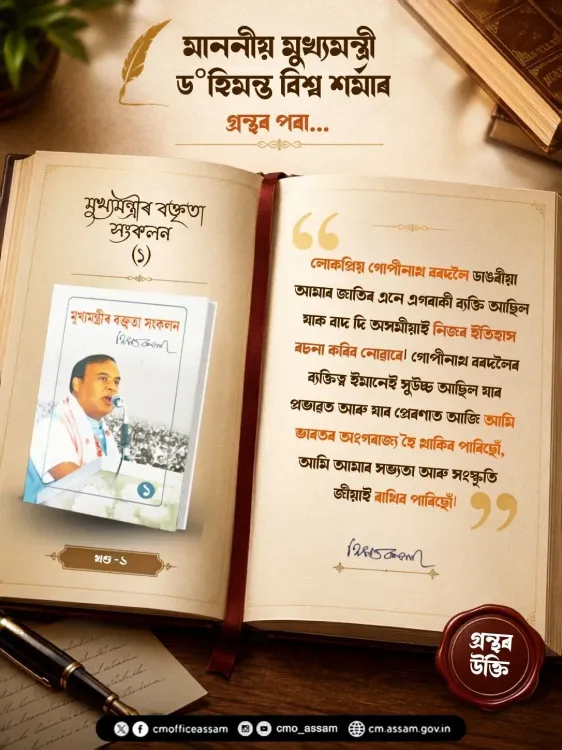
The Chief Minister's Office of Assam shared a tribute to Lokapriya Gopinath Bordoloi on 7 July 2026 .
Himanta Biswa Sarma called Bordoloi a 'towering personality' without whom Assamese history cannot be written.
The quote is drawn from Volume 1 of Mukhyamantrir Boktrita Sankalan , an official compilation of the Chief Minister's speeches.
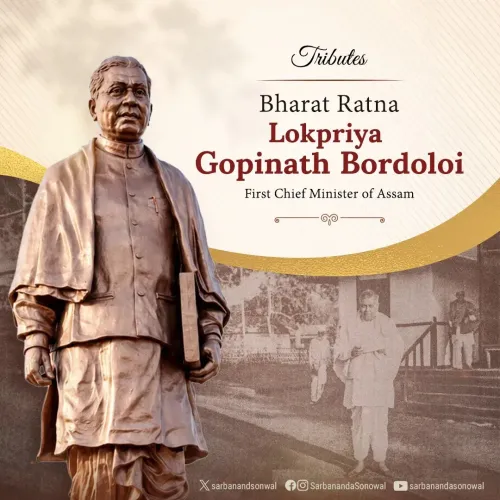
Gopinath Bordoloi was Assam's first Chief Minister and a posthumous Bharat Ratna awardee.
Bordoloi's resistance to the 1946–47 Cabinet Mission grouping plan preserved Assam's direct link to the Indian Union.
The current administration frames its governance narrative within this same tradition of national integration.
The Chief Minister's Office of Assam on Tuesday, 7 July 2026 shared a tribute to Lokapriya Gopinath Bordoloi, quoting Chief Minister Dr. Himanta Biswa Sarma from the first volume of his official speech anthology, Mukhyamantrir Boktrita Sankalan, underscoring Bordoloi's indispensable role in shaping the state's place within the Indian Union.
Context
The quoted passage from CM Dr. Himanta Biswa Sarma reads: 'Lokapriya Gopinath Bordoloi was one of those towering personalities without whom the Assamese cannot write their own history. It is because of his vision and leadership that we remain an integral part of India.' The statement appears in Volume 1 of Mukhyamantrir Boktrita Sankalan, a compilation of the Chief Minister's speeches on state history and governance.
The tribute places Bordoloi at the centre of Assam's foundational political narrative, framing his legacy as the reason the state remained connected to the Indian Union rather than drifting into a separate administrative grouping at the time of independence.
Policy Backdrop
Gopinath Bordoloi served as the first Chief Minister of Assam after independence and was awarded the Bharat Ratna posthumously for his contributions to national integration. His most consequential act came during the 1946–47 Cabinet Mission negotiations, when he successfully resisted a plan that would have grouped Assam with Muslim-majority provinces under a separate administrative section.
Had that grouping proceeded, Assam's constitutional relationship with the Indian Union would have been fundamentally different. Bordoloi's resistance — conducted through sustained negotiation with central leadership — preserved the state's direct link to the republic that came into being on 26 January 1950.
Stakeholders and Impact
For the people of Assam, Bordoloi's legacy carries both historical and contemporary resonance. His role in the partition-era negotiations is taught as a defining moment in the state's political identity, and successive governments have invoked his memory when articulating themes of national integration and Assamese distinctiveness within the Indian federal structure.
The publication of Mukhyamantrir Boktrita Sankalan as an official speech anthology signals the current administration's intent to anchor its governance narrative in that same historical lineage — linking CM Himanta Biswa Sarma's tenure directly to the decisions of 1947.
What's Next
Further volumes of Mukhyamantrir Boktrita Sankalan are expected to continue compiling the Chief Minister's speeches, potentially deepening the official record of how the current government interprets Assam's post-independence history. State-sponsored commemorations and any curriculum references tied to Bordoloi's role in Assam's accession will be worth watching as markers of how prominently this legacy features in public policy discourse going forward.
Point of View
The Himanta Biswa Sarma administration is doing more than commemorating a historical figure — it is constructing a documented ideological lineage for its governance. The invocation of Bordoloi's resistance to partition-era grouping carries unmistakable contemporary resonance in a state where questions of territory, identity, and belonging remain politically live. Successive Assam governments across party lines have drawn on Bordoloi's legacy, but publishing it in a compiled volume signals an intent to institutionalise that narrative. The move reflects a broader pattern among state governments of using official publications to shape the historical memory that underpins current political authority.
NationPress
7 Jul 2026
Frequently Asked Questions
Who was Lokapriya Gopinath Bordoloi?
Lokapriya Gopinath Bordoloi was the first Chief Minister of Assam after Indian independence and was awarded the Bharat Ratna posthumously. He is credited with resisting the 1946–47 Cabinet Mission plan that would have grouped Assam with Muslim-majority provinces, thereby keeping the state an integral part of the Indian Union.
What is Mukhyamantrir Boktrita Sankalan?
Mukhyamantrir Boktrita Sankalan is an official anthology of speeches by Assam Chief Minister Dr. Himanta Biswa Sarma. Volume 1 has been published and includes addresses on state history and governance, including the tribute to Gopinath Bordoloi quoted in the post.
Why is Gopinath Bordoloi important to Assam's history?
Bordoloi is considered the architect of Assam's integration into India. During the 1946–47 Cabinet Mission negotiations, he successfully opposed a plan that would have placed Assam in a separate administrative grouping with Muslim-majority regions, preserving the state's direct constitutional link to the Indian Union.
What did CM Himanta Biswa Sarma say about Bordoloi?
CM Dr. Himanta Biswa Sarma said: 'Lokapriya Gopinath Bordoloi was one of those towering personalities without whom the Assamese cannot write their own history. It is because of his vision and leadership that we remain an integral part of India.'
What was the Cabinet Mission plan for Assam in 1947?
The Cabinet Mission's grouping plan of 1946–47 proposed placing Assam alongside Muslim-majority provinces in a separate administrative section. Gopinath Bordoloi opposed and ultimately defeated this plan, ensuring Assam joined the Indian Union directly rather than through an intermediate grouping.