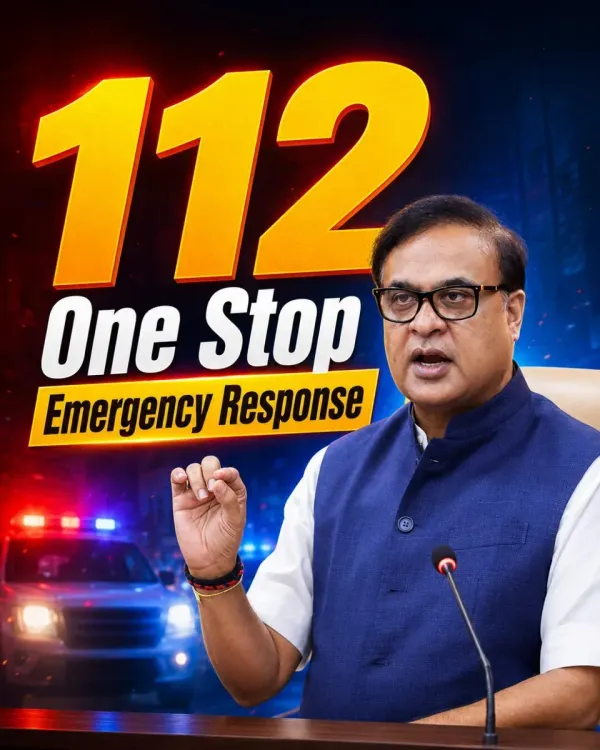
CM Himanta Launches 112 Emergency System for Assam
Synopsis
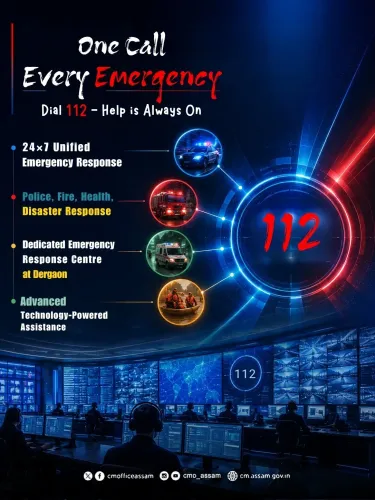
Assam Chief Minister Himanta Biswa Sarma has announced a 112 Emergency Management System monitored from LBPA, Assam, set to deploy 200 mobile police stations for rapid emergency response across the state, building on the national ERSS framework launched in 2018.
Key Takeaways
Assam CM Himanta Biswa Sarma announced the 112 Emergency Management System on 6 July 2026 .
The system will monitor and dispatch the nearest of 200 mobile police stations in response to emergency calls.
Central monitoring will be based at Lok Bandhu Police Academy (LBPA), Assam .
The initiative is built on the Ministry of Home Affairs' national ERSS framework launched in 2018 .
An official launch date has not been specified; the Chief Minister described deployment as coming 'soon'.
The upgrade is part of a broader pattern of technology-led policing reforms in Assam since 2021 .
Assam Chief Minister Himanta Biswa Sarma on Monday, 6 July 2026, announced an upgraded 112 Emergency Management System for the state, promising that a fleet of mobile police stations will be dispatched to any emergency caller within the shortest possible time. The system will be monitored centrally from the Lok Bandhu Police Academy (LBPA), Assam, and is set to deploy across the state imminently.
Context
In his post, Sarma stated: 'Dial 112, we'll take care of the rest. Soon, Assam Police's 112 Emergency Management System, monitored from LBPA Assam, will dispatch the nearest of its 200 mobile police stations for a swift response to any emergency.' The announcement signals a significant operational upgrade for Assam Police, positioning the state as one of the more technologically advanced forces in the Northeast in terms of emergency response infrastructure.
The single emergency number 112 serves as the unified contact point for police, fire, and medical emergencies across India. Assam's new system builds on this national framework by adding a dedicated fleet of mobile units that can be tracked and dispatched in real time from a central command hub.
Policy Backdrop
The Ministry of Home Affairs launched the pan-India Emergency Response Support System (ERSS) in 2018 to integrate all emergency services under the single number 112, replacing the fragmented system of separate numbers for police (100), fire (101), and ambulance (108). States were tasked with building their own command-and-control infrastructure aligned with the national framework.
Assam has progressively modernised its policing apparatus since 2021, when Sarma assumed office. The deployment of 200 mobile police stations linked to a centralised monitoring system at LBPA, Assam represents the most visible operational expression of that modernisation drive. Multiple states, particularly those governed by the BJP, have pursued similar technology-led policing upgrades under the ERSS umbrella to reduce emergency response times.
Stakeholders and Impact
For ordinary citizens across Assam, the practical promise is straightforward: a single call to 112 will trigger the dispatch of the nearest mobile police unit rather than relying on a static police station that may be kilometres away. This is especially significant for residents in rural and semi-urban areas of the state, where distances between police outposts can be considerable.
Assam Police stands to gain operationally through better resource allocation, real-time vehicle tracking, and a unified command picture. The central monitoring role assigned to LBPA, Assam also suggests the system will serve a training and quality-assurance function alongside its dispatch role. Civil society groups and women's safety advocates have consistently identified faster police response as a priority concern in the state.
What's Next
The Chief Minister's use of the word 'soon' leaves the precise launch date unspecified. Observers will watch for the official inauguration, the integration of the new system with existing district control rooms, and the publication of response-time benchmarks once the network becomes operational.
If the 200-unit mobile fleet is deployed as described and response-time data is made public, Assam could set a measurable standard for emergency policing in the Northeast — and potentially influence how other states structure their own ERSS implementations going forward.
Point of View
Allowing Sarma to demonstrate tangible security infrastructure investment. Framing the system around a single memorable action — 'Dial 112, we'll take care of the rest' — is a deliberate public communication choice that prioritises citizen accessibility over technical detail. The deployment fits a wider BJP-state pattern of using national schemes such as ERSS as platforms for state-level branding of policing upgrades. Whether the system delivers on its promise will ultimately depend on operational execution, response-time transparency, and adequate staffing of the mobile units.
NationPress
7 Jul 2026
Frequently Asked Questions
What is the 112 Emergency Management System in Assam?
It is an upgraded emergency response system for Assam in which a centralised command hub at LBPA, Assam monitors and dispatches the nearest of 200 mobile police stations when a citizen dials 112 .
How many mobile police stations will Assam deploy under the new 112 system?
Assam Police plans to deploy 200 mobile police stations that can be tracked and dispatched in real time from the central monitoring centre.
When will Assam's new 112 emergency system be launched?
Chief Minister Himanta Biswa Sarma described the launch as coming 'soon' in his announcement on 6 July 2026 , but an exact date has not been confirmed.
What is India's national ERSS and how does Assam's system relate to it?
The Emergency Response Support System (ERSS) was launched by the Ministry of Home Affairs in 2018 to unify police, fire, and medical emergencies under the single number 112. Assam's new system is built on this national framework with state-specific mobile dispatch infrastructure.