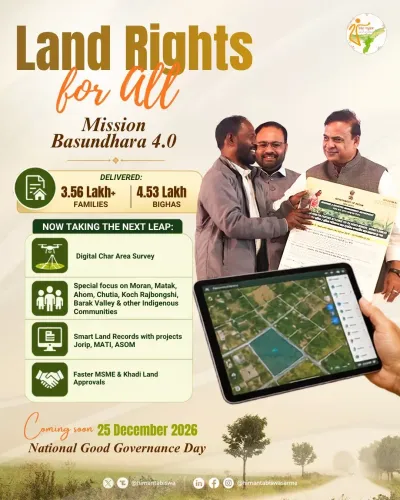
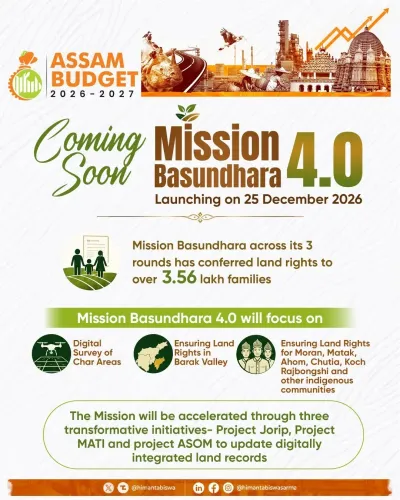
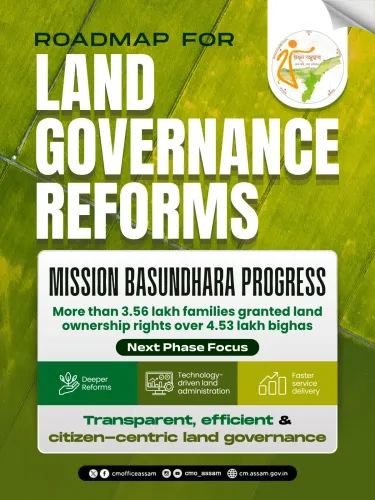
CM Himanta launches Mission Basundhara 4.0 in Assam

Synopsis
Assam Chief Minister Himanta Biswa Sarma launched Mission Basundhara 4.0 on 9 August 2026, the fourth phase of the state's flagship land-records modernisation drive, framing land as a source of identity and security for Assam's people.
Key Takeaways
Mission Basundhara 4.0 was announced by Assam CM Himanta Biswa Sarma on 9 August 2026 .
The programme is the fourth phase of a land-records modernisation initiative first launched in 2021 .
CM Sarma described land as 'a source of identity, security and opportunity' — framing the reform as a rights agenda, not just a digitisation exercise.
Earlier phases focused on digitising records, simplifying mutations, and settling pending land-rights cases across Assam.
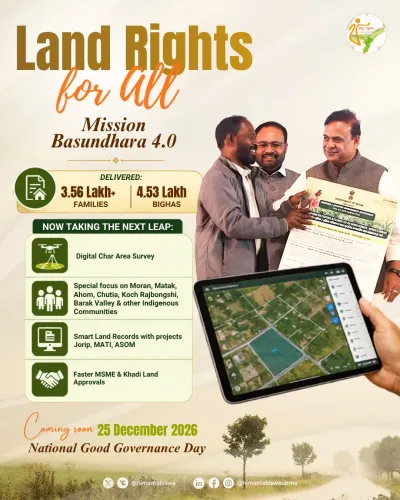
Specific features, budget, and targets for Mission Basundhara 4.0 have not yet been disclosed.
Indigenous communities and plain-district landholders are key stakeholders watching for district-level implementation details.
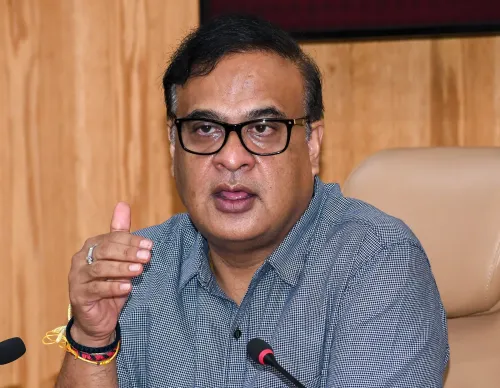
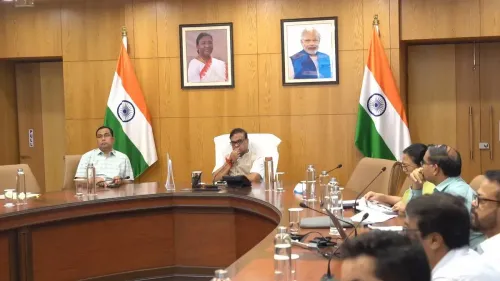
Land is power — and in Assam, the state government is betting that getting its land records right can reshape lives. Assam Chief Minister Himanta Biswa Sarma announced the launch of Mission Basundhara 4.0 on Sunday, 9 August 2026, calling it 'a landmark reform that will shape the future of land administration' in the state.
The fourth push in Assam's land-records overhaul
Mission Basundhara is not new — it was first launched in 2021 as a flagship drive to modernise Assam's land revenue administration, digitise records, simplify mutation processes, and clear a backlog of pending land-rights cases. Each successive phase has built on the last, addressing what successive governments have acknowledged as one of the state's most stubborn governance gaps: fragmented titles, disputed boundaries, and years-long litigation that locks ordinary families out of the security their land should provide.
The fourth iteration arrives as CM Sarma frames the issue in explicitly human terms. 'Land is not just an asset,' he said, 'but also a source of identity, security and opportunity for our people.' That framing matters — it signals the programme is being positioned not merely as a bureaucratic digitisation exercise, but as a rights-and-recognition agenda, particularly relevant in a state where indigenous communities have long sought formal title to ancestral holdings.
Why Assam's land question cuts deep
Assam's land governance challenges are layered in ways few other Indian states can match. Decades of migration, shifting river courses, and the coexistence of general revenue land with tribal belts and blocks have produced a landscape of competing claims that paper-based records were never equipped to resolve. The national Digital India Land Records Modernisation Programme provided a framework, but implementation in the northeast has required state-specific adaptations.
For landholders in both the Brahmaputra valley plains and the hill districts, a clean, legally recognised title is the difference between accessing bank credit and being shut out of it — between passing on a family's most valuable asset with confidence and leaving heirs to fight it out in court. Mission Basundhara's earlier phases are credited with processing hundreds of thousands of mutation and settlement cases; the fourth phase is expected to push that effort further, though specific targets and a budget have not yet been disclosed.
What officials and communities will be watching
The announcement sets the political direction; the operational details are what stakeholders will now wait for. District-level targets, the scope of any new legislative amendments needed to back the reforms, and the timeline for delivery will determine whether Mission Basundhara 4.0 lands as a genuine administrative leap or another incremental update. Indigenous community groups, in particular, will be watching whether this phase extends formal recognition to holdings in tribal belt areas that previous rounds left unresolved.
For CM Sarma, the programme also carries political weight — land rights have been a defining issue in Assam's electoral politics, and a visible, deliverable reform ahead of future election cycles is an asset as much as a governance imperative.
The chapter is open. The details will write the story.
Point of View
The announcement speaks directly to indigenous anxieties that have historically driven electoral outcomes in the state. The fourth phase also signals institutional confidence — successive iterations suggest the programme has survived scrutiny and built enough administrative muscle to keep scaling. The real test, as with earlier phases, will be whether district-level delivery matches the ambition of the announcement.
NationPress
9 Aug 2026
Frequently Asked Questions
What is Mission Basundhara 4.0 in Assam?
Mission Basundhara 4.0 is the fourth phase of Assam's flagship land administration reform programme, announced by Chief Minister Himanta Biswa Sarma on 9 August 2026. It aims to modernise land records, simplify mutation processes, and settle pending land-rights cases across the state.
When was Mission Basundhara first launched?
Mission Basundhara was first launched in 2021 by the Assam government under Chief Minister Himanta Biswa Sarma to digitise land records and reduce land disputes.
Who benefits from Mission Basundhara in Assam?
The primary beneficiaries are Assam's landholders — particularly indigenous communities and families in both plain and tribal districts who have long-pending land title or mutation cases.
What are the specific features of Mission Basundhara 4.0?
The specific features, budget, and district-level targets of Mission Basundhara 4.0 have not yet been officially disclosed. The government is expected to release operational guidelines in the coming weeks.
Why is land governance important in Assam?
Assam has complex land governance challenges due to decades of migration, shifting river courses, and overlapping tribal and general revenue land categories. Unresolved titles block access to credit and inheritance, making land reform a high-stakes social and economic issue.