CM Himanta Marks 6 Months of Nalbari District Stadium

Synopsis
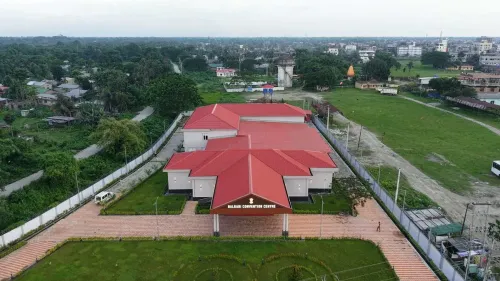
Assam Chief Minister Himanta Biswa Sarma marked six months of Nalbari's district stadium on 12 July 2026, calling it a hub for local talent and healthy living. The venue is part of a state initiative to equip all 35 Assam districts with dedicated sports infrastructure, addressing the historic concentration of facilities in Guwahati.
Key Takeaways
CM Himanta Biswa Sarma highlighted the six-month milestone of Nalbari 's district stadium on 12 July 2026 .
The stadium is described as a hub for nurturing local sporting talent and promoting a healthy lifestyle in the district.
The Nalbari facility is part of a broader state plan to equip all 35 districts of Assam with dedicated sports infrastructure.
The initiative addresses the historic concentration of quality sports facilities in Guwahati and larger urban centres.
Assam expanded to 35 districts between 2015 and 2023, forming the administrative basis for the uniform district-level rollout.
Completion timelines for stadiums in remaining districts and linked coaching or tournament programmes remain the key milestones to watch.
Assam Chief Minister Himanta Biswa Sarma on Sunday, 12 July 2026 highlighted the six-month milestone of Nalbari's district stadium, describing the facility as an emerging hub for local sporting talent and community health promotion. The post, shared on X, situates the Nalbari stadium within a state-wide push to build or upgrade sports infrastructure across all 35 districts of Assam.
Context
In the post, CM Sarma wrote that the Nalbari district stadium is 'becoming a hub to nurture local sporting talent and promote a healthy lifestyle' six months after its inauguration. He described this as 'part of our broader initiative of equipping each of Assam's 35 districts with such a facility.' The remark frames the Nalbari venue not as an isolated project but as one node in a district-by-district rollout of sports infrastructure across the state.
Policy Backdrop
Assam's sports infrastructure push reflects a long-standing concern about the concentration of quality facilities in Guwahati and a handful of urban centres, leaving athletes in smaller districts without adequate training venues. The Assam Sports and Youth Welfare Department has anchored the broader programme, which aims to place at least one multi-purpose stadium in every district to support grassroots training and community fitness activities.
The administrative foundation for this initiative was laid between 2015 and 2023, when Assam expanded its district count to 35, creating the administrative units that now serve as the basis for uniform district-level infrastructure planning. Similar district-stadium programmes have been pursued by other north-eastern states, reflecting a regional consensus on decentralised sports development as a tool for youth engagement.
Stakeholders and Impact
The primary beneficiaries of the Nalbari facility — and the wider programme — are local athletes, school-age youth, and district-level sports associations who previously had limited access to structured training environments. A functional district stadium typically enables regular inter-district tournaments, coaching camps, and fitness programmes, creating a pipeline from grassroots participation to state-level competition.
Community health is an equally stated objective. Multi-purpose district stadiums in Assam are designed to serve general public fitness use alongside competitive sport, making them dual-purpose civic assets. For a district like Nalbari in western Assam, the facility represents a meaningful addition to public infrastructure beyond the capital region.
What's Next
The central question now is the pace of delivery across the remaining districts. With the Nalbari stadium marking six months of operation, attention will turn to inauguration timelines for venues in districts where construction is ongoing or planned. Any state government announcements on coaching academies, inter-district tournament calendars, or talent-identification programmes linked to these stadiums would signal the next phase of the initiative.
If the programme reaches completion across all 35 districts, Assam would hold one of the more comprehensive district-level sports infrastructure networks in north-east India — a model that could influence similar planning in neighbouring states under the North-East Democratic Alliance (NEDA) framework that CM Sarma convenes.
Point of View
Using a six-month anniversary to reinforce the narrative of systematic, district-by-district governance delivery ahead of any future electoral cycle in Assam. The 35-district framing is significant: it universalises the promise, making every district a potential beneficiary and every local athlete a stakeholder in the government's delivery record. The focus on both talent development and public health broadens the political constituency for what is essentially an infrastructure announcement. Within the NEDA context, visible sports infrastructure in smaller districts also serves as a tangible symbol of development in a region where governance reach has historically been uneven.
NationPress
11 Oct 2026
Frequently Asked Questions
What is the Nalbari district stadium in Assam?
The Nalbari district stadium is a sports facility in Nalbari , western Assam, inaugurated as part of the state government's initiative to provide dedicated sports infrastructure in each of Assam's 35 districts . It is designed to support grassroots athletic training and community fitness activities.
How many district stadiums is Assam planning to build?
The Assam government, under CM Himanta Biswa Sarma , has announced a plan to equip all 35 districts of Assam with a dedicated sports facility, aiming to decentralise sports infrastructure beyond Guwahati .
Why is Assam building district-level stadiums?
The initiative addresses the long-standing concentration of quality sports facilities in Guwahati and a few urban centres. District-level stadiums are intended to provide local athletes with structured training environments and to promote community health across the state.
What is Himanta Biswa Sarma's role in Assam sports development?
Himanta Biswa Sarma is the Chief Minister of Assam and has championed decentralised sports infrastructure as part of his government's broader youth and development agenda, with the Assam Sports and Youth Welfare Department overseeing implementation.
When did Assam expand to 35 districts?
Assam expanded its number of districts to 35 through a series of reorganisations between 2015 and 2023 , and these administrative units now form the basis for the state's uniform district-level infrastructure programmes, including the stadium rollout.