CM Himanta Marks World No Tobacco Day, Urges Healthier Choices
Synopsis
Assam Chief Minister Himanta Biswa Sarma marked World No Tobacco Day on 31 May 2026 by urging citizens to raise awareness about tobacco's harmful effects and commit to healthier choices, echoing India's two-decade legislative push under COTPA and the National Tobacco Control Programme.
Key Takeaways
Assam CM Himanta Biswa Sarma posted a World No Tobacco Day message on 31 May 2026 , calling for renewed commitment to tobacco awareness.
World No Tobacco Day is a WHO -established annual observance, held every year since 1987 on 31 May .
India's Cigarettes and Other Tobacco Products Act (COTPA), 2003 and ratification of the WHO Framework Convention on Tobacco Control in 2005 form the backbone of the country's tobacco control regime.
The National Tobacco Control Programme (2007-08) funds state-level enforcement and cessation services, including in Assam .
India's National Health Policy 2017 targets a 30 percent reduction in tobacco use prevalence by 2025 as part of non-communicable disease prevention.
Northeastern states including Assam face distinct challenges around high smokeless tobacco consumption alongside national tobacco control goals.
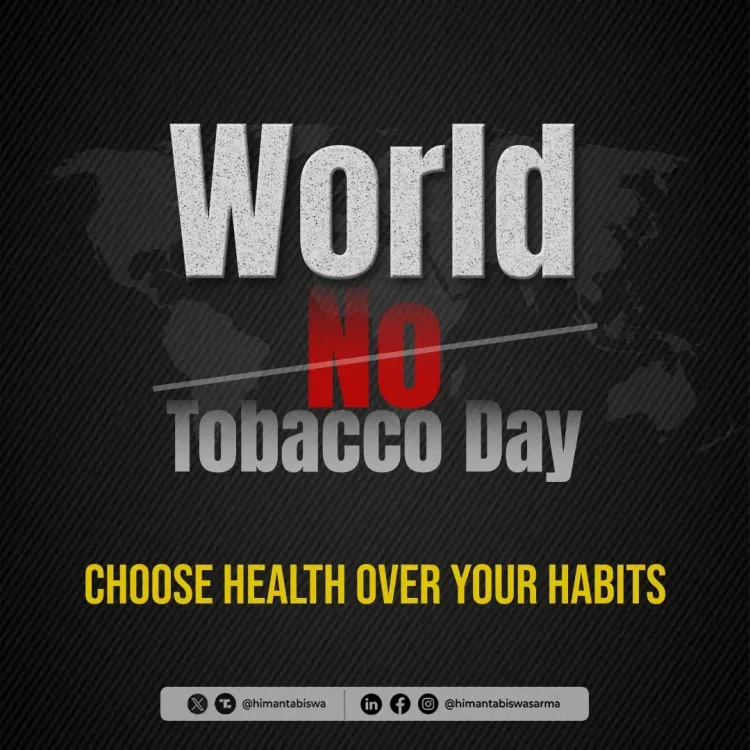
Assam Chief Minister Himanta Biswa Sarma on Sunday, 31 May 2026 marked World No Tobacco Day by calling on citizens to reaffirm their commitment to a healthier future, urging awareness of tobacco's harmful effects and encouraging people to make healthier choices.
Context
World No Tobacco Day is observed every year on 31 May, a date established by the World Health Organization (WHO) in 1987 to draw global attention to the health risks associated with tobacco use. The day serves as a focal point for governments, health bodies, and civil society to intensify public messaging around cessation and prevention.
Chief Minister Sarma's message — 'let us reaffirm our commitment to a healthier future by raising awareness about the harmful effects of tobacco and encouraging healthier choices' — aligns with the annual global call to action that WHO and member states coordinate each year.
Policy Backdrop
India has built a layered legislative and programmatic framework for tobacco control over the past two decades. The Cigarettes and Other Tobacco Products Act (COTPA), 2003 prohibits smoking in public places and tightly regulates tobacco advertising, promotion, and sponsorship. India subsequently ratified the WHO Framework Convention on Tobacco Control in 2005, binding itself to international standards on pricing, packaging, and demand-reduction measures.
The National Tobacco Control Programme (NTCP), launched in 2007-08, operationalised these commitments at the state level through awareness campaigns, enforcement support, and tobacco cessation services. Tobacco control also features in India's National Health Policy 2017, which set a target of reducing tobacco use prevalence by 30 percent by 2025 as part of a broader non-communicable disease prevention agenda.
Northeastern states, including Assam, have aligned their health campaigns with the national programme while contending with a distinct regional challenge: comparatively high rates of smokeless tobacco consumption, which includes products such as gutka, khaini, and betel-quid mixtures.
Stakeholders and Impact
The primary beneficiaries of intensified tobacco control messaging are current tobacco users seeking cessation support, youth who are the primary target of prevention campaigns, and state health departments responsible for enforcement and service delivery. In a state like Assam, where smokeless tobacco use has historically been prevalent, public awareness drives carry particular weight.
Civil society groups, school and college networks, and frontline health workers under programmes such as Ayushman Bharat are typically mobilised around World No Tobacco Day to amplify cessation messaging at the grassroots level. Industry stakeholders — particularly manufacturers of bidis, cigarettes, and smokeless tobacco products — remain subject to evolving regulatory scrutiny under COTPA and its proposed amendments.
What's Next
Observers will watch for the release of the next round of Global Adult Tobacco Survey (GATS) state-level data, which will indicate whether India is on track to meet its National Health Policy 2017 prevalence-reduction target. Possible amendments to COTPA rules — including stricter pictorial health warnings and restrictions on single-stick sales — remain under policy discussion at the central level.
At the state level, Assam's health administration is expected to sustain awareness campaigns through the year, with World No Tobacco Day providing an annual platform to renew public and institutional focus on the issue. Chief Minister Sarma's public messaging reinforces the signal that tobacco control remains a stated health priority for the state government.
Point of View
Such messaging from the top executive carries normative weight even when it stops short of announcing new policy. The post fits a broader pattern of state chief ministers using high-visibility WHO calendar dates to signal health governance priorities without committing to specific legislative or budgetary action. The real test will be whether Assam's health administration translates the awareness push into measurable declines in tobacco prevalence when the next round of survey data is released.
NationPress
14 Sept 2026
Frequently Asked Questions
What is World No Tobacco Day and when is it observed?
World No Tobacco Day is an annual global health observance held on 31 May every year, established by the World Health Organization in 1987 to highlight the health risks of tobacco use and advocate for effective policies to reduce consumption.
What did Assam CM Himanta Biswa Sarma say on World No Tobacco Day 2026?
Chief Minister Himanta Biswa Sarma called on citizens to 'reaffirm our commitment to a healthier future by raising awareness about the harmful effects of tobacco and encouraging healthier choices' in a post on 31 May 2026 .
What is India's main law on tobacco control?
India's primary tobacco control legislation is the Cigarettes and Other Tobacco Products Act (COTPA), 2003 , which prohibits smoking in public places and regulates the production, sale, and advertisement of tobacco products.
What is the National Tobacco Control Programme in India?
The National Tobacco Control Programme (NTCP) is a Central government scheme launched in 2007-08 to implement tobacco control laws, run public awareness campaigns, and provide cessation services across Indian states, including in the Northeast.
What is India's target for reducing tobacco use?
India's National Health Policy 2017 set a target of reducing tobacco use prevalence by 30 percent by 2025 as part of the country's broader strategy to prevent non-communicable diseases.