CM Himanta pays tribute to 10,000 martyrs of 1669 Battle of Alaboi
Synopsis
Assam Chief Minister Himanta Biswa Sarma marked the 357th anniversary of the Battle of Alaboi on August 5, honouring the ten thousand Ahom warriors who died in a single day fighting the Mughal cavalry in 1669, calling the battle 'the heartbeat of our freedom.'
Key Takeaways
August 5, 1669 : the Battle of Alaboi was fought between Ahom forces and the Mughal army commanded by Ram Singh I under Aurangzeb .
Ten thousand Ahom warriors died in a single day, making it one of the largest single-day losses in the Ahom-Mughal conflict.
The Ahoms were vastly outnumbered but refused to retreat, choosing death over dishonour.
Despite the loss, the Mughal forces never permanently annexed Assam; the Battle of Saraighat (1671) under Lachit Borphukan reversed Mughal gains.
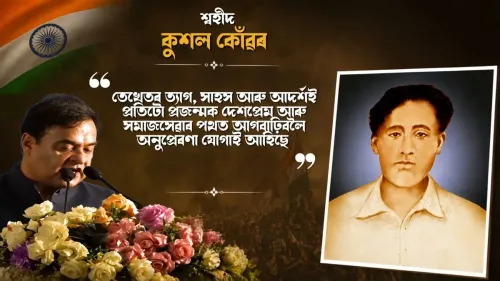
CM Himanta Biswa Sarma called Alaboi 'the heartbeat of our freedom' and paid tribute to the immortal martyrs on the battle's 357th anniversary .
On the 357th anniversary of the Battle of Alaboi, Assam Chief Minister Himanta Biswa Sarma invoked one of the most devastating yet defiant chapters in the state's history — a day in 1669 when ten thousand Assamese warriors rode into the Mughal cavalry and chose death over surrender.
The day ten thousand chose death over dishonour
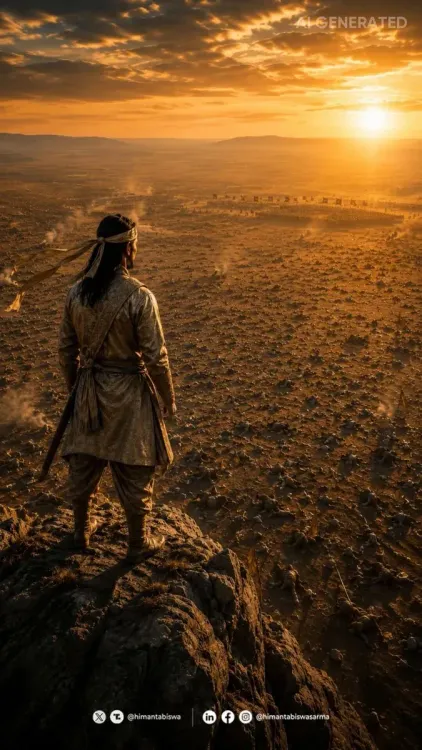
August 5, 1669 — the date CM Sarma called 'written in the sacred blood of Assam's greatest heroes.' The Battle of Alaboi, fought on the banks of the Brahmaputra in what is now Assam, saw a Ahom force charge headlong into the superior Mughal army under the command of Ram Singh I, the general dispatched by Aurangzeb. The Ahom warriors, vastly outnumbered, did not retreat. By the end of that single day, all ten thousand had fallen. It remains one of the largest single-day losses in the long Ahom resistance against Mughal expansion into the northeast.
Alaboi in the arc of Ahom resistance
The Battle of Alaboi did not end the Ahom kingdom — it steeled it. The Mughals never succeeded in permanently annexing Assam. Just four years later, in 1671, the Ahoms delivered a decisive counter-blow at the Battle of Saraighat under commander Lachit Borphukan, a name now synonymous with Assamese pride. Alaboi, in that sense, was the wound that preceded the reckoning. CM Sarma's framing — 'the heartbeat of our freedom' — places the martyrs not as victims of defeat but as the moral foundation of eventual victory.
Why CM Sarma's tribute lands with political weight
For Himanta Biswa Sarma, invoking Alaboi on its anniversary is both an act of historical remembrance and a statement of regional identity. As the Chief Minister of Assam and convenor of the North-East Democratic Alliance (NEDA), Sarma has consistently positioned Assam's pre-colonial warrior heritage as a living source of pride — distinct, sovereign, and worth commemorating with the same gravity as national events. The post, shared with a video, is addressed to all of Assam: 'Salute to the immortal martyrs of Alaboi.'
Three hundred and fifty-seven years on, the Battle of Alaboi endures not as a footnote but as a symbol — proof that the northeast's resistance to conquest was written, at enormous cost, long before the modern nation was born.
Point of View
Sarma signals that Assam's freedom story is its own, not a regional footnote to a Delhi-centric narrative. The tribute also reinforces his political brand as the custodian of Assamese civilisational pride, a posture that carries real electoral currency in a state where identity and history remain live political terrain.
NationPress
5 Aug 2026
Frequently Asked Questions
What was the Battle of Alaboi?
The Battle of Alaboi was fought on August 5, 1669 between the Ahom kingdom of Assam and the Mughal army led by Ram Singh I , a general of Emperor Aurangzeb . Ten thousand Ahom warriors died in a single day charging the Mughal cavalry, making it one of the bloodiest single-day engagements in the long Ahom-Mughal conflict.
Did the Mughals ever conquer Assam?
No. Despite the heavy losses at Alaboi, the Mughals never permanently conquered Assam. The Ahoms decisively defeated them at the Battle of Saraighat in 1671 under the legendary commander Lachit Borphukan , ending sustained Mughal ambitions in the northeast.
Why is Himanta Biswa Sarma paying tribute to Alaboi martyrs?
August 5 marks the anniversary of the Battle of Alaboi. Assam CM Himanta Biswa Sarma annually honours the occasion to recognise the sacrifice of ten thousand Ahom warriors and to assert Assam's distinct pre-colonial heritage of resistance.
What is the significance of Alaboi compared to the Battle of Saraighat?
While the Battle of Saraighat (1671) is more widely celebrated as the Ahom victory that expelled the Mughals, Alaboi (1669) represents the sacrifice that preceded it — the moment ten thousand warriors died so that Assam's resistance could continue. CM Sarma calls it 'the heartbeat of our freedom.'