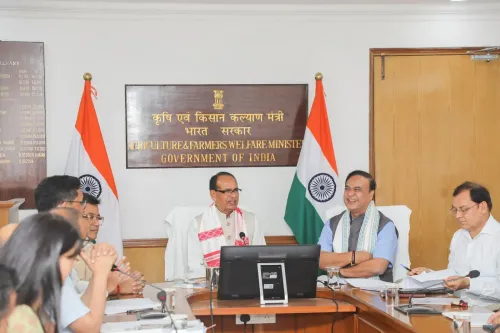
CM Himanta Urges Assam Farmers to Tap Agriculture Infrastructure Fund

Synopsis
Chief Minister Himanta Biswa Sarma has urged Assam's farmers, FPOs, PACS, SHGs and agri-entrepreneurs to fully utilise the Agriculture Infrastructure Fund, expanded with a ₹1 lakh crore central top-up, to build modern warehouses and processing units for high-value crops and raise farm incomes.
Key Takeaways
The Chief Minister's Office of Assam highlighted a ₹1 lakh crore central top-up to the Agriculture Infrastructure Fund on 25 July 2026 .
CM Himanta Biswa Sarma urged farmers, FPOs, PACS, SHGs and agri-entrepreneurs to fully utilise the scheme.
The CM specifically called for building modern warehouses and processing units to enable value addition for high-value crops.
The Agriculture Infrastructure Fund was originally launched in 2020 under the Atmanirbhar Bharat package to finance post-harvest infrastructure.
FPOs and PACS — which represent small and marginal farmers — are among the key eligible beneficiaries under the expanded scheme.
Uptake of AIF projects in Assam, including warehouse and processing unit proposals, will be a key metric to watch in coming months.
The Chief Minister's Office of Assam on Saturday, 25 July 2026, highlighted the expansion of the Agriculture Infrastructure Fund (AIF) with a central top-up of ₹1 lakh crore, with Chief Minister Dr. Himanta Biswa Sarma calling on farmers, Farmer Producer Organisations (FPOs), Primary Agricultural Credit Societies (PACS), Self-Help Groups (SHGs), and agri-entrepreneurs across Assam to fully utilise the scheme.
Context
The Chief Minister's Office shared the appeal as part of ongoing state-level outreach to channel central agricultural infrastructure financing into Assam's rural economy. CM Himanta specifically emphasised building modern warehouses and processing units to drive value addition for high-value crops and boost farm incomes. The post underscores the state government's intent to integrate the AIF's expanded mandate into local agricultural priorities.Policy Backdrop
The Agriculture Infrastructure Fund was launched in 2020 under the Atmanirbhar Bharat package, providing debt financing for post-harvest infrastructure including cold storage, warehouses, and processing units. The scheme was subsequently broadened to include a wider set of beneficiaries — FPOs, PACS, and SHGs — enabling village-level cooperatives and small farmer collectives to access financing for value-addition projects. The central top-up referenced in the post signals a continued federal commitment to scaling agricultural infrastructure capacity nationwide.Stakeholders and Impact
Assam is a predominantly agrarian state where crops such as tea, rice, and horticulture produce form a significant share of rural livelihoods. Post-harvest losses remain a structural challenge, and the availability of AIF-backed warehousing and processing infrastructure is expected to reduce those losses while enabling farmers to realise better prices. FPOs and PACS — which aggregate small and marginal farmers — stand to benefit most directly, as the scheme lowers the cost of borrowing for infrastructure that individual farmers cannot afford independently. SHGs and agri-entrepreneurs are also positioned as key implementing actors, broadening the scheme's grassroots reach.What's Next
The immediate focus will be on uptake: how many warehouse and processing unit proposals from Assam are submitted and approved under the expanded AIF framework. State-level implementation guidelines and any budget linkages in the next fiscal cycle will determine whether the Chief Minister's appeal translates into measurable on-ground infrastructure. A sustained rise in AIF project registrations from the state would be a concrete indicator of the outreach's effectiveness and could serve as a model for other northeastern states facing similar post-harvest infrastructure gaps.Point of View
Particularly as the northeastern region has historically lagged in post-harvest infrastructure investment. By naming FPOs, PACS and SHGs alongside individual farmers, the appeal targets the cooperative and collective layer of rural agriculture — a signal that the state sees institutional aggregation as the primary vehicle for scheme absorption. This fits a broader pattern of centre-state coordination on rural economy modernisation that has accelerated since 2020, with states increasingly acting as active promoters rather than passive conduits of central schemes. The emphasis on high-value crops and value addition also points to a longer-term income-diversification agenda beyond Assam's traditional rice and tea economy.
NationPress
24 Oct 2026
Frequently Asked Questions
What is the Agriculture Infrastructure Fund and how can Assam farmers apply?
The Agriculture Infrastructure Fund is a central government scheme launched in 2020 under the Atmanirbhar Bharat package that provides concessional debt financing for post-harvest infrastructure such as warehouses, cold storage and processing units. Eligible applicants including farmers, FPOs, PACS, SHGs and agri-entrepreneurs can apply through the AIF portal facilitated by banks and cooperative institutions.
What did CM Himanta Biswa Sarma say about the Agriculture Infrastructure Fund?
CM Himanta Biswa Sarma urged farmers, FPOs, PACS, SHGs and agri-entrepreneurs in Assam to fully utilise the Agriculture Infrastructure Fund, emphasising the construction of modern warehouses and processing units to add value to high-value crops and boost farm incomes.
What is the ₹1 lakh crore central top-up to the Agriculture Infrastructure Fund?
The ₹1 lakh crore figure refers to the central government's expanded corpus for the Agriculture Infrastructure Fund, announced to scale up financing for agri-infrastructure projects across India. The Chief Minister's Office of Assam highlighted this expansion on 25 July 2026 as an opportunity for state-based beneficiaries.
Who are FPOs and PACS and why are they important for the AIF scheme?
Farmer Producer Organisations (FPOs) are government-promoted collectives that help small and marginal farmers access markets, credit and infrastructure. Primary Agricultural Credit Societies (PACS) are village-level cooperatives being upgraded to handle storage, processing and credit services. Both are key institutional channels for AIF uptake because they aggregate farmers who individually lack the resources to build large-scale infrastructure.
How does the Agriculture Infrastructure Fund help reduce post-harvest losses in Assam?
By financing modern warehouses, cold storage and processing units, the AIF enables farmers and cooperatives to store produce safely after harvest rather than selling immediately at low prices. This reduces spoilage and gives farmers time to access better markets, which is particularly significant for Assam's horticulture and high-value crop sectors.