CM Himanta Pushes Assam's Waste Management Overhaul

Synopsis
Assam CM Himanta Biswa Sarma on October 4 outlined a structured waste management framework spanning source segregation, scientific treatment of legacy dumpsites, and clear accountability for citizens, institutions, and local bodies across the state.
Key Takeaways
Assam CM Himanta Biswa Sarma announced a structured waste management vision on October 4, 2026 .
The plan covers source segregation at the household level as its foundational step.
Scientific treatment of legacy dumpsites — a technically demanding and costly process — is explicitly included.
Accountability is distributed across citizens, institutions, and urban local bodies , addressing the blame-shifting loop common in sanitation drives.
Assam's urban centres, including Guwahati , face acute solid-waste pressure due to rapid urbanisation.
Implementation details — budgets, timelines, and measurable diversion rates — will determine whether the framework translates into lasting change.
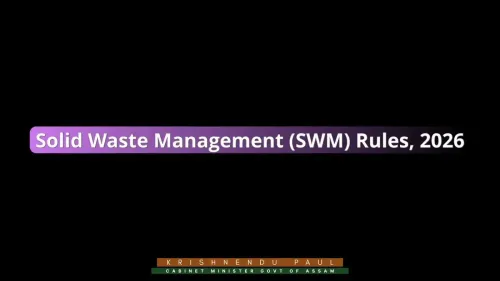
Waste is not just a municipal headache — it is a governance test. Assam Chief Minister Himanta Biswa Sarma on Sunday, October 4, 2026, laid out a three-tier vision for a cleaner Assam: source segregation, scientific treatment of legacy dumpsites, and clearly defined responsibilities for citizens, institutions, and local bodies.
From Household Bins to Legacy Dumpsites
The Chief Minister's framing moves the conversation beyond streetside sweeping. Source segregation — sorting wet, dry, and hazardous waste at the point of generation — is widely regarded as the foundational step that determines whether the rest of the chain works. Without it, even the most sophisticated treatment plants receive a mixed, unprocessable stream. Equally significant is the explicit mention of legacy dumpsites. Across India's towns, these are decades-old, unlined mounds of mixed waste that leach into soil and groundwater. Committing to their 'scientific treatment' signals a shift from containment to active remediation — a more expensive and technically demanding path, but the only one that eliminates long-term environmental liability.Roles Pinned on Citizens, Institutions, and Local Bodies
Perhaps the sharpest line in Sarma's post is the one about accountability: 'clear roles for citizens, institutions and local bodies.' This is the governance architecture that determines whether a sanitation drive outlasts its launch-day headlines. Assigning explicit responsibility to each tier — households, hospitals and schools, and urban local bodies — is an attempt to close the blame-shifting loop that typically derails waste management reforms. Urban local bodies in Assam, as in much of India's northeast, operate with constrained finances and thin technical capacity. Whether the state pairs this vision with ring-fenced funding and trained manpower for municipalities will be the real indicator of intent.Where Assam Stands in India's Sanitation Push
India's national clean-city frameworks have pushed states to move beyond open dumping toward engineered landfills and material recovery. Assam's urban centres, including Guwahati, have faced persistent challenges around solid waste, partly because rapid urbanisation has outpaced infrastructure. A state-level push that explicitly names legacy dumpsite remediation and source segregation in the same breath suggests the administration is aligning with the more demanding end of the national standard. The proof, as always, will be in implementation timelines, municipal budgets, and measurable diversion rates — numbers that will tell a more complete story than any policy declaration. A cleaner Assam is a stated goal; the system Sarma describes is the scaffold. Whether citizens and local bodies actually fill their assigned roles will decide if this is a turning point or a talking point.Point of View
Institutions, local bodies — reflects a growing recognition that top-down sanitation drives stall when no one below the state level owns the outcome. The missing piece, and the one analysts will watch, is whether fiscal transfers to urban local bodies actually follow the rhetoric.
NationPress
4 Oct 2026
Frequently Asked Questions
What is Assam CM Himanta Biswa Sarma's waste management plan?
CM Himanta Biswa Sarma has outlined a framework covering source segregation of waste at the household level, scientific remediation of legacy dumpsites, and clearly defined responsibilities for citizens, institutions, and local bodies across Assam.
What is source segregation and why does it matter?
Source segregation means separating wet, dry, and hazardous waste at the point where it is generated — typically the home or office. It is the foundational step that makes downstream processing and recycling viable; without it, treatment facilities receive unsortable mixed waste.
What are legacy dumpsites and how will Assam treat them?
Legacy dumpsites are old, often unlined waste mounds accumulated over decades in and around towns. Scientific treatment involves engineered closure, leachate management, and gas capture to eliminate soil and groundwater contamination — a process more demanding than simply covering them over.
Which Assam cities face the biggest solid waste challenges?
Guwahati, Assam's largest city, faces the most acute pressure due to rapid urbanisation outpacing waste infrastructure. Other growing urban centres in the state similarly struggle with collection gaps and open dumping.
How does Assam's plan align with national sanitation standards?
India's national frameworks push states toward engineered landfills, material recovery, and zero open burning. Assam's explicit mention of source segregation and legacy dumpsite remediation places it in line with the more demanding national benchmarks rather than minimal compliance.