CM Himanta Spotlights Cancer Survivor's Comeback in Hajo

Synopsis
Assam Chief Minister Himanta Biswa Sarma shared the story of Kishor Deka, a Hajo cancer survivor who lost his savings and business to illness but rebuilt through state welfare support, now running Babru Nano Mart — a symbol of the state's dual push on health coverage and micro-enterprise revival.
Key Takeaways
Kishor Deka of Hajo, Kamrup district lost his savings and business after battling cancer.
With support from CMAAA , a state welfare initiative, Deka launched Babru Nano Mart , his own grocery store.
Assam CM Himanta Biswa Sarma shared Deka's story on 6 November 2026 , calling his resilience an inspiration.
Assam's Atal Amrit Abhiyan , launched in 2016 , provides health coverage for serious illnesses including cancer for low-income families.
The state has consistently paired medical support schemes with livelihood restoration programmes for cancer-affected households.
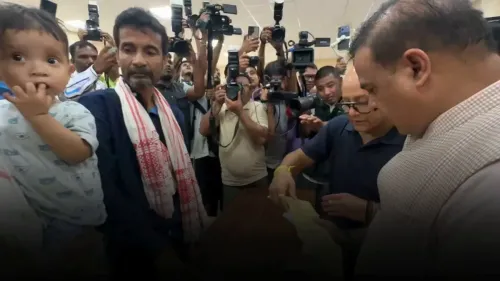
A grocery store in Hajo, Assam is more than a shop — it is proof that a single second chance can rewrite a life. Assam Chief Minister Himanta Biswa Sarma on Friday, 6 November 2026, shared the story of Kishor Deka, a resident of Hajo who lost both his savings and his business to cancer, only to rebuild from scratch with state support.
'Sometimes, one opportunity is all it takes to begin again,' the Chief Minister wrote, recounting how Deka, after surviving cancer, refused to surrender to circumstance. With assistance from CMAAA — a welfare initiative operating under the Assam government — Deka launched Babru Nano Mart, a grocery store that now stands as his own enterprise and his family's livelihood.
Cancer's Double Blow — Health and Income, Both Gone
Cancer in rural Assam rarely strikes alone. For families with small businesses and no financial cushion, a prolonged illness often wipes out decades of savings long before it claims a life. Kishor Deka's story fits a pattern that welfare planners in the state know well: treatment costs hollow out household finances, businesses close, and survivors emerge medically recovered but economically devastated.
Assam has run targeted health coverage programmes for serious illnesses — including cancer — since the launch of the Atal Amrit Abhiyan in 2016, which aimed to shield low-income families from catastrophic medical expenditure. Successive administrations have paired such health schemes with livelihood restoration efforts, recognising that medical survival without economic recovery is an incomplete victory.
CMAAA and the Nano Mart Model
The current emphasis under Chief Minister Sarma has continued and deepened this dual approach — combining health support with micro-enterprise revival, particularly in rural and semi-urban pockets of the state. Babru Nano Mart represents exactly this model: a small, owner-operated retail unit that requires modest capital but delivers meaningful independence.
Hajo, a town in Kamrup district with deep historical and religious roots, is emblematic of the kind of community these schemes are designed to reach — well-known but not metropolitan, where informal economies absorb most livelihoods and where a single illness can undo years of hard work overnight.
Sarma's Message Beyond Kishor
By amplifying Deka's story publicly, the Chief Minister is doing something politicians often do with welfare — making the beneficiary visible, putting a human face on a programme, and signalling to others in similar circumstances that the pathway exists. 'Your resilience inspires us all,' Sarma wrote, closing his post with a note of personal encouragement directed at Deka.
How many Kishor Dekas are waiting in Assam's towns and villages is a question the state's health and social welfare departments will need to answer with data. The stories are compelling; the scale of the need remains the harder number to track.
Point of View
Not just administratively functional. The post also arrives at a moment when north-eastern states are under pressure to demonstrate that welfare spending translates into tangible outcomes on the ground, not just budget line items. For Sarma, who has consistently used social media to narrate governance, this is on-brand: governing visibly, one story at a time.
NationPress
6 Nov 2026
Frequently Asked Questions
Who is Kishor Deka from Hajo, Assam?
Kishor Deka is a resident of Hajo in Kamrup district, Assam, who lost his savings and business after battling cancer. With support from CMAAA, a state welfare initiative, he rebuilt his livelihood and now runs Babru Nano Mart, his own grocery store.
What is CMAAA in Assam?
CMAAA is a welfare initiative operating under the Assam government that provides support to individuals — including cancer survivors — to help them rebuild their livelihoods. The exact full form is not publicly verified in widely available records.
What is the Atal Amrit Abhiyan scheme in Assam?
The Atal Amrit Abhiyan is a health coverage scheme launched in Assam in 2016 to provide financial protection to low-income families facing serious illnesses, including cancer, by covering treatment costs.
Why did Himanta Biswa Sarma post about Kishor Deka?
Chief Minister Himanta Biswa Sarma shared Kishor Deka's story to highlight the impact of state welfare programmes on cancer survivors and to inspire others facing similar hardship, calling Deka's resilience an inspiration.
Where is Hajo located in Assam?
Hajo is a town in Kamrup district of Assam with deep historical and religious significance. It lies near Guwahati and is known as an important cultural and pilgrimage site in the region.