CM Dhami Hails UCC in Uttarakhand, Cites Amit Shah
Synopsis
Uttarakhand CM Pushkar Singh Dhami amplified Union Home Minister Amit Shah's statement declaring that triple talaq and polygamy no longer hold in Uttarakhand after the state enacted India's first post-independence Uniform Civil Code in February 2024.
Key Takeaways
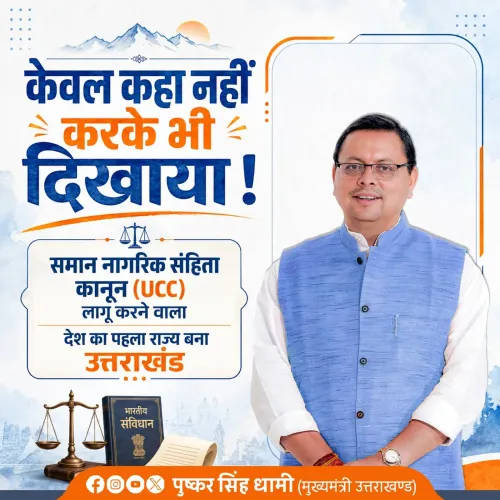
Uttarakhand became the first Indian state since independence to enact a Uniform Civil Code , passing the bill on 7 February 2024 .
The UCC covers marriage, divorce, inheritance, and adoption under a single framework for all residents regardless of religion.
Union Home Minister Amit Shah explicitly stated that triple talaq and polygamy no longer run unchecked in Uttarakhand under the UCC.
The national ban on instant triple talaq came via the Muslim Women (Protection of Rights on Marriage) Act, 2019 ; Uttarakhand's UCC extends the reform further at the state level.
Legal challenges before the High Court and Supreme Court remain active, with the UCC rules under continued judicial scrutiny.
CM Dhami's post positions Uttarakhand as a BJP-validated national model for other states considering similar legislation.
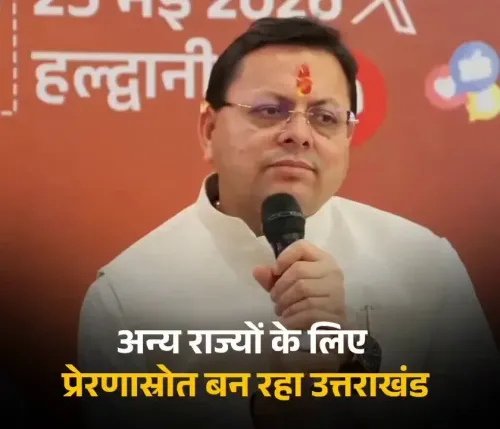
Uttarakhand has drawn a hard line — triple talaq and the practice of multiple simultaneous marriages no longer have legal cover in the state. Uttarakhand Chief Minister Pushkar Singh Dhami on Friday, 6 November 2026, shared a pointed remark by Union Home and Cooperation Minister Amit Shah reaffirming that the state's Uniform Civil Code (UCC) has established one law for all citizens of Devbhoomi — the land of gods.
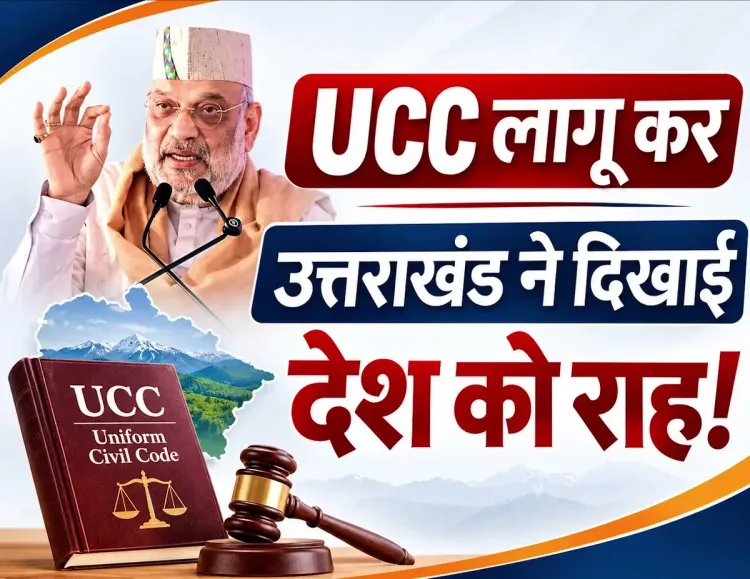
The quote CM Dhami amplified reads: 'Uttarakhand mein ab triple talaq aur chaar-chaar shaadion ki manmaani nahi chalti' — 'In Uttarakhand, the arbitrary practices of triple talaq and marrying four times no longer run unchecked. By implementing the Uniform Civil Code, one equal law has been ensured for everyone in Devbhoomi.' The statement, attributed to Amit Shah in his capacity as Home Minister, underscores the federal government's endorsement of Uttarakhand's trail-blazing legislation.
How Uttarakhand Became India's First UCC State
The Uttarakhand Legislative Assembly passed the Uniform Civil Code Bill on 7 February 2024 — a first for any Indian state since independence. The legislation replaced religion-based personal laws with a single, common framework covering marriage, divorce, inheritance, and adoption, applicable equally to all residents regardless of faith. No other state had crossed that threshold in the seven-plus decades since the Constitution came into force.
The national backdrop mattered too. The Muslim Women (Protection of Rights on Marriage) Act, 2019 had already criminalised instant triple talaq across India. Uttarakhand's UCC went a step further, folding that prohibition into a comprehensive civil code and extending its reach to other personal-law domains — including polygamy — that the 2019 law did not fully address at the state level.
Shah's Framing and the BJP's Broader Constitutional Push
Article 44 of the Indian Constitution lists a Uniform Civil Code among the Directive Principles of State Policy — an aspiration embedded in the founding document but left unlegislated for decades. The BJP has long positioned UCC implementation as fulfilling that constitutional promise. Amit Shah's remarks, amplified by CM Dhami, signal that the party intends to keep Uttarakhand's experiment at the centre of that national conversation.
The political geometry is deliberate. By quoting the Home Minister directly, CM Dhami elevates the state's UCC from a local reform to a nationally validated model — one other BJP-governed states are watching closely as they weigh similar legislation.
Legal Battles and the Road Ahead for UCC Rules
Uttarakhand's UCC has not been without contest. Legal challenges before the High Court and the Supreme Court remain a live variable; the operational rules governing specific provisions continue to be scrutinised by both the judiciary and civil-society groups. How those challenges resolve will determine whether the Uttarakhand model becomes a replicable template or a cautionary case study for other states considering similar laws.
For now, the message from Devbhoomi is unambiguous: uniform law is in force, and India's highest law-enforcement authority has said so out loud.
Point of View
CM Dhami deftly converts a state reform into a Centre-endorsed national statement — a move that raises Uttarakhand's UCC above intra-party debate and anchors it to the BJP's long-standing Article 44 promise. The timing matters: with potential Supreme Court scrutiny ahead, associating the law with Amit Shah's authority pre-empts any narrative that the UCC is a peripheral or contested experiment. For the broader BJP project, Uttarakhand functions as a proof-of-concept that other Hindi-belt states can cite when building their own legislative case.
NationPress
6 Nov 2026
Frequently Asked Questions
What is the Uttarakhand Uniform Civil Code?
The Uttarakhand Uniform Civil Code, passed on 7 February 2024 , is a law that replaces religion-based personal laws with a single, common legal framework covering marriage, divorce, inheritance, and adoption for all residents of the state, regardless of their religion.
Is triple talaq banned in Uttarakhand?
Yes. Triple talaq was criminalised nationally by the Muslim Women (Protection of Rights on Marriage) Act, 2019 , and Uttarakhand's UCC reinforces that prohibition within its comprehensive civil code framework.
Which was the first state in India to implement the Uniform Civil Code?
Uttarakhand is the first Indian state since independence to enact a Uniform Civil Code, with its assembly passing the bill on 7 February 2024 .
What did Amit Shah say about Uttarakhand's UCC?
Union Home Minister Amit Shah stated that arbitrary practices of triple talaq and marrying multiple wives simultaneously no longer continue in Uttarakhand, and that the UCC has ensured one equal law for everyone in the state.
Can the Uttarakhand UCC be challenged in court?
Yes. Legal challenges before the High Court and Supreme Court are ongoing, with the UCC's specific rules and provisions under judicial scrutiny — the outcomes of which will shape whether the law becomes a model for other states.