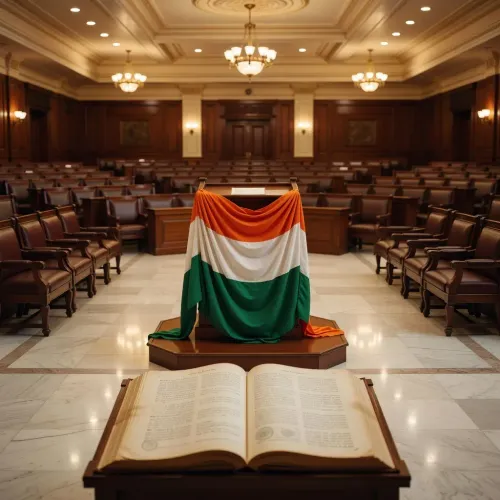
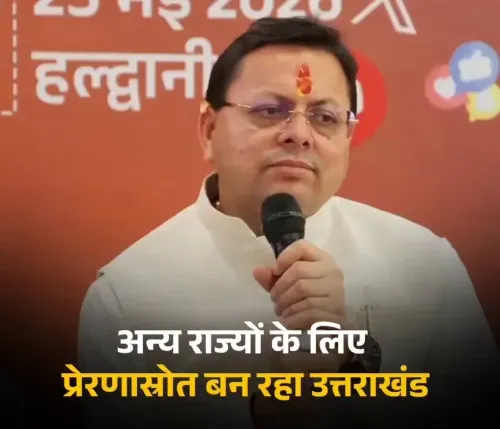
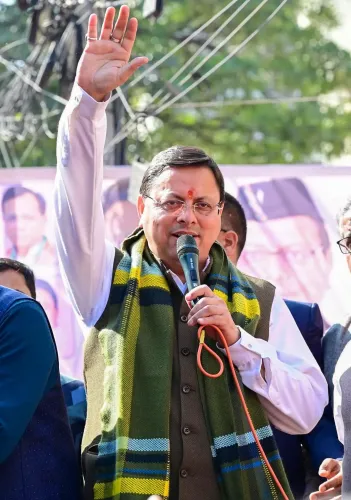
CM Dhami: Uttarakhand First State to Implement UCC
Synopsis
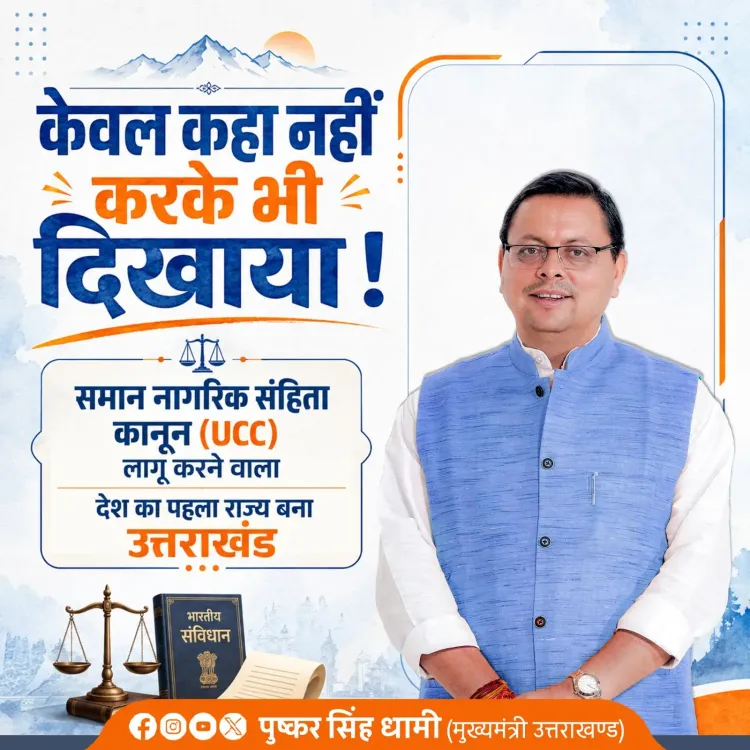
Uttarakhand Chief Minister Pushkar Singh Dhami has declared that his state is the first in India to implement the Uniform Civil Code, framing it as a constitutional milestone achieved under the BJP's 'double engine government' model and PM Narendra Modi's leadership.
Key Takeaways
Uttarakhand has become the first state in India to implement the Uniform Civil Code (UCC) , according to CM Pushkar Singh Dhami .
The Uttarakhand UCC Bill was passed in the state Assembly in February 2024 and received gubernatorial assent the following month.
The UCC replaces religion-specific personal laws governing marriage, divorce, inheritance, and adoption with a single framework for all residents.
Article 44 of the Constitution has directed the state to enact a uniform civil code since 1950 , making this a decades-long constitutional aspiration.
The legislation faces legal challenges in the Uttarakhand High Court and the Supreme Court of India .
Other BJP-governed states, including Gujarat and Assam , are watching Uttarakhand's model for possible replication.
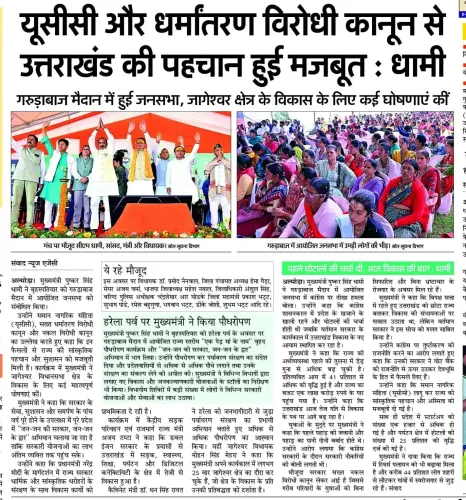
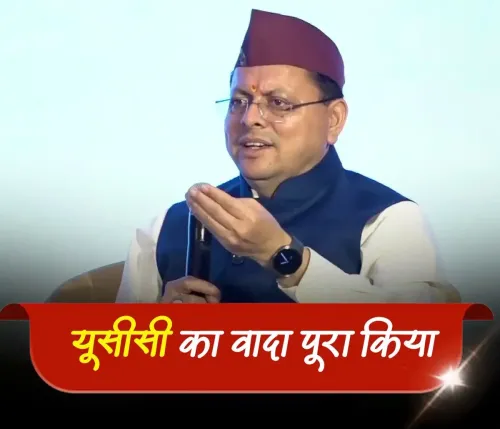
Uttarakhand Chief Minister Pushkar Singh Dhami on Friday, 22 May 2026, declared that Uttarakhand has become the first state in India to implement the Uniform Civil Code (UCC), crediting the achievement to the 'double engine government' under Prime Minister Narendra Modi.
Posting on X, CM Dhami wrote: 'उत्तराखंड देश का पहला राज्य बना, जहां समान नागरिक संहिता (UCC) कानून लागू किया गया' — ('Uttarakhand has become the first state in the country where the Uniform Civil Code law has been implemented'). He added that citizens' rights in the state are now being secured not on the basis of religion or sect, but on the basis of equality and the Constitution.
Context
Article 44 of the Constitution of India, adopted in 1950, enshrines the Uniform Civil Code as a Directive Principle of State Policy, directing the state to secure a common civil law framework for all citizens. For decades, the provision remained aspirational, with personal matters such as marriage, divorce, inheritance, and adoption governed by religion-specific laws.
The Uttarakhand Legislative Assembly passed the Uniform Civil Code Bill in February 2024, which received gubernatorial assent the following month, making the state the first in independent India to legislate a UCC applicable to all residents regardless of religion.
Policy Backdrop
The UCC has been a cornerstone of the Bharatiya Janata Party (BJP)'s successive election manifestos, framed as a measure to advance gender equality and legal uniformity across communities. Uttarakhand's process included expert committee reports and public consultations conducted in the state since 2022, giving the legislation a consultative foundation before it reached the Assembly floor.
CM Dhami has consistently positioned the UCC as a fulfilment of a pre-election promise made to the people of Uttarakhand, describing it as a model that other states could emulate. The 'double engine government' formulation — a BJP phrase for alignment between a state government and the central government both led by the party — is central to his framing of how the reform was made possible.
Stakeholders and Impact
The UCC's most direct impact is on women, particularly those from communities where religion-specific personal laws have historically limited rights in marriage, divorce, and inheritance. Supporters argue the code levels the legal playing field and brings Uttarakhand's civil framework in line with constitutional guarantees of equality.
Minority communities have raised concerns about the erosion of personal law protections, and the legislation faces legal challenges before the Uttarakhand High Court and the Supreme Court of India. The outcome of these proceedings will determine the durability and scope of the UCC's implementation.
What's Next
Uttarakhand's enactment is being watched closely by other BJP-governed states, including Gujarat and Assam, which have signalled interest in similar legislation during forthcoming legislative sessions. A Supreme Court ruling on the pending challenges could set a national precedent on the constitutional validity of state-level uniform civil codes.
With CM Dhami publicly reinforcing the milestone, the UCC is expected to remain a prominent plank in the BJP's governance narrative ahead of future electoral cycles — and a benchmark against which other states' legislative ambitions will be measured.
Point of View
Cementing Uttarakhand's identity as the vanguard of a reform the BJP has championed for three decades. By invoking PM Modi's leadership and the 'double engine' framework, he ties a state-level legislative achievement to the party's national narrative, amplifying its resonance beyond Dehradun. The timing — well after the bill's passage — suggests the communication is aimed at keeping the UCC visible as a governance deliverable rather than announcing fresh policy. How the Supreme Court resolves pending challenges will ultimately determine whether Uttarakhand's model becomes a template or a cautionary tale for other states.
NationPress
6 Oct 2026
Frequently Asked Questions
Which is the first state to implement Uniform Civil Code in India?
Uttarakhand is the first state in India to implement the Uniform Civil Code (UCC), following the passage of the UCC Bill in the state Assembly in February 2024 and its gubernatorial assent the same year.
What does the Uniform Civil Code mean for citizens of Uttarakhand?
Under the UCC, citizens of Uttarakhand are governed by a single civil law framework for matters such as marriage, divorce, inheritance, and adoption, replacing the earlier system where these were regulated by religion-specific personal laws.
What is the 'double engine government' that CM Dhami refers to?
'Double engine government' is a BJP phrase describing a political alignment where both the state government and the central government are led by the BJP, with the argument that this alignment accelerates policy delivery and reform.
Is the Uttarakhand UCC facing any legal challenges?
Yes, the Uttarakhand UCC faces legal challenges before the Uttarakhand High Court and the Supreme Court of India, with petitioners questioning its constitutional validity, particularly regarding minority personal law protections.
Will other states implement a Uniform Civil Code like Uttarakhand?
States such as Gujarat and Assam, both governed by the BJP, have signalled interest in similar legislation, and Uttarakhand's experience is being studied as a possible model, though no other state has yet enacted a UCC.