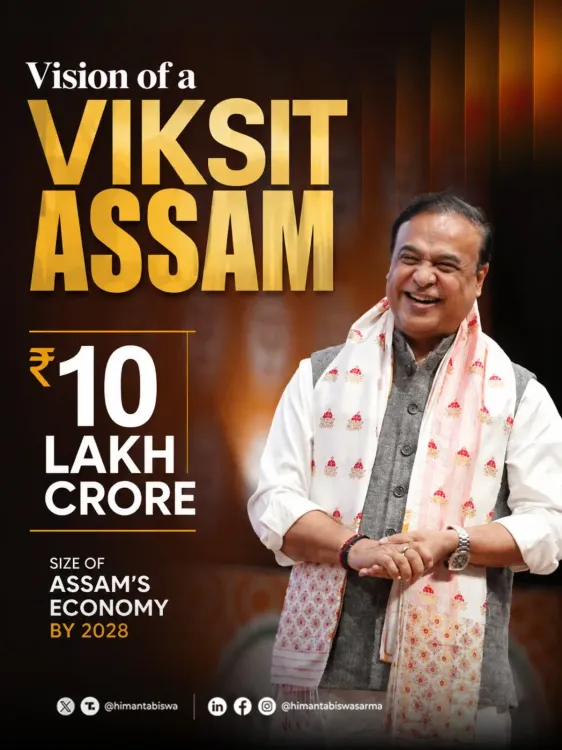
CM Himanta Sets ₹10 Lakh Crore Economy Target for Assam by 2028
Synopsis
Assam Chief Minister Himanta Biswa Sarma declared on 27 May 2026 that Assam is now India's fastest growing state and set a target of reaching a ₹10 lakh crore economy by 2028, citing the end of decades of violence and unrest that had held the state back.
Key Takeaways
CM Himanta Biswa Sarma declared Assam India's fastest growing state on 27 May 2026 .
He set a target of scaling Assam's economy to ₹10 lakh crore by 2028 .
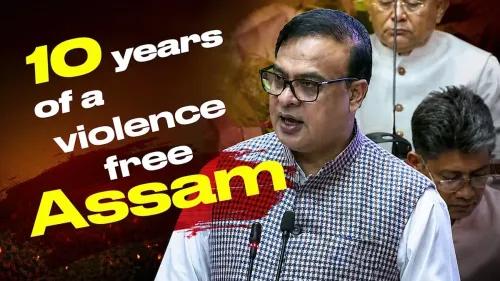
The post explicitly links past violence and insurgency to years of stunted economic growth in the state.
The Bodo Peace Accord (2020) and the Act East Policy (2014) form key pillars of the state's post-conflict economic pivot.
The #ViksitAssam campaign frames the target within the national Viksit Bharat 2047 development vision.
Local entrepreneurs and Assam's youth are identified as the primary stakeholders in the state's growth story.
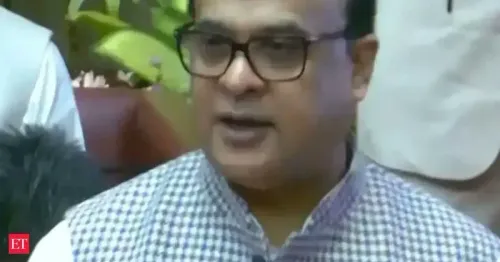
Assam Chief Minister Himanta Biswa Sarma on Wednesday, 27 May 2026, declared that Assam has become India's fastest growing state and set an ambitious target of scaling the state's economy to ₹10 lakh crore by 2028, citing a decisive break from decades of violence and unrest that had stunted the region's development.
Context
CM Sarma posted on X that Assam had 'lost out precious years due to violence and unrest which severely stunted our growth,' but asserted that the state has 'regained our momentum.' The post, tagged #ViksitAssam, frames the ₹10 lakh crore gross state domestic product goal as the next milestone in the state's economic turnaround. The statement positions Assam as a success story within the broader Viksit Bharat 2047 national development framework.
Policy Backdrop
The shift in Assam's fortunes is rooted in a series of peace settlements with insurgent groups through the 2010s, culminating in the landmark Bodo Peace Accord of 2020. With the security environment stabilised, successive state governments — and particularly the BJP administration since 2016 — redirected focus toward industrial policy, ease-of-doing-business reforms, and capital attraction. The Assam Industrial Policy introduced after 2016 was explicitly designed to reverse decades of capital flight triggered by ethnic violence and insurgency.
At the national level, the Act East Policy, launched in 2014, positioned Assam as a strategic node for trade and connectivity between India and Southeast Asia. Central infrastructure funding flowing into roads, railways, waterways and logistics corridors in the Northeast has complemented state-level reforms, creating conditions for accelerated growth. CM Sarma, who also serves as convenor of the North-East Democratic Alliance (NEDA), has been a consistent advocate for integrating the region's peace dividend into measurable economic output.
Stakeholders and Impact
The primary beneficiaries of Assam's growth trajectory are local entrepreneurs and the state's large youth population, who were disproportionately affected by the economic stagnation caused by decades of unrest. A sustained push toward the ₹10 lakh crore economy would require significant investment in manufacturing, agro-processing, tourism, and energy — sectors where Assam holds natural advantages in tea, oil, and its geographic gateway position.
For the BJP government in Assam, the target also carries political weight. Framing economic ambition in concrete, time-bound numbers — ₹10 lakh crore by 2028 — sets a measurable benchmark ahead of the next state assembly election cycle and aligns with the party's national messaging around development as governance.
What's Next
Achieving the stated target will require sustained double-digit growth in the state's economy over the next two years, a pace that will be closely tracked through state budget presentations and upcoming investment summits. Analysts and opposition parties are likely to seek detailed roadmaps covering land banks, fiscal incentives, connectivity projects, and employment generation that can substantiate the 2028 goal. The #ViksitAssam campaign framing suggests the government intends to build a sustained public narrative around the target in the months ahead.
Point of View
And it plants a concrete, verifiable benchmark — ₹10 lakh crore by 2028 — that will define his government's economic legacy. The move mirrors a broader NDA playbook of attaching ambitious, time-bound targets to development narratives in states where the party has overseen a security-to-growth transition. As convenor of NEDA, Sarma is also signalling to the wider Northeast that Assam's model is replicable. The risk is equally clear: a publicly stated deadline creates an accountability moment that opposition parties and civil society will hold the government to.
NationPress
26 Sept 2026
Frequently Asked Questions
What is Assam CM Himanta Biswa Sarma's economy target for 2028?
CM Himanta Biswa Sarma has set a target of growing Assam's economy to ₹10 lakh crore by 2028 , which he announced on 27 May 2026.
Is Assam really India's fastest growing state?
CM Sarma claimed on 27 May 2026 that Assam is currently India's fastest growing state . Independent verification of the precise ranking requires the latest official GSDP data from central statistical agencies.
Why did Assam's economy lag behind for so long?
Assam experienced prolonged insurgency and ethnic violence from the 1980s through the 2010s, which caused capital flight and stunted industrial development. Multiple peace accords, including the Bodo Peace Accord of 2020 , helped stabilise the security environment and enabled an economic pivot.
What is the Viksit Assam initiative?
#ViksitAssam is the Assam government's campaign framing its development agenda, aligned with the central government's Viksit Bharat 2047 vision of making India a developed nation by its centenary of independence.
What is the Act East Policy and how does it help Assam?
The Act East Policy , launched by the central government in 2014 , aims to boost infrastructure, trade and connectivity between India's Northeast and Southeast Asian nations. Assam, as a geographic gateway, is a primary beneficiary of the roads, railways and logistics investments flowing from this policy.