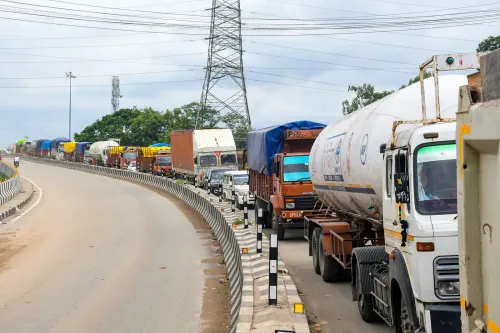
CM Himanta Unveils ₹150cr Flood Plan for Jorabat Junction

Synopsis
Assam Chief Minister Himanta Biswa Sarma has announced a ₹150 crore flood-mitigation plan for Guwahati's chronically waterlogged Jorabat junction, developed in coordination with IIT Guwahati under the Guwahati Ring Road project. The initiative signals a technical-partnership approach to one of the city's most persistent urban infrastructure challenges.
Key Takeaways
Assam CM Himanta Biswa Sarma announced a ₹150 crore plan on 15 July 2026 to tackle recurring flooding at Jorabat junction , Guwahati.
The plan is being developed in coordination with IIT Guwahati and forms part of the Guwahati Ring Road project .
Jorabat is a major highway junction on Guwahati's outskirts that faces annual waterlogging and traffic disruption during the monsoon.
The project is currently 'in the works,' indicating an active planning or design phase ahead of formal tendering.
IIT Guwahati , established in 1994 , has an established research focus on water management and urban engineering in the Northeast.
The initiative aligns with broader central and state efforts to upgrade ring-road and drainage infrastructure across the Brahmaputra valley .
Assam Chief Minister Himanta Biswa Sarma on Wednesday, 15 July 2026 announced a ₹150 crore plan, developed in coordination with IIT Guwahati, to address recurring urban flooding at the Jorabat junction on the outskirts of Guwahati. The initiative forms part of the broader Guwahati Ring Road project, which aims to decongest traffic and improve regional connectivity across the city.
Context
Jorabat, a major entry-exit junction on the periphery of Guwahati, has long been a flashpoint for waterlogging and traffic gridlock during the monsoon season. The low-lying geography of the area, combined with inadequate drainage infrastructure, has made it one of the most persistently flood-affected urban corridors in Assam. Residents and highway users have faced annual disruptions that ripple into supply chains and daily commutes across the Brahmaputra valley.
Sarma stated that the plan is 'in coordination with IIT Guwahati' and is currently 'in the works,' signalling that the project is in an active planning or design phase rather than at the construction stage. The ₹150 crore outlay, if confirmed through formal budget allocation, would represent a significant state investment in site-specific flood mitigation.
Policy Backdrop
Guwahati was included under the Smart Cities Mission launched in 2015, which carried drainage and flood-mitigation components as part of its urban renewal mandate. However, the chronic flooding at junctions like Jorabat has persisted, underscoring the limits of earlier interventions and the need for engineering-led, location-specific solutions.
Across the Northeast, state governments have increasingly turned to technical partnerships with IITs for urban infrastructure challenges that require site-specific hydrological modelling. IIT Guwahati, established in 1994 and deeply embedded in regional research on water management and urban planning, is a natural institutional partner for such an exercise. The broader Guwahati Ring Road project also aligns with the Ministry of Road Transport and Highways' push to upgrade national and state highway corridors in the region.
Stakeholders and Impact
The most immediate beneficiaries of the proposed plan would be Guwahati residents living near and commuting through the Jorabat corridor, as well as freight and passenger traffic using the junction as a gateway to the city. Seasonal flooding at this point disrupts not just local movement but also inter-state connectivity, affecting goods movement across Assam and neighbouring states.
For IIT Guwahati, the collaboration represents an extension of its applied research mandate into live urban infrastructure challenges. The partnership model — where a premier technical institution co-designs solutions with state government — is increasingly seen as a template for evidence-based infrastructure planning in the Northeast.
What's Next
The announcement leaves several details to be formalised, including the release of a detailed project report, tendering timelines, and the precise scope of IIT Guwahati's technical role. Observers will watch whether the ₹150 crore figure is backed by a formal budget line in the state's infrastructure outlay or earmarked through a central scheme.
If the project moves to execution, Jorabat could serve as a replicable model for flood-resilient junction design across other vulnerable urban nodes in the Brahmaputra valley — a region where climate variability and rapid urbanisation continue to strain existing drainage systems.
Point of View
Institutionally-backed solutions. By anchoring the plan within the Guwahati Ring Road project, the Assam government is framing flood resilience as a connectivity issue, which broadens its eligibility for central highway-sector funding. The IIT Guwahati partnership lends technical credibility and signals that the state is seeking solutions grounded in hydrological modelling rather than ad hoc drainage work. Whether the ₹150 crore figure translates into a time-bound project will be the real test of political intent.
NationPress
15 Jul 2026
Frequently Asked Questions
What is the ₹150 crore plan for Jorabat junction in Guwahati?
Assam Chief Minister Himanta Biswa Sarma has announced a ₹150 crore flood-mitigation plan for the Jorabat junction, developed in coordination with IIT Guwahati as part of the Guwahati Ring Road project, to address the area's recurring waterlogging problem.
Why does Jorabat in Guwahati flood so frequently?
Jorabat is a low-lying junction on the outskirts of Guwahati with historically inadequate drainage infrastructure, making it highly vulnerable to waterlogging during the monsoon season, which disrupts both local traffic and inter-state highway connectivity.
What is the Guwahati Ring Road project?
The Guwahati Ring Road is a proposed urban bypass intended to decongest traffic around Guwahati and improve regional connectivity. It also serves as the broader framework under which the new flood-mitigation plan for Jorabat has been announced.
What is IIT Guwahati's role in the Jorabat flood plan?
IIT Guwahati is serving as a technical partner in developing the ₹150 crore flood-mitigation plan for Jorabat junction. The institute has expertise in water management and urban engineering relevant to the Brahmaputra valley region.
Has Guwahati received central funding for flood and drainage projects before?
Yes. Guwahati was included under the Smart Cities Mission launched in 2015, which had drainage and flood-mitigation components, though chronic flooding at junctions like Jorabat has persisted, highlighting the need for more targeted engineering interventions.