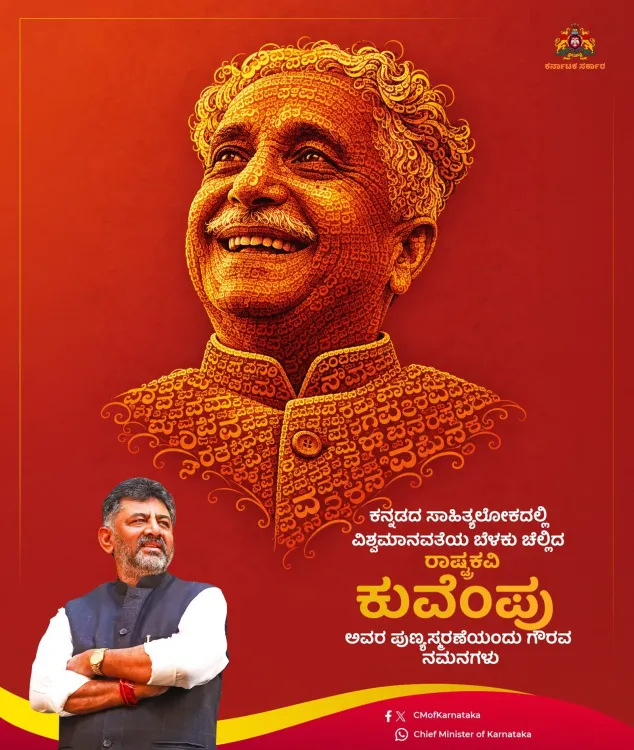
CM Karnataka Pays Tribute to Rashtrakavi Kuvempu
Synopsis
The Chief Minister's Office of Karnataka paid tribute to Rashtrakavi Kuvempu on 11 November 2026, honouring the poet who won the Jnanpith Award in 1967 as the first Kannada writer to do so, and whose 'Vishwa Manava' philosophy of universal humanity continues to resonate.
Key Takeaways
The Chief Minister's Office of Karnataka posted a formal tribute to Rashtrakavi Kuvempu on 11 November 2026 , his death anniversary.
Kuvempu was born Kuppali Venkatappa Puttappa and is widely regarded as the greatest modern Kannada literary figure.
In 1967 , he became the first Kannada writer to receive the Jnanpith Award , India's highest literary honour.
His philosophy of Vishwa Manava (Universal Human) advocates transcending caste, religion and regional identity in favour of shared humanity.
Kuvempu composed Karnataka's official state anthem, Jaya Bharata Jananiya Tanujate , and held the title of Rashtrakavi of Karnataka.
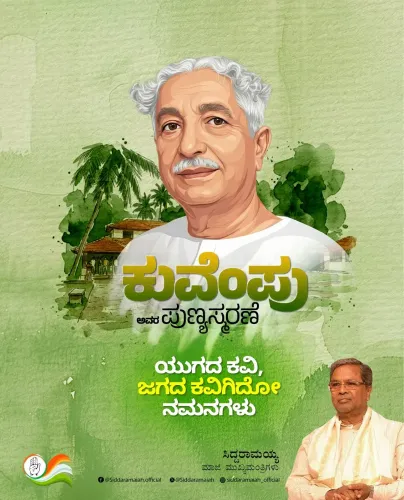
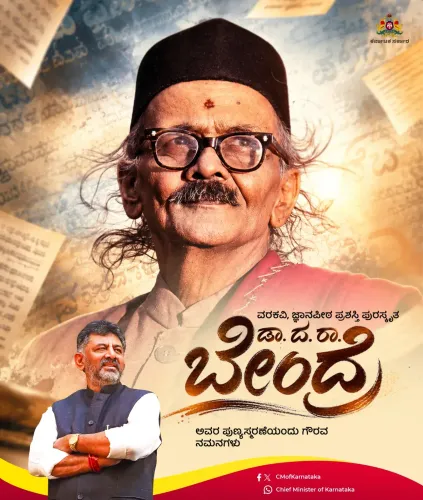
On Wednesday, 11 November 2026, the Chief Minister's Office of Karnataka paid a formal tribute to Rashtrakavi Kuvempu — the towering poet, novelist and humanist who brought the Jnanpith Award to Kannada literature for the first time — honouring his enduring legacy of universalist thought and cultural contribution.
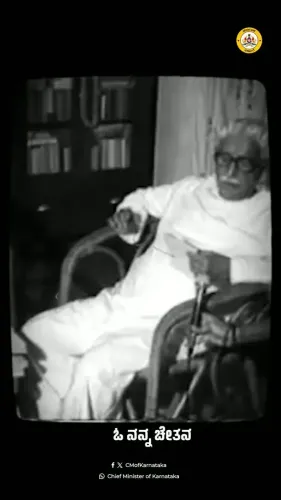
The CMO's post, written in Kannada, remembered Kuvempu for enriching the state's cultural world through his literature, philosophy and human values. 'ವಿಶ್ವಮಾನವ' ('Vishwa Manava' — the Universal Human), the post noted, was his defining concept: a call to transcend the narrow walls of caste, religion and regionalism, and to recognise humanity itself as the highest ideal. 'His ideology remains relevant even today,' the post declared.
Who Was Kuvempu — and Why the Jnanpith Mattered
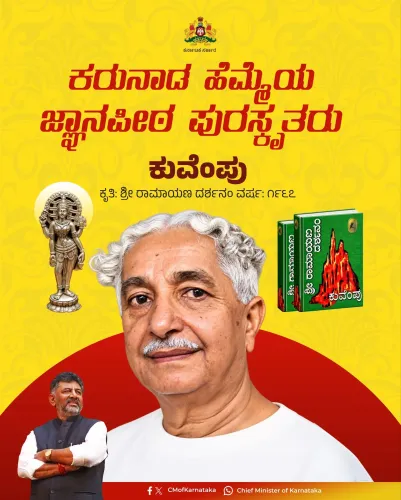
Kuppali Venkatappa Puttappa, known universally as Kuvempu, was born on 29 December 1904 in the Malnad hills of what is today Karnataka. A poet, playwright, novelist and essayist, he reshaped modern Kannada literature almost single-handedly across the mid-twentieth century. In 1967, he became the first Kannada writer ever to receive the Jnanpith Award — India's highest literary honour, instituted in 1961 — a moment that placed the Kannada language firmly on the national literary map.
That recognition was not merely ceremonial. It validated a literary tradition stretching back over a thousand years and gave Karnataka's cultural identity a modern anchor. Kuvempu went on to receive the title of Rashtrakavi (National Poet) of Karnataka, and the state's official anthem, Jaya Bharata Jananiya Tanujate, is his composition.
The 'Vishwa Manava' Ideal — Still a Living Argument
What makes Kuvempu more than a literary figure is the philosophical framework he built around the idea of Vishwa Manava — the Universal Human. At its core, the concept argues that true civilisation lies not in the assertion of communal, caste or regional identity, but in the recognition of a shared, undivided humanity. For Kuvempu, literature was the vehicle for that message, not an ornament to it.
That argument carries particular resonance in contemporary India, where questions of identity — linguistic, religious, regional — remain live and contested. Karnataka governments across administrations have periodically invoked Kuvempu's universalism precisely because it offers a culturally rooted, non-partisan vocabulary for social inclusion. The CMO's tribute today lands squarely in that tradition.
Karnataka's Pattern of Honouring Its Literary Icons
Official tributes to canonical Kannada writers are a consistent feature of Karnataka's governance calendar. They serve a dual purpose: reinforcing the state's commitment to Kannada language promotion and signalling continuity with a humanistic cultural legacy that pre-dates and transcends party lines. For the current administration, keeping Kuvempu's Vishwa Manava ideal visible is both cultural stewardship and a soft statement of values.
Kuvempu passed away on 11 November 1994 — a date that gives this tribute its quiet but unmistakable weight. Thirty-two years on, the man who asked Karnataka — and India — to look beyond its divisions is still being summoned to the conversation.
Point of View
Non-sectarian tradition — one that is difficult to contest across party lines. By invoking the Vishwa Manava ideal specifically, the current CMO aligns itself with an explicitly universalist, anti-caste strand of Kannada thought at a moment when identity politics remain sharply contested in the state. The timing on Kuvempu's death anniversary adds solemnity that elevates the tribute beyond routine ceremonial. It is a low-cost, high-resonance act of cultural governance.
NationPress
11 Nov 2026
Frequently Asked Questions
Who is Rashtrakavi Kuvempu?
Kuvempu, born Kuppali Venkatappa Puttappa on 29 December 1904, was a celebrated Kannada poet, novelist and philosopher. He received the title Rashtrakavi (National Poet) of Karnataka and wrote the state's official anthem.
When did Kuvempu receive the Jnanpith Award?
Kuvempu received the Jnanpith Award in 1967, becoming the first Kannada-language writer to win India's highest literary honour.
What is the Vishwa Manava concept?
Vishwa Manava, meaning 'Universal Human,' is Kuvempu's philosophical ideal that calls on people to transcend divisions of caste, religion and region and recognise shared humanity as the highest value.
Why did Karnataka's CMO post a tribute to Kuvempu on 11 November?
11 November is the death anniversary of Kuvempu, who passed away on 11 November 1994. The Chief Minister's Office of Karnataka posted the tribute to mark the occasion.
What is the Jnanpith Award?
The Jnanpith Award is India's highest literary honour, instituted in 1961 and awarded annually for outstanding contribution to literature in one of the scheduled Indian languages.