CM Pema Khandu speaks on Article 371H, China, press welfare
Synopsis
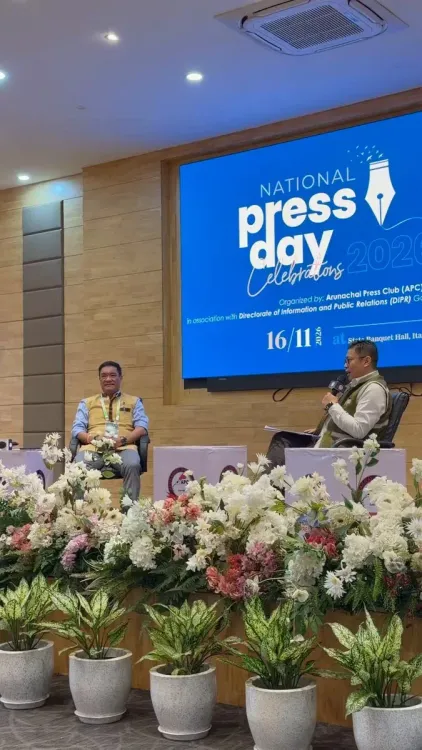
On National Press Day, Arunachal Pradesh CM Pema Khandu gave an unscripted interview to journalist Ranju Dodum, addressing Article 371H, Chinese border transgressions, journalist welfare, and state development — pledging candour over prepared speeches.
Key Takeaways
Pema Khandu gave a candid interview on National Press Day, 16 November 2026 , explicitly rejecting prepared oratory ('bhashanbaazi').
The conversation with journalist Ranju Dodum covered Article 371H — the constitutional provision giving the Arunachal Pradesh Governor special law-and-order powers, inserted in 1986 .
Khandu addressed Chinese transgressions along the disputed Arunachal Pradesh border, a recurring security concern for the state.
Journalist welfare and state development initiatives were also on the agenda, significant in a frontier state with fragile media economics.
Two videos of the full interview were shared publicly, an unusual transparency move on a range of sensitive governance topics.
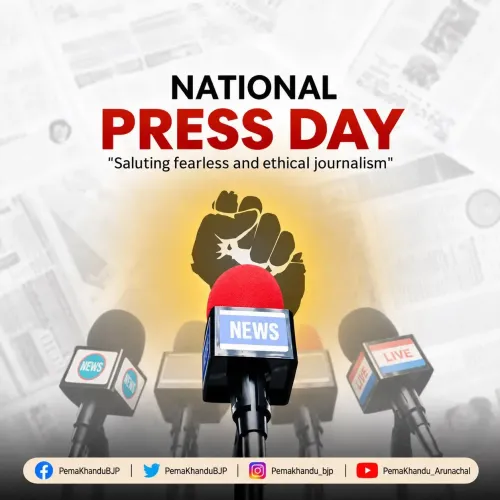
National Press Day marks the founding of the Press Council of India on 16 November 1966 .
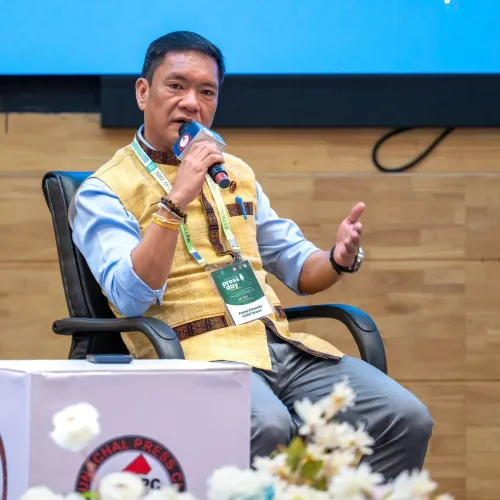
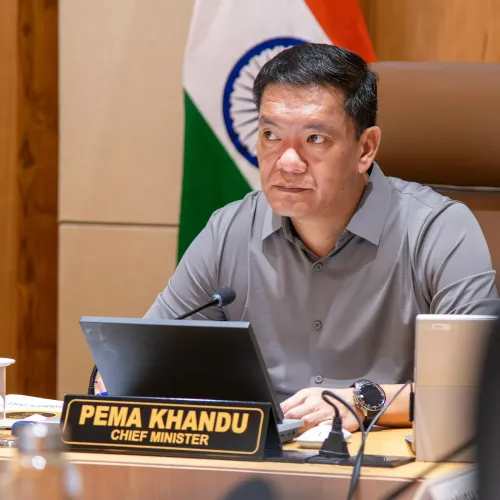
On National Press Day, 16 November 2026, Arunachal Pradesh Chief Minister Pema Khandu sat down for an unscripted conversation — no prepared speeches, no hedged talking points — and took direct questions on some of the most consequential issues facing his state.
Posting on X, Khandu described the exchange with journalist Ranju Dodum as 'no bhashanbaazi' — the Hindi idiom for empty oratory — and said it covered Article 371H, journalist welfare, Chinese transgressions along the border, and development initiatives across Arunachal Pradesh. The candour was deliberate. National Press Day, observed every 16 November to mark the founding of the Press Council of India in 1966, is precisely the occasion when a Chief Minister's willingness to face a free press carries its own signal.
What Article 371H means for Arunachal
Article 371H was inserted into the Constitution by the 55th Amendment Act of 1986, giving the Governor of Arunachal Pradesh special discretionary powers over law and order — a provision that has periodically generated debate about the balance between elected government and gubernatorial authority in a sensitive border state. That Khandu chose to address it in an open interview, rather than through a legislative statement, suggests the conversation is live in the public domain and not merely an academic one.
The China question on Arunachal's border
Arunachal Pradesh shares a long and disputed frontier with China, which claims virtually the entire state as 'South Tibet.' Border transgressions — incursions by Chinese personnel into areas that India administers — have been a recurring flashpoint, and residents of forward villages live with that reality daily. A Chief Minister going on record about those transgressions, in a media interview rather than a government press note, is a consequential act of public communication for a region that often feels its security concerns are discussed in New Delhi rather than by people who live there.
Journalist welfare and a free press in a frontier state
The welfare of working journalists in Arunachal Pradesh is a persistent concern: the state's mountainous terrain, limited digital infrastructure, and small advertising markets make independent journalism financially precarious. Raising it on National Press Day, in conversation with a journalist, closes a symbolic loop — but the follow-through, whether in the form of welfare schemes or press accreditation reforms, is what the media community will be watching for.
Two videos accompanied the post, suggesting the full interview is available for public viewing — an unusual degree of transparency for a sitting Chief Minister on topics as fraught as border security and constitutional provisions. That choice, on the day India celebrates its press freedom tradition, may itself be the loudest statement Khandu made.
Point of View
Accessible governance in the Northeast, a region the party has worked hard to consolidate. The deliberate 'no bhashanbaazi' framing positions him against the performative politics associated with older political cultures in the region. On the border question, any on-record remark by a sitting Chief Minister about Chinese transgressions carries diplomatic weight beyond state politics, feeding into India's ongoing management of the Line of Actual Control narrative. The journalist-welfare angle, meanwhile, signals awareness that press freedom optics matter in a state where infrastructure constraints already limit media independence.
NationPress
16 Nov 2026
Frequently Asked Questions
What is Article 371H and why does it matter for Arunachal Pradesh?
Article 371H, inserted by the 55th Constitutional Amendment Act of 1986 , gives the Governor of Arunachal Pradesh special discretionary powers over law and order, distinct from the elected government's authority. It matters because it creates a unique constitutional framework for a sensitive border state, and debates about its scope periodically affect the relationship between the state government and Raj Bhavan.
What are Chinese transgressions in Arunachal Pradesh?
China claims virtually all of Arunachal Pradesh as 'South Tibet,' and Chinese personnel have periodically entered areas administered by India, an act described as a 'transgression.' These incidents are a recurring security concern and a live diplomatic issue between India and China.
Why is National Press Day celebrated on 16 November?
National Press Day is observed every 16 November to commemorate the establishment of the Press Council of India on that date in 1966 . The Council was set up to preserve press freedom and maintain journalistic standards.
What journalist welfare issues exist in Arunachal Pradesh?
Journalists in Arunachal Pradesh face challenges including difficult terrain, limited digital connectivity, and small advertising markets that make independent journalism financially precarious. Welfare schemes for working journalists — covering health, insurance, and income support — are a recurring policy demand in the state.