CM Pema Khandu Applauds Army's Plantation Drive in Tawang
Synopsis
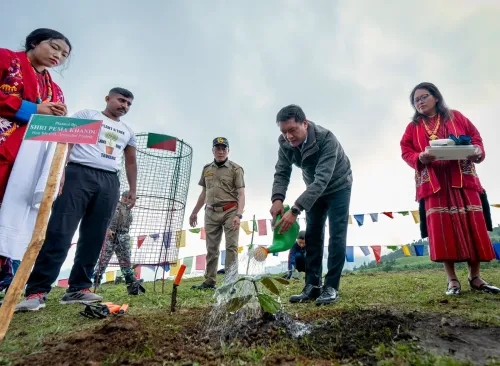
Arunachal Pradesh Chief Minister Pema Khandu on 5 June 2026 applauded the Indian Army's Tawang Brigade and Gajraj Corps for organising a large-scale plantation drive in Tawang on World Environment Day, themed 'Sanjhedari Se Sanrakshan,' uniting the military, civil administration, religious leaders, students, and citizens in a shared conservation effort.
Key Takeaways
Chief Minister Pema Khandu praised the Tawang Brigade and Gajraj Corps for a large-scale plantation drive in Tawang on World Environment Day, 5 June 2026 .
The drive was led by Major General Amit Nautiyal , GOC, and carried the theme 'Sanjhedari Se Sanrakshan' (Protection through Shared Responsibility).
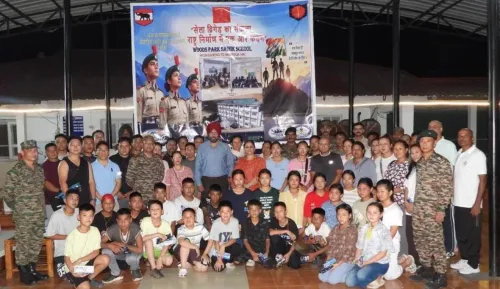
Participants included the civil administration, public representatives, religious leaders, students, and local citizens.
The initiative is part of the Indian Army's long-running civic engagement tradition in northeast border districts, rooted in Operation Sadbhavana .
Tawang is a strategically sensitive district bordering China and home to the Tawang Monastery , making civil-military cooperation there especially significant.
Further joint conservation programmes in other Arunachal Pradesh border districts are anticipated ahead of the monsoon afforestation season.
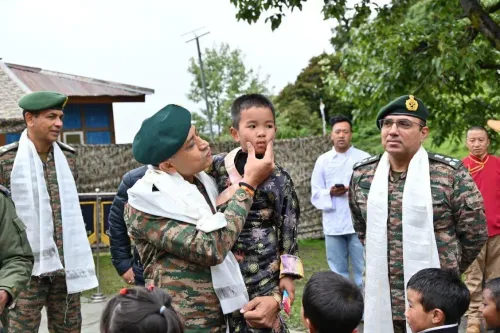
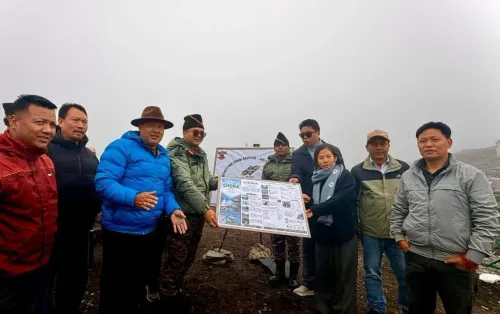
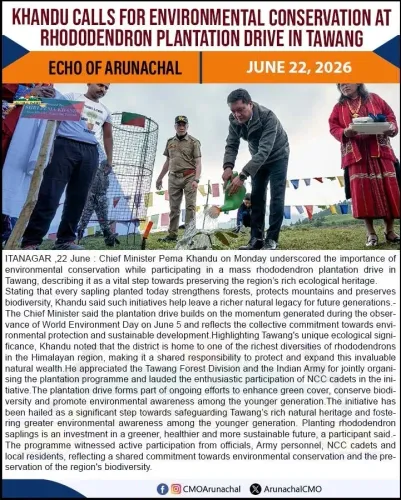
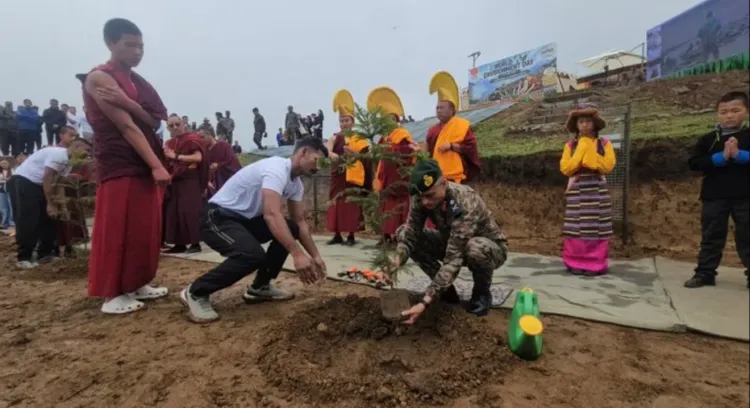
Arunachal Pradesh Chief Minister Pema Khandu on Friday, 5 June 2026 praised the Tawang Brigade of the Indian Army and the Gajraj Corps for organising a large-scale plantation drive across Tawang on the occasion of World Environment Day. The initiative, led by Major General Amit Nautiyal, General Officer Commanding, brought together civil administration, public representatives, religious leaders, students, and citizens in a collective environmental conservation effort.
Context
World Environment Day, observed globally on 5 June every year, serves as the principal United Nations platform for promoting environmental awareness and action. This year's plantation drive in Tawang was themed 'Sanjhedari Se Sanrakshan' — meaning 'Protection through Shared Responsibility' — underscoring the role of collective community participation in safeguarding natural ecosystems. Chief Minister Khandu described the theme as 'apt' in reminding citizens that environmental protection is a shared obligation.
The drive was notable for its breadth of participation, drawing together the military, local civil administration, elected representatives, religious figures from Tawang's prominent monastic community, students, and ordinary residents into a unified effort.
Policy Backdrop
The Indian Army's civic and environmental engagement in Arunachal Pradesh's border districts has a long institutional lineage. Since the early 2000s, army formations in the northeast have conducted annual afforestation and community outreach activities under Operation Sadbhavana, a programme designed to foster goodwill between security forces and border populations.
The Gajraj Corps — formally designated XVII Corps — is the Indian Army formation responsible for operations in the eastern sector, and its mandate includes sustained community engagement alongside its primary defence role. Tawang, which borders China and is home to the revered Tawang Monastery, is among the most strategically sensitive districts in the northeast, making civil-military cooperation there particularly significant.
Stakeholders and Impact
The plantation drive directly benefits residents of Tawang and surrounding border communities, who live in a high-altitude ecosystem vulnerable to deforestation and climate stress. By involving religious leaders alongside civil and military stakeholders, the initiative taps into the cultural authority of the monastic establishment — a significant force in local public life — to amplify the conservation message.
Students participating in the drive represent a longer-term investment: environmental awareness at the school level is widely regarded as foundational to sustained behavioural change in communities. The breadth of participation signals that the #GreenTawang effort is conceived as a community movement rather than a one-off ceremonial gesture.
What's Next
Observers will watch for similar joint civil-military plantation or conservation programmes in other Arunachal Pradesh border districts, particularly as the monsoon season approaches — a period traditionally associated with large-scale government afforestation drives across India. Any state government announcement on formal afforestation targets or follow-up conservation programmes for 2026 would indicate whether this initiative is part of a broader seasonal strategy. Chief Minister Khandu's public appreciation signals political backing for expanding such efforts across the state.
Point of View
He aligns the state government with a narrative of cooperative governance at the border — a message with resonance well beyond environmental policy. The inclusion of religious leaders from Tawang's monastic establishment in a military-led initiative is notable: it weaves together institutional legitimacy across the security, administrative, and cultural domains. This pattern of civil-military environmental outreach in Arunachal's border belt is increasingly a soft-power instrument in the broader context of India's boundary management with China.
NationPress
20 Sept 2026
Frequently Asked Questions
What is the Sanjhedari Se Sanrakshan theme about?
'Sanjhedari Se Sanrakshan' translates to 'Protection through Shared Responsibility' and was the theme of the Tawang plantation drive on World Environment Day 2026, emphasising that environmental conservation requires collective community participation rather than individual or institutional effort alone.
What is the Gajraj Corps and what does it do in Arunachal Pradesh?
The Gajraj Corps, formally XVII Corps of the Indian Army, is the formation responsible for operations in India's eastern sector including Arunachal Pradesh. Beyond its defence mandate, it conducts regular civic action and community engagement programmes in border districts.
Why is Tawang strategically important for India?
Tawang is a high-altitude district in Arunachal Pradesh that shares a border with China and is home to the historic Tawang Monastery. It has been a focal point in India-China boundary negotiations and sees significant Indian Army presence for border defence.
What is Operation Sadbhavana?
Operation Sadbhavana is an Indian Army programme launched in the early 2000s to foster goodwill between security forces and civilian populations in border and conflict-affected areas of northeast India, through activities including afforestation, healthcare, and education drives.
When is World Environment Day observed?
World Environment Day is observed globally on 5 June every year. It is the United Nations' principal platform for encouraging awareness and action for the protection of the environment.