CM Khandu hails Arunachal's Khyoda Talik for Karate Gold
Synopsis
Arunachal Pradesh CM Pema Khandu praised athlete Khyoda Talik, a CM ACES beneficiary, for winning gold with the Indian Men's Kata Team at the Commonwealth Karate Championship 2026 in Glasgow — with three Arunachal athletes representing Team India.
Key Takeaways
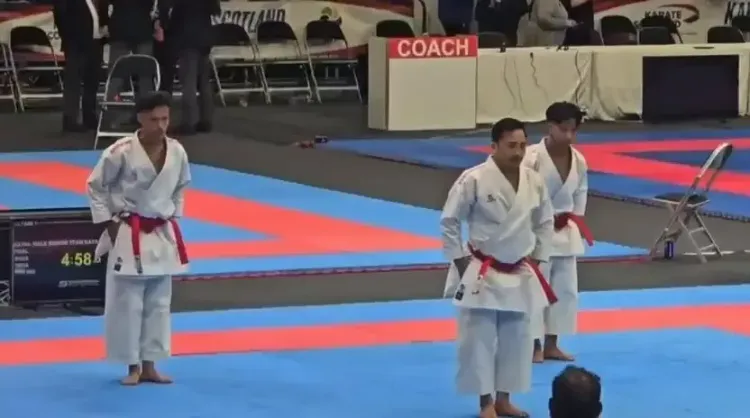
Khyoda Talik , an Arunachal Pradesh athlete, won a gold medal as part of the Indian Men's Kata Team at the Commonwealth Karate Championship 2026 in Glasgow, Scotland .
Three athletes from Arunachal Pradesh represented Team India at the championship — all beneficiaries of the state's CM ACES scheme.
The Chief Minister's Athlete Coaching and Empowerment Scheme (CM ACES) is an Arunachal Pradesh government initiative to identify, train, and support competitive sporting talent.
CM Pema Khandu described the result as 'a proud moment' and evidence of CM ACES succeeding in nurturing talent.
The achievement highlights the growing capacity of northeastern states to produce nationally competitive athletes through targeted state-level sports funding.
A gold medal in Glasgow, earned under a government scheme designed precisely for moments like this — Arunachal Pradesh Chief Minister Pema Khandu on Saturday, 7 November 2026 celebrated the triumph of Khyoda Talik, a state athlete who helped the Indian Men's Kata Team claim top honours at the Commonwealth Karate Championship 2026 in Glasgow, Scotland.
A gold from Glasgow — and what it took to get there
Talik competed as part of a three-member Arunachal contingent representing Team India in Glasgow. All three athletes are products of the state government's Chief Minister's Athlete Coaching and Empowerment Scheme (CM ACES), a targeted programme built to identify and train competitive sporting talent within the northeastern state. Their presence on the national squad is itself a marker of how far the scheme has carried them.
The Men's Kata event demands precision, synchronisation, and nerve — the team format leaves no room for a single weak link. Talik and his teammates delivered. The gold is Arunachal Pradesh's to celebrate.
What CM ACES is — and why this win matters for it
CM ACES was introduced by the Khandu government to channel state resources directly toward coaching, competition exposure, and athlete support. Northeastern states have historically fielded athletes in niche disciplines — combat sports, archery, and endurance events — but the pipeline to national representation has often been fragile. Schemes like CM ACES are designed to institutionalise that pipeline rather than leave it to chance or individual patronage.
Having three athletes from a single northeastern state simultaneously wearing the Indian jersey at a Commonwealth-level championship is not routine. It signals that the scheme's selection and training model is producing results at the competitive end, not just at the grassroots.
Khandu's message and the broader Northeast sporting push
Posting on X, Khandu called the achievement 'a proud moment for our state and a testament to the success of CM ACES in nurturing sporting talent.' The framing was deliberate — tying an individual's gold medal to a policy outcome, making the case that state investment in sport is a productive spend, not a ceremonial one.
Across the Northeast, state governments have increasingly used targeted sports funding to lift both talent and profile. For Arunachal Pradesh, a state whose athletes have often trained without the infrastructure advantages of larger states, a gold at Glasgow carries weight beyond the podium. It becomes an argument — made in results, not rhetoric — for sustained investment.
Khyoda Talik stepped onto a mat in Scotland. What echoed back was heard in Itanagar.
Point of View
Chief Minister Khandu is doing something politically savvy and substantively legitimate at once — converting an athlete's performance into a policy proof-point. For northeastern states that often struggle to claim space in India's national sports narrative, a Commonwealth gold is a rare, concrete credential. The move also reflects a broader pattern among BJP-governed states of branding welfare and development schemes tightly to the chief minister — building political identity through visible outcomes rather than just announcements. Whether CM ACES can sustain and scale this pipeline will determine if this is a milestone or merely a moment.
NationPress
7 Nov 2026
Frequently Asked Questions
Who is Khyoda Talik?
Khyoda Talik is a karate athlete from Arunachal Pradesh and a beneficiary of the state government's Chief Minister's Athlete Coaching and Empowerment Scheme (CM ACES). He won a gold medal as part of the Indian Men's Kata Team at the Commonwealth Karate Championship 2026 in Glasgow, Scotland.
What is the CM ACES scheme in Arunachal Pradesh?
CM ACES, or the Chief Minister's Athlete Coaching and Empowerment Scheme, is an Arunachal Pradesh government programme designed to identify, coach, and support competitive sporting talent from the state, helping athletes reach national and international competition level.
Where was the Commonwealth Karate Championship 2026 held?
The Commonwealth Karate Championship 2026 was held in Glasgow, Scotland.
How many athletes from Arunachal Pradesh represented India at the Commonwealth Karate Championship 2026?
Three athletes from Arunachal Pradesh represented Team India at the Commonwealth Karate Championship 2026, all of them beneficiaries of the state's CM ACES scheme.
What did Pema Khandu say about the karate gold medal win?
Chief Minister Pema Khandu congratulated Khyoda Talik and the Indian Men's Kata Team, calling the achievement 'a proud moment' for Arunachal Pradesh and citing it as a testament to the success of CM ACES in nurturing sporting talent.