CM Samrat Choudhary Hails IAF's Record IL-76MD Landing at Nyoma
Synopsis
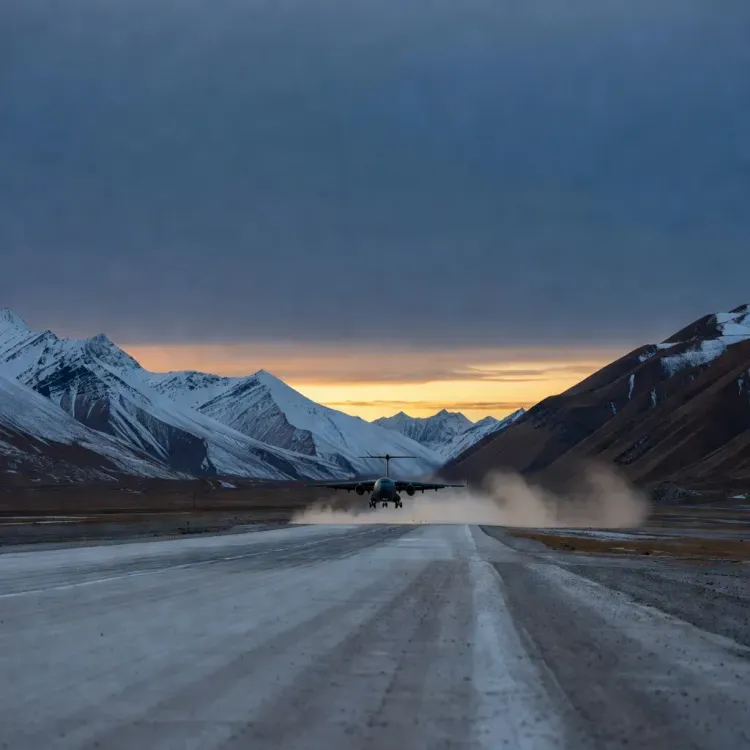
Bihar Chief Minister Samrat Choudhary has hailed the Indian Air Force for successfully landing an IL-76MD heavy transport aircraft at Nyoma, Ladakh, at 13,629 feet — described as the highest-ever landing for that aircraft type in world aviation history.
Key Takeaways
The Indian Air Force landed an IL-76MD at Nyoma, Ladakh , at 13,629 feet — claimed as a world record for that aircraft type.
Bihar Chief Minister Samrat Choudhary saluted the feat on 7 November 2026 , calling it a 'new chapter in world aviation history.' Nyoma Advanced Landing Ground lies in eastern Ladakh close to the Line of Actual Control with China, making the capability operationally significant.
The landing altitude exceeds Leh airfield (approx.
10,600 feet) — long considered a benchmark for high-altitude air operations — by roughly 3,000 feet.
The achievement reflects the IAF's phased programme to qualify heavier aircraft for forward landing grounds across Ladakh.
Enhanced airlift at Nyoma directly improves logistics and rapid reinforcement capability for troops deployed in the high-altitude eastern sector.
At 13,629 feet above sea level, in the bone-dry cold of eastern Ladakh, the Indian Air Force has done something no operator of the IL-76MD heavy transport aircraft has ever done before — landed one safely. Bihar Chief Minister Samrat Choudhary took to X on Saturday, 7 November 2026, to salute the feat, calling it a new chapter in world aviation history.
Posting in Hindi, CM Choudhary described the achievement as 'nabh ke sudridh prahariyonka nav kirtiman' — 'a new record by the sky's resolute sentinels' — and declared: 'The nation is proud of its brave air warriors.'What happened at Nyoma — and why it matters
The Nyoma Advanced Landing Ground in eastern Ladakh sits at 13,629 feet, making it one of the highest operational airstrips anywhere on Earth. The IL-76MD — a Soviet-designed, four-engine strategic airlifter that entered Indian service decades ago — is a workhorse built for bulk, not altitude. Landing a heavy-frame aircraft of that class at nearly 14,000 feet, where the air is roughly 40 percent thinner than at sea level, demands extraordinary aerodynamic margins, modified approach profiles, and pilots trained specifically for the conditions. According to CM Choudhary's post, this landing is the highest-altitude successful touchdown ever recorded for the IL-76MD anywhere in the world.
The significance is operational as much as symbolic. Nyoma sits in eastern Ladakh, close to India's border with China — a region that has seen sustained military infrastructure investment since the 2020 Galwan Valley standoff. The ability to land a strategic airlifter there, rather than relying solely on smaller aircraft or road convoys through mountain passes, fundamentally changes the logistics equation for troops stationed near the Line of Actual Control.
Thin air, thick challenge — the engineering behind the record
The Indian Air Force has long operated transport aircraft into Leh airfield at approximately 10,600 feet — itself among the highest commercial and military airfields in the world. But Nyoma is 3,000 feet higher still. At that elevation, engines produce less thrust, wings generate less lift, and both takeoff and landing rolls stretch significantly. Pilots must calculate precise approach speeds, touch-down points, and abort thresholds that bear little resemblance to their standard operating procedures.
The IAF's expansion of high-altitude aviation capability in Ladakh has been a deliberate, phased project — progressively qualifying more aircraft types and heavier payloads for forward landing grounds that were once considered beyond reach. The IL-76MD milestone is the latest, and most dramatic, proof point of that programme.
A Union Territory transformed into a strategic aviation hub
Since becoming a Union Territory in 2019, Ladakh has seen rapid upgrades to its road, tunnel, and airfield infrastructure. Multiple advanced landing grounds across the territory have been expanded, surfaced, and equipped to handle larger aircraft year-round. The investment reflects a doctrine shift: in a high-altitude standoff, the side that can move men and materiel faster — by air — holds a decisive edge. Landing the IL-76MD at Nyoma plants that edge firmly on the Indian side of the equation.
For the Indian Air Force, it is a world record. For the soldiers deployed at the roof of the world, it is a lifeline — wider, faster, and more reliable than anything that came before.Point of View
629-foot strip, the IAF substantially compresses the time needed to surge supplies or reinforcements to the eastern sector — a capability gap that the 2020 Galwan crisis exposed sharply. CM Choudhary's public endorsement from Bihar also signals how defence achievements in Ladakh have become a nationwide political touchstone, not merely a military one, reflecting the broader BJP emphasis on 'new India' capability milestones.
NationPress
7 Nov 2026
Frequently Asked Questions
What is the Nyoma airfield in Ladakh?
Nyoma is an Advanced Landing Ground in eastern Ladakh situated at approximately 13,629 feet above sea level, close to India's border with China. It has been progressively developed to support military aircraft operations near the Line of Actual Control.
What is the IL-76MD aircraft?
The IL-76MD is a Soviet-designed, four-engine heavy strategic transport aircraft operated by the Indian Air Force for bulk cargo and troop airlift. It is a large, wide-body airlifter not typically designed for extreme high-altitude landing strips.
Why is landing at 13,629 feet so difficult for large aircraft?
At 13,629 feet , the air is roughly 40 percent thinner than at sea level, reducing engine thrust and wing lift significantly. Pilots must fly faster approach speeds, calculate longer landing rolls, and work within tighter safety margins than at lower-altitude airfields.
Why is the Nyoma landing strategically important for India?
Nyoma lies in eastern Ladakh near the Line of Actual Control with China. Qualifying a heavy airlifter like the IL-76MD for that strip means India can move large quantities of supplies or troops by air to the border region far faster than by road.
What did Bihar CM Samrat Choudhary say about the IAF achievement?
Bihar Chief Minister Samrat Choudhary posted on X calling the landing 'a new chapter in world aviation history' and declaring that 'the nation is proud of its brave air warriors,' praising the IAF's technical excellence and ability to achieve the seemingly impossible.