IAF IL-76MD Sets World Altitude Record at Nyoma, Ladakh

Synopsis
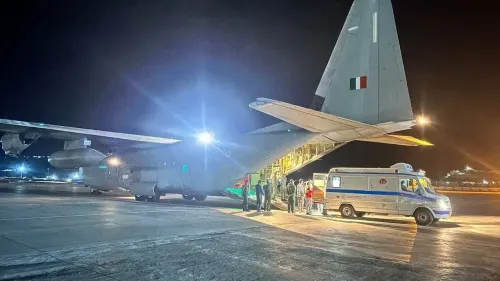
The Indian Air Force has landed an IL-76MD heavy-lift transport at Nyoma ALG in Ladakh at 13,629 feet — claimed as the highest-altitude landing ever recorded for the aircraft type — underscoring India's expanding strategic airlift capacity along the Line of Actual Control.
Key Takeaways
An IAF IL-76MD completed a landing at Nyoma ALG, Ladakh at 13,629 feet , described as a global altitude record for the aircraft type.
Nyoma is a forward Advanced Landing Ground in eastern Ladakh near the Line of Actual Control with China.
India has been upgrading Ladakh and Arunachal Pradesh airfields for larger transport aircraft since 2020 .
The IL-76MD is a Soviet-designed strategic heavy-lift transport operated by the IAF for troop and equipment movement.
The achievement signals a shift in India's high-altitude logistics doctrine, reducing dependence on road supply routes near the LAC.
At 13,629 feet above sea level, the Indian Air Force has pulled off something no operator of the IL-76MD heavy-lift transport has managed anywhere on earth — a landing at Nyoma Advanced Landing Ground in eastern Ladakh, marking what Union Coal and Mines Minister G. Kishan Reddy called 'the highest-altitude landing ever recorded by the aircraft anywhere in the world.'
A Soviet-era workhorse, a Himalayan first
The IL-76MD is no nimble mountain-hopper. Originally designed in the Soviet Union as a strategic heavy-lifter, it is built for bulk — troops, armour, outsized cargo — not for the razor-thin air and unforgiving terrain of the Line of Actual Control. Getting one down safely at Nyoma, tucked into the high-altitude bowl of eastern Ladakh, is a feat of airmanship, aircraft performance, and ground infrastructure working in rare concert. Minister Reddy, sharing the news on X on 7 November 2026, described it as 'a proud moment that reflects the exceptional capabilities and operational acumen of the Indian Air Force and India's growing strategic airlift strength.'
Nyoma's rise as a frontline logistics hub
Nyoma ALG sits in the shadow of the LAC with China, and its strategic logic is blunt: whoever can move the most, fastest, at altitude, holds the initiative. India began accelerating upgrades to Nyoma and a string of other Ladakh and Arunachal Pradesh airfields after 2020, with runway strengthening and expanded hardstands specifically intended to accommodate larger transport aircraft. The IL-76MD landing is the clearest proof yet that those investments are delivering operational results — not just on paper, but in the thinned-out air above 13,000 feet.
What rapid airlift at this altitude actually means
Strategic airlift is the unglamorous backbone of modern high-altitude warfare. The ability to fly a heavy-lift aircraft into Nyoma means India can surge troops, artillery ammunition, fuel, and equipment to the eastern Ladakh sector without depending solely on road convoys through mountain passes that can be blocked by weather or conflict. That changes the calculus of any standoff along the northern border significantly. The IAF's feat is less a single headline and more a proof-of-concept for an entire logistics doctrine India has been quietly building since the Galwan Valley confrontation reshaped its border-infrastructure priorities.
Point of View
Translating years of runway upgrades and policy intent into operational airlift capability. For the IAF, it validates the IL-76MD's modified performance envelope at extreme altitudes and demonstrates that Nyoma can now function as a genuine heavy-lift node — not merely a light-aircraft strip. Politically, the achievement gives the government a concrete, apolitical win to anchor its narrative of strengthened northern border readiness. The broader pattern — accelerated ALG development, fighter-jet deployments to Ladakh, and now a record heavy-lift landing — points to a deliberate, layered strategy to make India's forward posture along the LAC self-sustaining.
NationPress
7 Nov 2026
Frequently Asked Questions
What is the IL-76MD and why does the IAF use it?
The IL-76MD is a Soviet-designed strategic heavy-lift transport aircraft used by the Indian Air Force to move troops, vehicles, and large quantities of equipment over long distances, including to high-altitude forward bases.
Where is Nyoma ALG and why is it strategically important?
Nyoma Advanced Landing Ground is located in eastern Ladakh at roughly 13,600 feet, close to the Line of Actual Control with China. It is being developed to enable rapid military logistics and reinforcement in a region where road access can be disrupted by weather or conflict.
What record did the IAF set at Nyoma?
According to the post by Minister G. Kishan Reddy, the IAF IL-76MD completed the highest-altitude landing ever recorded for that aircraft type anywhere in the world, at 13,629 feet at Nyoma, Ladakh.
Why has India been upgrading airfields in Ladakh?
India accelerated upgrades to Ladakh airfields — including runway strengthening and expanded capacity for larger aircraft — after the 2020 Galwan Valley standoff, to improve rapid deployment and logistics capability near the LAC.
What does this mean for India's military capability along the northern border?
The ability to fly a heavy-lift transport into Nyoma allows India to surge troops and supplies to eastern Ladakh by air, reducing dependence on mountain road convoys and significantly improving the speed and scale of any potential military response along the LAC.