CM Pema Khandu Leads Yoga Day at Jang with Army, Students
Synopsis
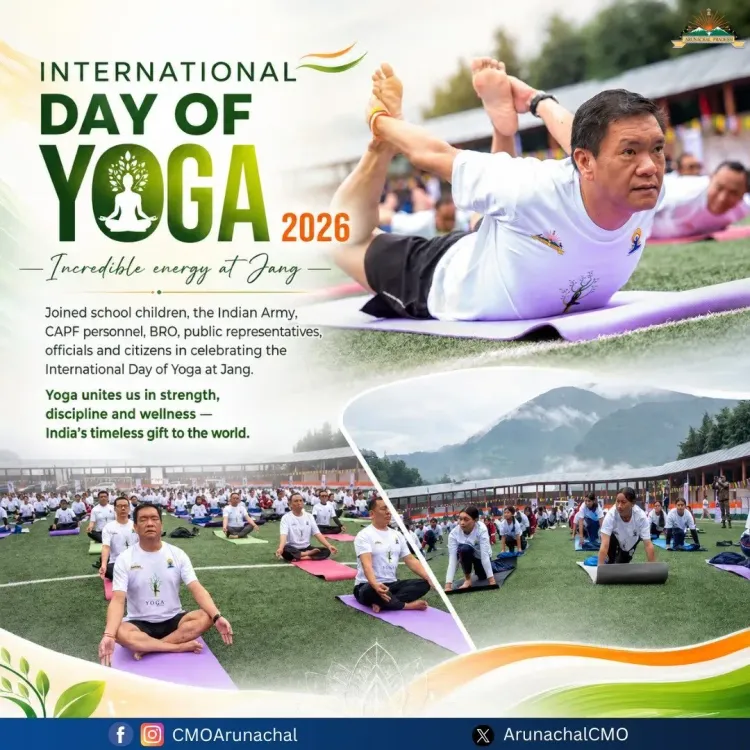
Chief Minister Pema Khandu joined school children, Indian Army, CAPF, and BRO personnel at Jang in Tawang district on June 21, 2026, to mark International Day of Yoga, describing the practice as 'India's gift to the world.'
Key Takeaways
Pema Khandu led the International Day of Yoga observance at Jang, Tawang district on June 21, 2026 .
Participants included school children, Indian Army , CAPF , BRO personnel, officials, and local citizens.
Jang is located near the Line of Actual Control with China, making the venue symbolically significant.
The International Day of Yoga was established by the UN General Assembly in December 2014 following a proposal by Prime Minister Narendra Modi .
India promotes yoga through the Ministry of AYUSH as a public health and cultural diplomacy initiative, with border-state events routinely including defence forces.
The Chief Minister's Office of Arunachal Pradesh announced on Sunday, June 21, 2026, that Chief Minister Pema Khandu celebrated the International Day of Yoga at Jang in Tawang district, joining school children, personnel from the Indian Army, Central Armed Police Forces (CAPF), the Border Roads Organisation (BRO), local officials, and citizens in the observance.
Context
The Chief Minister's Office shared that Pema Khandu participated in the event alongside a cross-section of frontier society, from schoolchildren to uniformed personnel. The official post described yoga as 'strength, discipline and wellness — India's gift to the world,' framing the observance as both a wellness practice and a statement of national identity. Jang is a town in Tawang district, situated close to the Line of Actual Control with China, making the choice of venue symbolically significant.
Policy Backdrop
The International Day of Yoga is observed annually on June 21 following a United Nations General Assembly resolution in December 2014, adopted after Prime Minister Narendra Modi proposed the observance during his address to the UN. India has since promoted yoga through the Ministry of AYUSH as a pillar of both public health and cultural diplomacy, with mass events held each year across the country and at Indian missions abroad. The participation of the Indian Army, CAPF, and BRO at frontier locations has become a recurring feature of these observances in border states, combining wellness messaging with visible civil-military coordination.
Stakeholders and Impact
The event in Jang brought together a notably diverse group: school children from the region, defence and paramilitary personnel stationed at one of India's most sensitive frontiers, infrastructure workers from BRO who build and maintain strategic roads in the area, and local citizens. For residents of Tawang district, participation by the Chief Minister in a border-area event carries both administrative and symbolic weight, signalling state-level attention to a region that is geographically remote and strategically critical. The inclusion of schoolchildren also reflects the broader push to embed yoga in educational curricula across northeastern states.
What's Next
Arunachal Pradesh is expected to expand yoga-based wellness modules within its school system in the coming academic year, consistent with the central government's direction under AYUSH. Border-area wellness programmes that integrate security forces and civilian communities are likely to continue as a model for other frontier districts in the state. The pattern set by high-visibility events at locations such as Jang may inform how the state government designs outreach in similarly remote constituencies going forward.
Point of View
Integrated identity for border communities. By placing schoolchildren alongside Army, CAPF, and BRO personnel in the same frame, the event projects civil-military cohesion in a district that carries outsized geopolitical sensitivity. The gesture also reinforces the central government's decade-long effort to position yoga as a soft-power instrument that simultaneously advances public health, national pride, and frontier outreach.
NationPress
20 Sept 2026
Frequently Asked Questions
Where did Pema Khandu celebrate Yoga Day 2026?
Chief Minister Pema Khandu celebrated International Day of Yoga 2026 at Jang in Tawang district, Arunachal Pradesh, alongside school children, Indian Army, CAPF, BRO personnel, and local citizens.
Why is International Day of Yoga celebrated on June 21?
The United Nations General Assembly designated June 21 as International Day of Yoga in December 2014 following a proposal by Prime Minister Narendra Modi. June 21 is the summer solstice, the longest day of the year in the Northern Hemisphere, which holds significance in many cultures.
What is Jang in Arunachal Pradesh?
Jang is a town in Tawang district of Arunachal Pradesh, located near the Line of Actual Control with China. It is a strategically sensitive area where Indian Army and BRO maintain a significant presence.
What is BRO and why was it at the Yoga Day event?
BRO stands for Border Roads Organisation, a body that constructs and maintains strategic roads and infrastructure in India's border states. Its personnel participated in the Yoga Day event at Jang as part of the civil-military community observance in the frontier area.
How does India promote yoga internationally?
India promotes yoga internationally through the Ministry of AYUSH and its diplomatic missions, organising mass events on June 21 each year. The initiative stems from the UN recognition of International Day of Yoga in 2014 and is a key element of India's cultural diplomacy.