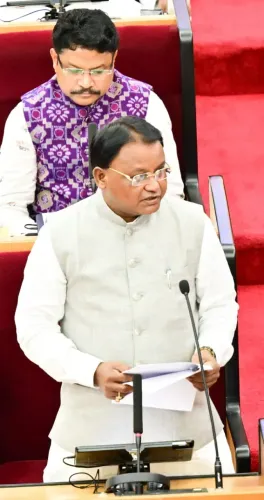
CM Majhi Hails ₹8,300 Cr Coastal Highway for Odisha

Synopsis
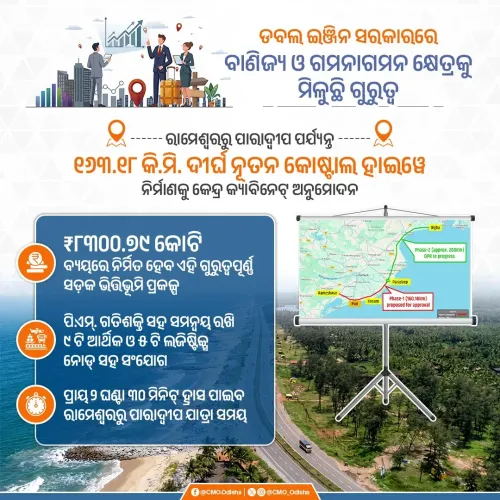
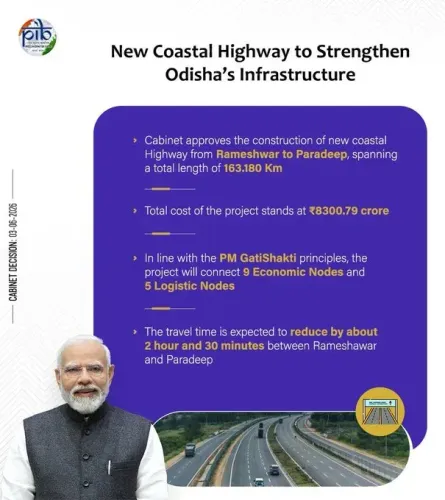
Odisha CM Mohan Charan Majhi has welcomed the approval of a 163-km Coastal Highway from Rameshwar to Paradeep, backed by over ₹8,300 crore under PM GatiShakti. The corridor will link 9 Economic Nodes and 5 Logistic Nodes, cutting travel time by nearly 2.5 hours and boosting port-led growth.
Key Takeaways
The 163-km Coastal Highway from Rameshwar to Paradeep has received formal approval, as announced by CM Mohan Charan Majhi on 5 June 2026 .
The project carries an investment of over ₹8,300 crore and is being developed under the PM GatiShakti National Master Plan .
The highway will connect 9 Economic Nodes and 5 Logistic Nodes along Odisha's coastline.
Travel time along the corridor is expected to be reduced by nearly 2.5 hours .
Paradeep , a major deep-water port in Jagatsinghpur district , is the eastern anchor of the new corridor.
Key next steps include land acquisition, environmental clearances, and construction tender awards.
Odisha Chief Minister Mohan Charan Majhi on 5 June 2026 welcomed the approval of a 163-kilometre Coastal Highway connecting Rameshwar to Paradeep, describing it as a transformative step for the state's infrastructure and economic future. The project, backed by an investment of over ₹8,300 crore under the PM GatiShakti vision, is expected to reduce travel time along the corridor by nearly 2.5 hours.
Context
Announcing the approval on social media, CM Majhi said the highway would connect 9 Economic Nodes and 5 Logistic Nodes, positioning the corridor as a catalyst for logistics efficiency and coastal commerce. He framed the development as central to his government's vision of a 'Viksit Odisha' — a developed Odisha — aligning state ambitions with the national development narrative. The highway stretches along Odisha's coastline, linking inland areas to the major deep-water port at Paradeep in Jagatsinghpur district.
Policy Backdrop
The project sits within the PM GatiShakti National Master Plan, launched by the central government in October 2021 to integrate road, rail, port and logistics planning through a unified GIS-based framework. The initiative was designed to eliminate siloed infrastructure development and fast-track multimodal corridors that directly link industrial production zones with ports and markets. Coastal and port-connectivity roads have been a recurring priority under this framework, with similar corridors advanced in other eastern and southern states to reduce logistics costs and improve freight movement.
The broader Bharatmala Pariyojana, initiated in 2015, also laid the groundwork for national highway development including coastal and port-access routes, providing a policy lineage that the current project builds upon. Paradeep, as one of India's busiest deep-water ports and a hub for eastern India's maritime trade, has long been identified as a node requiring stronger road connectivity to unlock its full industrial potential.
Stakeholders and Impact
Logistics operators, coastal businesses, and daily commuters across the corridor stand to benefit most directly from the reduced travel time and improved road access. The connection of 9 Economic Nodes along the route suggests the highway is designed not merely as a transit artery but as a spine for industrial and commercial activity. Port-linked road infrastructure of this scale typically attracts ancillary investment in warehousing, cold-chain facilities, and light manufacturing along the corridor.
For Odisha, which has been actively pursuing port-led industrialisation, the approval reinforces the state's positioning as a gateway for eastern India's trade. Communities between Rameshwar and Paradeep could see improved market access, while the logistics sector may gain a faster, more reliable freight route to one of the country's key maritime terminals.
What's Next
The project's progression will depend on land acquisition timelines, environmental clearances, and the award of construction tenders — each a potential bottleneck for large highway schemes in coastal and ecologically sensitive zones. Watchers will also track whether the nine economic nodes along the corridor attract formal industrial or port-capacity announcements that convert the highway's connectivity promise into tangible investment. CM Majhi's government is likely to use the project as a centrepiece of its infrastructure record ahead of future electoral cycles, making its execution pace a politically significant variable.
Point of View
Who took office in mid-2024, anchoring a flagship infrastructure win of this scale strengthens the BJP government's economic credentials in Odisha ahead of future electoral tests. The project's focus on linking economic and logistic nodes, rather than simply building a road, reflects a maturing infrastructure philosophy that treats connectivity as an industrial policy tool. Execution — particularly land acquisition and environmental approvals in a coastal zone — will ultimately determine whether the announcement translates into ground-level impact.
NationPress
21 Oct 2026
Frequently Asked Questions
What is the Rameshwar to Paradeep Coastal Highway in Odisha?
It is a newly approved 163-kilometre coastal road corridor in Odisha connecting Rameshwar to Paradeep , funded at over ₹8,300 crore under the PM GatiShakti National Master Plan to improve logistics, cut travel time, and link economic and port nodes along the state's coastline.
What is the cost of the Odisha Coastal Highway project?
The project involves an investment of over ₹8,300 crore , as stated by Chief Minister Mohan Charan Majhi in his announcement on 5 June 2026 .
What is PM GatiShakti and how does it relate to this highway?
PM GatiShakti is a National Master Plan launched in October 2021 to integrate multimodal infrastructure planning across ministries using GIS-based tools. The Odisha Coastal Highway is being developed under this framework, which prioritises port-linked corridors and economic node connectivity.
How much will the Odisha Coastal Highway reduce travel time?
According to CM Majhi's announcement, the highway is expected to reduce travel time along the Rameshwar-Paradeep corridor by nearly 2.5 hours .
What are the economic nodes connected by the Odisha Coastal Highway?
The highway will connect 9 Economic Nodes and 5 Logistic Nodes along its 163-km route, though the specific names of each node were not detailed in the official announcement.